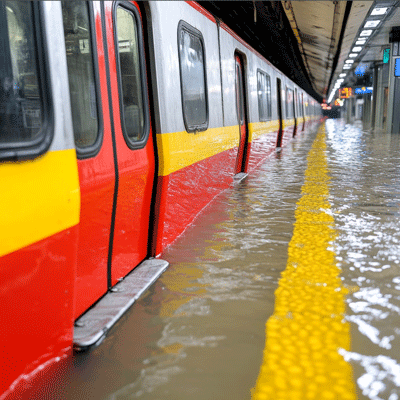
As Rain Pounds NYC, a Century-Old Subway System Struggles to Stay Afloat
On Monday night, a slow-moving storm swept through New York City, turning subway stations into makeshift waterfalls and disrupting commutes across the five boroughs. By Tuesday morning, trains were mostly back on schedule. Still, the episode served as a soggy reminder of how vulnerable the city’s century-old transit system is to the growing threats posed by climate change.
At least 20 of the city’s 472 subway stations were temporarily shuttered during the storm, including several major Manhattan stops along the 1, 2, 3, and 6 lines. Cascades of water streamed through entrances and platforms, with footage from riders capturing torrents rushing into the 23rd and 28th Street stations. Widespread service delays followed as Metropolitan Transportation Authority (MTA) crews scrambled to manage the deluge.
“When it rains here in New York, it sucks. I don’t know what is going on, the drainage, I mean, look at this. God forbid if someone slips and falls in this,” one frustrated rider told CBS News.
“It’s super frustrating. People just want to go home. These are not the conditions that New Yorkers deserve to be traveling in.”
New York’s subways are underprepared for the intense rainfall events that are becoming more common in the Northeast. In fact, regional projections show that within 25 years, the frequency of such heavy rainstorms could nearly double.
“We have all of the subway lines operating, Metro-North, Long Island Rail Road,” MTA CEO Janno Lieber told CBS News New York on the progress of repairs. “People worked overnight, worked their tails off, to make sure that we could accommodate our customers this morning.”
While the MTA has implemented some resilience measures, the broader transit network remains highly susceptible to water. Tunnels are laced through dense bedrock and surrounded by groundwater. Even on dry days, MTA workers remove between 10 and 13 million gallons of water from the system. On Monday night alone, more than 15 million gallons were pumped out, a surge exacerbated by a sewer system that simply couldn’t keep up.
New York’s sewer infrastructure, much like its subway, dates back to the early 20th century. Most of the city is served by a combined sewer system, which handles both waste and storm runoff through the same pipes. These pipes were designed to withstand approximately 1.75 inches of rain. Monday’s storm dumped over 2.5 inches in parts of the city, overwhelming the system and causing water to spill into the subway.
Rohit Aggarwala, commissioner of the Department of Environmental Protection, which manages the city’s sewer and water systems, boiled the issue down to the key fact.
“What happened last night is really quite simple. The pipes were designed for a certain amount of water. A lot more water fell from the sky.”
The porous design of the subway only compounds the problem. Station entrances, stairwells, elevator shafts, and ventilation grates are each a passage for floodwater to enter. Every opening is a vulnerability, Klaus Jacob, a geophysicist and professor emeritus at Columbia University, told The New York Times.
“It’s not just an MTA issue — the flash flooding has to do with insufficient drainage, and that’s a city issue.”
Lieber put it simply, stating, “The system is not a hermetically sealed submarine.” Still, the agency has taken steps to bolster its defenses, including the development of automatic closures for the system’s 39,000 street-level air vents. However, such upgrades come with a steep price tag, and the MTA has requested an additional $6 billion for stormwater and coastal flooding improvements.
The Department of Environmental Protection, for its part, is pursuing multiple fronts, modernizing sewer lines, expanding green infrastructure projects, and maintaining the city’s 150,000 catch basins. However, with only $1 billion allocated annually for sewer work and an estimated $30 billion needed, progress will be slow.
“The reality is we are going to do as much work as we possibly can, but number one, we can’t protect against absolutely everything, and this is a long-term project – there’s no way around it,” said Aggarwala.

Moumita Basuroychowdhury is a Contributing Reporter at The National Digest. After earning an economics degree at Cornell University, she moved to NYC to pursue her MFA in creative writing. She enjoys reporting on science, business and culture news. You can reach her at moumita.b@thenationaldigest.com.