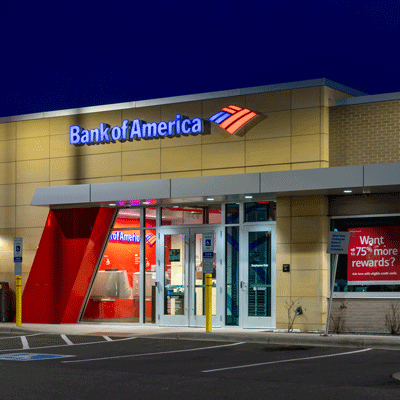
Bank of America Fined $1.2 Billion Over Major Money Laundering and Sanctions Failures
Bank of America shares fell more than 6% Wednesday, putting the stock on pace for its worst single-day decline since April 2025 after a $1.2 billion regulatory penalty over anti-money laundering failures weighed on the lender’s third-quarter earnings.
The nation’s second-largest bank reported net income of $6.93 billion, or $0.91 per share, falling short of analysts’ expectations of $1.10 per share. Excluding the penalty, Bank of America said it earned $8.1 billion, or $1.08 per share.
Quarterly profit declined approximately 17% from a year earlier. Revenue increased 3% to $30 billion, also missing Wall Street estimates of roughly $30.6 billion.
The stock had tumbled 7.5% shortly after the opening bell, leaving shares down approximately 9% for the year at that point in trading.
The fines, announced Tuesday afternoon, stem from widespread deficiencies in the Charlotte, North Carolina-based bank’s safeguards against money laundering and other illicit financial activity.
According to the Treasury Department, Bank of America failed to adequately address national security risks involving Chinese money laundering networks and illicit financial activity along the US-Mexico border. As part of the settlement, the bank admitted to willfully failing to maintain adequate compliance safeguards and report suspicious transactions.
Federal officials said the bank overlooked warning signs involving customers with suspected ties to drug trafficking, even after compliance personnel raised concerns. The failures left more than $5 billion in suspicious activity unreported. Bank of America processed over $9 trillion in transactions last year.
CNN separately reported that a flaw in the bank’s sanctions-screening system prevented certain potentially prohibited transactions from receiving heightened scrutiny. Even when a customer’s name and birth date matched an individual on the Treasury Department’s sanctions list, the system failed to flag the transaction as high priority. Treasury Secretary Scott Bessent said in a statement these deficiencies undermined enforcement of U.S. sanctions, including measures targeting Iran and narcotics trafficking.
“When a bank of this size fails to meet its anti-money laundering and sanctions obligations, the consequences extend far beyond its own walls, exposing the entire U.S. financial system to significant illicit finance risks.”
Of the total penalty, $750 million will go to the Office of the Comptroller of the Currency (OCC), marking the largest civil fine in the agency’s history. The enforcement action also ranks as the third-largest penalty imposed by the Treasury Department’s Financial Crimes Enforcement Network (FinCEN), behind a $3.4 billion fine against Binance in 2023 and a $1.3 billion penalty against TD Bank in 2024. Unlike those cases, Bank of America’s settlement was not accompanied by a Justice Department action.
Bank of America CFO Alastair Borthwick told reporters Wednesday that the company has already dedicated thousands of employees and substantial technological investments to addressing the violations. He said much of the anticipated remediation spending is already reflected in the bank’s operating expenses.
In a statement, a Bank of America spokesperson also emphasized the lender’s cooperation with authorities.
“We will continue to support federal and local law enforcement across thousands of investigations and report hundreds of thousands of suspicious activity reports each year.”
Borthwick declined to specify when regulators might formally conclude the remediation process but clarified during an earnings call that the consent order does not restrict Bank of America’s growth.
Such enforcement actions can last for years. Wells Fargo, for example, spent more than eight years operating under a broader regulatory order stemming from its fake accounts scandal, including a restriction that limited the bank’s ability to expand its assets.
The penalty also drew criticism from Dennis Kelleher, CEO of Better Markets, an organization that advocates for stricter banking oversight.
“Banks don’t break laws; people do, and until those people – including most importantly executives and supervisors – are personally and meaningfully punished by firings, prosecution, fines and being barred from employment in the industry, these crimes are not going to be stopped.”
Beyond the regulatory charge, Bank of America’s results highlighted contrasting trends across its businesses as rising borrowing costs supported lending income while weighing on some Wall Street operations.
Net interest income, which reflects the difference between what a bank earns on loans and pays on deposits and other funding, climbed 8% from a year earlier to $16.4 billion, supported by higher loan and deposit balances.
Investment banking fees, meanwhile, fell 11% year over year to $1.8 billion, although the figure still exceeded analyst forecasts. CEO Brian Moynihan had previously signaled a comparatively weaker dealmaking quarter.
“While investment banking and sales and trading revenues were lower, commercial lending grew in every client segment,” Moynihan said in a statement accompanying the earnings release.
“Our momentum, reflected in growth in client deposits, wealth flows and consumer activity, supported solid earnings, balance-sheet growth and long-term shareholder value,” he added.

Moumita Basuroychowdhury is a Contributing Reporter at The National Digest. After earning an economics degree at Cornell University, she moved to NYC to pursue her MFA in creative writing. She enjoys reporting on science, business and culture news. You can reach her at moumita.b@thenationaldigest.com.