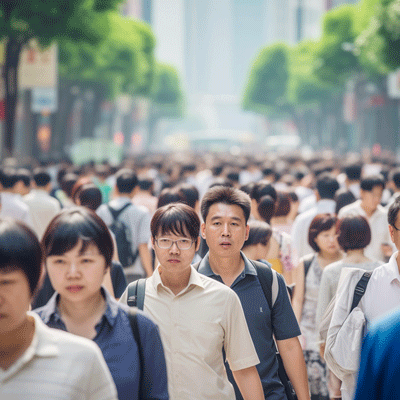
China’s Population Decreases For Third Year In A Row
China’s population decreased in 2024 for the third year in a row, the government said recently. At the end of last year, China’s population stood at 1.408 billion, this is a 1.39 million decrease from 2023.
These figures also follow worldwide population trends that have been especially present in East Asia, specifically in Japan, South Korea, Hong Kong, and other nations. China joined countries like Japan and other Eastern European countries three years ago when it comes to seeing their populations decline.
Some of the general reasoning behind these declines has to do with the rising costs of living, which are pushing younger people away from marriage and having kids, and instead opting for pursuing higher education and careers.
China also doesn’t allow for a lot of immigration. The nation has been known as the most populated country in the world. Historically this is partially due to the end of World War II and the rise of the Communist Party in 1949. Within three decades China saw their population double.
As the population began to rapidly increase, Communist leaders began to implement a “one child policy” among families to maintain resources.
While the policy has never been made into law, women have had to apply to have a second child and individuals who haven’t could’ve faced forced abortions and birth control procedures, as well as massive fines and the possibility of their child not having an identification number. Without an identification number, the child is considered non-citizens, according to reports from NPR.
In rural China, male children are preferred, and women had to present evidence of their own menstruation. With abortion being legal and available, the government worked to motivate pregnant women to abort their baby if it was a female.
The result is a major inequality in the amount of men versus the amount of women in China’s population. NPR reported that there are as many as millions of more boys for every 100 girls born. The recent report from Beijing showed an imbalance of about 104 men to every 100 women, however, independent census groups think that ratio is much higher.
Now, India has just surpassed China as the most populous nation in the world. With an aging population and decrease in births and marriages, the trends make sense.
More than one-fifth of China’s population is 60 or older, specifically, about 310.3 million people. For reference, the US has about only 30 million more people than that demographic. By 2035, reports suggest that the older population will account for more than 30% of the total population.

Eric Mastrota is a Contributing Editor at The National Digest based in New York. A graduate of SUNY New Paltz, he reports on world news, culture, and lifestyle. You can reach him at eric.mastrota@thenationaldigest.com.