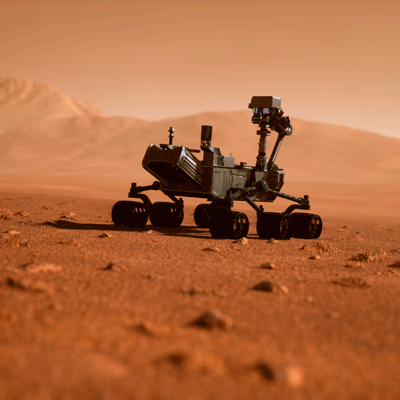
Curiosity Rover Uncovers Ancient Carbon on Mars, Hinting at Lost Habitability
NASA’s Curiosity rover uncovered significant new data while ascending the rugged terrain of Mount Sharp within Mars’ vast Gale Crater, where it detected extensive carbon-rich deposits inside carbonate minerals. The discovery carries profound implications, suggesting the Red Planet may have once been capable of supporting life.
Carbonate minerals, which form when carbon dioxide interacts with water and rocks, serve as critical markers of historical environmental conditions. Scientists had already documented sparse carbonate occurrences on Mars through various exploration methods, including satellite observations, rover analyses, and meteorites originating from the planet that had tumbled toward Earth. Yet, Curiosity’s newest discoveries offer newfound clarity about these deposits.
The findings were published this week in the journal Science. “It tells us that the planet was habitable and that the models for habitability are correct,” Dr. Ben Tutolo, lead author and associate professor at the University of Calgary’s Department of Earth, Energy, and Environment, said in a statement. Tutolo is a participating scientist on the NASA Mars Science Laboratory Curiosity Rover team.
“The discovery of large carbon deposits in Gale Crater represents both a surprising and important breakthrough in our understanding of the geologic and atmospheric evolution of Mars. The abundance of highly soluble salts in these rocks and similar deposits mapped over much of Mars has been used as evidence of the ‘great drying’ of Mars during its dramatic shift from a warm and wet early Mars to its current cold and dry state.”
The carbonate minerals identified appear to have crystallized in environments characterized by extreme aridity, emerging from reactions between scarce Martian water and surface rocks followed by significant evaporation. These conditions suggest that Mars once boasted a thicker, warmer atmosphere abundant in carbon dioxide, sufficient to maintain liquid water on its surface. However, as Mars gradually lost its atmospheric density, gaseous carbon dioxide became permanently locked into rock formations.
One mineral, siderite, stands out due to its surprisingly high concentration, constituting approximately five to ten percent of the discovered deposits in three drill sites. The rover also detected iron oxyhydroxides within these carbonate deposits alongside soluble salts.
These minerals also suggest Mars once possessed a dynamic carbon cycle similar to Earth’s, in which carbon trapped in rocks could eventually return to the atmosphere, influencing the planet’s climate.
“The question looking forward is how much of this CO2 from the atmosphere was actually sequestered? Was that potentially a reason we began to lose habitability?”
Tutolo emphasized the significant impact of this discovery on our understanding of how the planet’s atmosphere changed over time. “Studying the collapse of Mars’ warm and wet early days also tells us that habitability is a very fragile thing,” Tutolo said.
“The broader implications are the planet was habitable up until this time, but then, as the [carbon dioxide] that had been warming the planet started to precipitate as siderite, it likely impacted Mars’ ability to stay warm.”
Curiosity’s findings intersect compellingly with ongoing climate initiatives. Tutolo is actively researching ways to mitigate climate change by converting industrial carbon dioxide emissions into stable, solid carbonate minerals, a method analogous to what likely occurred naturally on Mars.
“What we’re trying to do on Earth to fight climate change is something that nature may have already done on Mars. Learning about the mechanisms of making these minerals on Mars helps us to better understand how we can do it here.”
This new data highlights the delicate and fleeting aspects of planetary habitability, offering essential insights for our comprehension of the environmental futures of both Mars and Earth.
NASA has indicated that upcoming missions and further examination of additional sulfate-rich regions on Mars may validate these findings, contributing to a deeper understanding of the planet’s early history and the transformations it underwent as its atmosphere dissipated.
“The most remarkable thing about Earth is that it’s habitable, and it has been for at least four billion years. Something happened to Mars that didn’t happen to Earth.”

Moumita Basuroychowdhury is a Contributing Reporter at The National Digest. After earning an economics degree at Cornell University, she moved to NYC to pursue her MFA in creative writing. She enjoys reporting on science, business and culture news. You can reach her at moumita.b@thenationaldigest.com.