Dolphin Named Bubbles Filmed Chasing Fish Until They Vomit, Then Eating Their Food
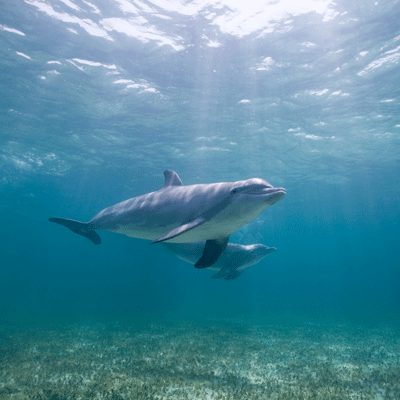
A wild bottlenose dolphin off Australia’s Great Barrier Reef has been caught on camera using an unusual feeding strategy — chasing fish until they vomit, then helping himself to their partially digested meals.
Researchers studying the dolphin, nicknamed Bubbles, documented 20 instances of the behavior, with 11 successful attempts. Their findings, published September 13 in the journal Ecology and Evolution, describe a hunting technique never before documented in bottlenose dolphins.
Study co-author Asia Armstrong first became aware of Bubbles in 2017 after watching footage of his unusual feeding behavior. She later recruited other researchers to investigate the adult male, who locals had nicknamed Bubbles. The team used GoPro cameras to document his feeding activities between June 2021 and October 2025.
Researchers observed the behavior near Lady Elliot Island, a coral cay at the southern end of the Great Barrier Reef, where Bubbles regularly encounters schools of bigeye trevally. Footage shows him approaching a school, singling out a fish and separating it from the group before giving chase. Once the distressed fish regurgitates its stomach contents, Bubbles promptly devours them.
And one meal apparently isn’t always enough. Scientists observed Bubbles repeating the process several times during a single feeding session, sometimes launching as many as 10 pursuits within half an hour.
The behavior represents an unusual variation of kleptoparasitism, a feeding strategy in which an animal steals food another animal has already obtained. Although the practice is well documented among numerous species, particularly birds such as frigatebirds, the findings represent one of the first detailed accounts of food stealing in cetaceans, the marine mammal group that includes dolphins, whales and porpoises.
One previously documented example involved a dolphin stealing fish from cormorants, as described by Georgetown University marine biologist Janet Mann. Bubbles, however, takes a different approach, extracting another animal’s last meal rather than stealing prey it has captured.
Researchers are particularly interested in how Bubbles identifies his targets and whether sound plays an important role in the technique. Before approaching schools of fish, researchers filmed him producing clicking sounds while moving his head from side to side, suggesting he might use echolocation to identify trevally with fuller stomachs.
“Echolocation does allow dolphins to discriminate small differences in their targets’ shape, size and structure, so the dolphin potentially uses echolocation to decide which fish to target to get the best reward,” Armstrong, a marine scientist at the University of the Sunshine Coast, told Scientific American.
During his pursuits, Bubbles also produced repetitive clicks and low-frequency sounds that researchers suspect might further distress his targets and contribute to their vomiting. Alternatively, the fish may regurgitate as a defensive tactic, using their discarded stomach contents to distract a predator and escape.
However, additional research is needed to establish whether Bubbles deliberately selects fish based on their stomach contents. Outside experts have also cautioned against assuming that the dolphin understands precisely how his actions produce a meal.
“I would be cautious, though, about assigning intention,” Jason Bruck, a dolphin behavioral scientist at Stephen F. Austin State University who was not involved in the research, told Scientific American. “We can’t yet say the dolphin is pursuing the fish because it expects it to regurgitate.”
Another unanswered question is how Bubbles acquired the technique. He may have discovered it independently, learned it by observing other dolphins, or initially pursued trevally with the intention of eating them before discovering that their regurgitated meals provided another food source.
“It’s very possible that other species use this tactic. Dolphins and whales use a variety of unique foraging tactics, which is reflective of their intelligence, adaptability and ability to learn and pass information to one another socially.”
Researchers also have several theories about why the technique might be advantageous. The bigeye trevally schools Bubbles targets reliably gather in approximately the same location almost every day, providing a recurring opportunity to obtain food.
The size of his targets may offer another incentive. Bigeye trevally can grow up to 33 inches long, making them potentially demanding prey. Vivienne Foroughirad, a Texas A&M University marine biologist who was not involved in the study, suggested to Science that eating regurgitated food could require considerably less time and energy than capturing and consuming the fish themselves.
“I’d speculate that the trevally vomit provides an easy snack on days when Bubbles hasn’t been as successful with hunting,” lead author Romney Edwards-Francis, a Ph.D. candidate at the University of the Sunshine Coast, told Discover Wildlife.
Bubbles has also displayed an intriguing behavior after successfully obtaining a meal. Study co-author Jacinta Shackleton, an independent marine biologist and underwater photographer, told BBC Wildlife Magazine that he sometimes turns directly toward her and produces a prolonged clicking sound after eating, almost as though he is showing off his accomplishment.
Whether Bubbles is the only dolphin employing this strategy remains unclear. Researchers believe unconventional feeding behaviors may be more common among cetaceans than existing scientific observations suggest, but documenting them is difficult because scientists rarely have the opportunity to follow marine mammals underwater for extended periods.
Edwards-Francis suggested that combining drone technology with underwater surveys could help researchers capture a broader range of behaviors and determine how widespread such techniques actually are.

Moumita Basuroychowdhury is a Contributing Reporter at The National Digest. After earning an economics degree at Cornell University, she moved to NYC to pursue her MFA in creative writing. She enjoys reporting on science, business and culture news. You can reach her at moumita.b@thenationaldigest.com.