Genetic Test Could Help Scientists Eradicate A Kind Of Inherited Blindness In Dogs
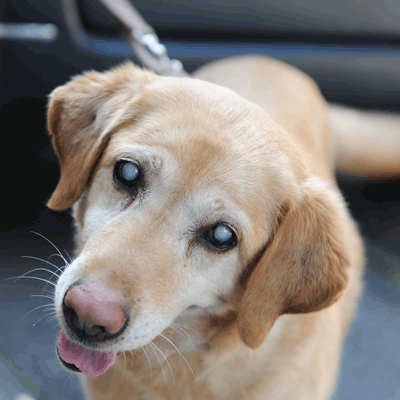
Shola is an English shepherd mountain rescue dog who had to retire due to her dwindling eyesight. Shola has an inherited eye disease known as Progressive Retinal Atrophy (PRA), which causes her light-sensitivity cells to deteriorate overtime, leading to blindness.
PRA impacts more than 100 different dog breeds, and can be caused by multiple different genetic variants; there is also currently no treatment, according to reports.
Certain dogs don’t experience the symptoms of PRA until they’re older, which unfortunately means they could’ve passed the gene along to their puppies.
Katherine Stanbury is the first author of the research coming out of the University of Cambridge, and Shola became a big part of that research. Stanbury said that Shola began experiencing symptoms of PRA at four years old when it was noticed she was struggling to see in dim lighting.
“She [Shola] was sent to a veterinary ophthalmologist and they confirmed that she had PRA, and then it turned out her brother also had PRA.”
Utilizing Shola’s English shepherd DNA, Stanbury was able to identify the genetic variant responsible for PRA in that breed specifically. Beyond that, Stanbury and her colleagues were able to develop a DNA test to show whether dogs have one or two copies of the variant, or none. The DNA test kit for English shepherds is currently on sale for £48.
While the kit may be specific for English shepherds, Stanbury said that the team will monitor and screen any dog of any breed impacted by the inherited eye disease as a means of identifying further variants for future test kits.
“If it does pop up in another breed, we can monitor that.”
Shola and her brother were initially brought in to be checked out by Stanbury and her team after their breeder was concerned over their behavior in relation to their eyesight. Published in the journal Genes, Stanbury and colleagues reported that they “carried out whole genome sequencing on the siblings’ DNA but found neither had genetic variants previously associated with PRA, suggesting a different variant was at play.”
“In a series of analyses using these genomes, as well as data on the genetic makeup of two additional English shepherds with PRA and 22 clear of eye disease, the team identified the variant responsible,” reported Nicola Nicola Davis a Science correspondent for the Guardian.
The goal is to give dog owners, specifically breeders, an easy way to identify the gene variant for PRA so they can avoid using the dogs for breeding purposes. That way, breeders can move towards a place where the potential for their dogs inheriting PRA would be eliminated.
“You could still breed from a carrier [which has one copy of the variant], as long as you breed with a clear dog. That was important for genetic variation given the breed is relatively rare, especially in the UK,” Stanbury said.
She said the team had “tested the father of Shola’s offspring, revealing the latter would not develop PRA. Two of her daughters have just completed their mountain rescue training with Mountain Rescue England, and one of her sons is a therapy dog,” said Stanbury.

Eric Mastrota is a Contributing Editor at The National Digest based in New York. A graduate of SUNY New Paltz, he reports on world news, culture, and lifestyle. You can reach him at eric.mastrota@thenationaldigest.com.