Mining Metals For EV Batteries Threatens One Of The Most Biodiverse Marine Habitats On Earth
Environmental campaigners recently shared images showing how nickel mining has stripped forests and polluted waters in the Raja Ampat archipelago, one of the most biodiverse marine habitats on Earth. The photographers shared the images with the BBC of what is referred to as the “Amazon of the Seas.”
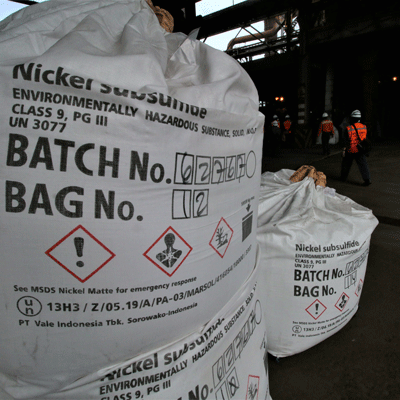
According to the organization Global Witness, mining for nickel has increased in the archipelago, located in Indonesia’s Southwest Papua Province, in recent years. Nickel is mined and used to create electric vehicles.
Papuans hold placards reading “revoke all nickel mining permits in Raja Ampat immediately” during a protest on June 10, 2025
To combat this issue, the Indonesian government revoked permits for four out of five mining companies that are operating in the area this month. Indonesia’s Ministry for the Environment recently released a statement in which they said:
“Raja Ampat’s biodiversity is a world heritage that must be protected. We pay great attention to mining activities that occur in the area.”
The recent photos showed environmental damage already done to the archipelago, showing forest loss and sediment run-off into the waters which are home to a largely biodiverse coral reef ecosystem.
Global Witness told the BBC that between 2020 and 2024 the land that’s been used for mining has increased greatly, and is equivalent to around 700 football pitches.
While conversationists are happy about the government’s recent decision to protect the islands and reefs, they’re concerned that the mining companies will pursue legal action to reverse it. One company that operates on Gag Island has been able to continue its mining with the government ordering the “restoration of the ecological impacts that occur there.”
Dr. Mark Erdmann, a coral reef conservationist and ecologist told the BBC that he was “blown away and so happy” about the government ceasing operations on the archipelago.
“This is the global epicenter of marine biodiversity.”
Papuans hold placards, reading “mining must fall”, “stop destroying our beloved homeland”, and “Resist all forms of state policies that exploit Papua’s natural resources and people”
Dr. Erdmann has been working in Raja Ampat for over 20 years and has worked hard to protect the marine environment and forests there. When it comes to the recent protections put into place, Dr. Erdmann credits the population in Indonesia for the decision.
“It was a voice of outrage from the Indonesian people that made the government pay attention.”
Indonesia is responsible for more than half of the world’s nickel mine production, according to reports from the Institute for Energy Economics and Financial Analysis. A 2024 study by Forest Watch Indonesia reported a connection between the loss of forests associated with mining activity, flooding, and landslides.
The demand for critical minerals is greatly impacting the economic decisions being made around the world. Dr. Erdmann stated that balancing economic growth with environmental protection is a major issue in Indonesia. “It has a lot of nickel – one way or the other, some of it’s going to come out of the ground,” he said.
Dr. Michaela Guo Ying Lo from the Durrell Institute of Conservation and Ecology led a study in 2024 regarding the impact of mining on local communities in Sulawesi, a large Indonesian island that contains most of the nation’s nickel deposits.
“Indonesia is positioning itself globally in the nickel market, but it’s important not to forget what’s happening locally,” Dr Lo said.
“They say nickel is a solution to the climate crisis, but it’s causing deforestation and destroying farmland,” Imam Shofwan, an environmental campaigner, stated.
“The nickel dilemma is a horrible one. Mining is always going to be environmentally impactful and we all tend to think that electrification is a good idea. But what is the acceptable damage that we’re willing to see,” Dr. Erdmann said.

Eric Mastrota is a Contributing Editor at The National Digest based in New York. A graduate of SUNY New Paltz, he reports on world news, culture, and lifestyle. You can reach him at eric.mastrota@thenationaldigest.com.