Nepal Proposes Everest Climbing Law Requiring Prior 7,000-Meter Ascent
Nepal is preparing to implement new regulations aimed at reducing overcrowding and enhancing climber safety on Mount Everest by restricting climbing permits exclusively to climbers who have previously ascended at least one mountain of 7,000 meters or higher within Nepal.
The legislation, known as the Integrated Tourism Bill, was presented in Nepal’s upper house of Parliament on April 18. It specifically targets pressing ecological issues, safety concerns, and overcrowding on Mount Everest, which at 8,848.86 meters (29,031.7 feet) remains the highest peak above sea level, confirmed by a 2020 joint survey between Nepal and China.
Nepal’s economy heavily relies on tourism income, especially mountaineering, trekking, and related activities. Revenue generated from climbing permits represents a substantial source of foreign exchange for the nation, which boasts eight of the world’s 14 tallest mountains.
However, this reliance has led to widespread criticism of the government’s permit issuance practices, particularly in allowing inexperienced climbers to attempt Everest, resulting in dangerous situations.
Recently, Nepal raised the price of Everest climbing permits by 36 percent, increasing from approximately £8,249 to £11,248. This was the first significant price adjustment in nearly a decade.
Despite the financial benefits, the environmental repercussions of increasing tourist traffic are severe. Everest faces mounting issues of pollution, including accumulated garbage, human waste, and broader ecological damage to the fragile alpine environment. Additionally, rescue operations at extreme altitudes are both exceptionally dangerous and costly.
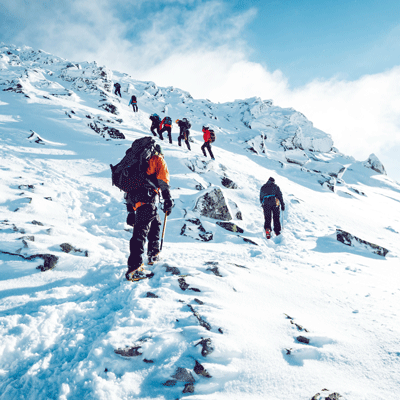
Overcrowding in critical sections of Everest, particularly the notorious “death zone” where oxygen is insufficient for human survival, has created hazardous bottlenecks, significantly increasing risks for climbers.
The new regulations aim to mitigate these problems by requiring prospective Everest climbers to submit documented proof of previously ascending a Nepal-based peak of at least 7,000 meters before applying for an Everest permit. This measure intends to ensure climbers have sufficient high-altitude experience, thus minimizing risks associated with inexperienced mountaineering.
Additionally, climbers must undergo a thorough medical examination by a government-approved medical institution within one month of the planned expedition. Applicants must also declare in advance any intentions to set or attempt records during their climbs.
The consequences for violating rules are set to increase in severity. Nepali climbers discovered to be in violation of regulations could face a decade-long ban from climbing, alongside fines equivalent to the cost of their climbing permits or a combination of both penalties. Foreigners could encounter identical penalties, along with a five-year prohibition on re-entering Nepal.
The proposed legislation also mandates that the primary guide, known locally as the Sardar, and accompanying mountain guides must be Nepali citizens. Furthermore, permit fees, once paid, cannot be transferred to another individual. In cases where expeditions are disrupted due to uncontrollable circumstances such as natural disasters or conflicts, permits will remain valid for a two-year period without refund.
International climbing companies have expressed significant concerns over the proposed restrictions, particularly regarding the exclusive requirement of prior ascents on Nepali peaks. Lukas Furtenbach, founder of the Austrian expedition organizer Furtenbach Adventures, argues that well-known international peaks should be recognized as qualifying climbs.
“That wouldn’t make any sense. And I would also add mountains that are close to 7,000 meters to that list and that are widely used as preparation, like Ama Dablam, Aconcagua, Denali and others.”
Furtenbach also emphasized to Reuters the importance of allowing qualified international guides to operate on Everest due to a shortage of adequately qualified Nepali guides.
“It is important that mountain guides have a qualification like IFMGA (International Federation of Mountain Guides Associations), no matter what nationality they are. We do also welcome Nepali IFMGA guides to work in the Alps in Europe.”
The Kathmandu Post reports that the new bill also includes provisions for improved dead body management insurance. The process of recovering bodies from Everest presents significant financial and logistical challenges, with costs ranging from $20,000 to $200,000, reflecting the inherent risks involved.
Additionally, the proposed legislation aims to substitute the existing $4,000 refundable garbage deposit with a non-refundable garbage fee. The funds will go toward climber welfare and environmental conservation.
“What’s already outlined in the bill paints a clear picture: the government is trying to bring order, accountability, and safety to the mountains.”
Nepal’s 2025 Everest climbing season began in April, and the country has already issued approximately 402 permits. The total number of permits issued is expected to exceed 500 during the peak climbing window in May.
Still in draft form, the law has to go through deliberations in both houses of Parliament. Nepal’s Ministry of Tourism officials claim changes are likely before the final bill is approved.

Moumita Basuroychowdhury is a Contributing Reporter at The National Digest. After earning an economics degree at Cornell University, she moved to NYC to pursue her MFA in creative writing. She enjoys reporting on science, business and culture news. You can reach her at moumita.b@thenationaldigest.com.