New Jane Austen Exhibit Opens in NYC Featuring Rare Letters and First Editions
More than two centuries after her death, Jane Austen remains one of the most beloved and studied writers in the English literary canon —a remarkable feat for a woman who once published her novels anonymously. Now, The Morgan Library & Museum in New York City is honoring her extraordinary legacy with a sweeping exhibition, “A Lively Mind: Jane Austen at 250,” which offers visitors a rare opportunity to step inside Austen’s world.
Open through September 14, 2025, the exhibit marks the 250th anniversary of Austen’s birthday. It assembles an extraordinary collection of first-edition novels, personal correspondence, family artifacts, and historical documents—many of which are on loan from Jane Austen’s House in Chawton, England, where she spent her most productive years as a writer.
“Our aim in the show is to welcome every visitor—regardless of their prior knowledge of Jane Austen, level of interest in Jane Austen, possible prejudices against Jane Austen,” Juliette Wells, co-curator of the exhibition and Professor of Literary Studies at Goucher College, stated during a preview event.
“If you were marched through Pride and Prejudice in 10th grade and that was not the right time in your life, you are retaining an idea of Jane Austen that does not serve you.”
The exhibition takes a chronological approach, beginning with Austen’s formative years in a household unusually rich with books. Her father, Reverend George Austen, maintained a personal library of roughly 500 volumes, an impressive collection for the late 18th century, and encouraged his daughters to read freely. This early exposure to literature, combined with the lively conversations that filled the Austen household, helped cultivate Jane’s sharp wit and keen eye for human nature.
But Austen’s early adulthood was not without hardship. After her father’s death in 1805, Jane, her sister Cassandra, and their mother faced financial uncertainty, frequently moving and relying on modest means. These struggles are documented in the many letters Austen exchanged with Cassandra, which form one of the most intimate and poignant elements of the exhibition. Seeing Austen’s elegant handwriting and candid reflections brings a deeply personal dimension to her life story.
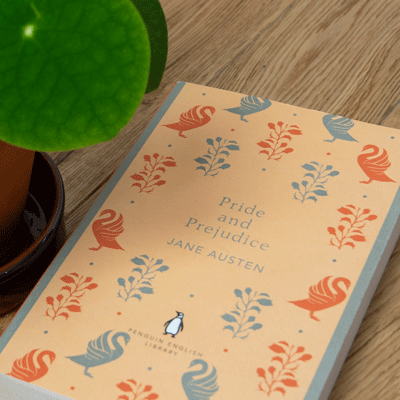
Despite these challenges, Austen eventually secured modest professional success. Between 1811 and 1816, she published “Sense and Sensibility,” “Pride and Prejudice,” “Mansfield Park,” and “Emma”—novels that would define her as one of the sharpest social observers of her time. Yet throughout her lifetime, her identity as an author was known only to a small circle of family and friends. Even her gravestone in Winchester Cathedral makes no mention of her literary achievements, focusing instead on her personal virtues.
The decision to publish anonymously—her books were simply credited as “By a Lady”—has long intrigued scholars. Her early letters suggest that she was interested in achieving literary success, but she seemed equally intent on maintaining personal privacy. It’s as if she wanted her novels to find an audience, but she didn’t want strangers recognizing her in the street.
Dale Stinchcomb, Drue Heinz Curator of Literary and Historical Manuscripts at The Morgan, added that Austen’s anonymity was partly a reflection of the time.
“A Lively Mind’ examines how it was possible for Austen to publish her now-beloved novels when women generally were not permitted to become writers, much less encouraged to be.”
Still, Austen’s work traveled far beyond England. Even during her lifetime, American readers were discovering her novels, and her popularity continued to grow after her death in 1817. In many ways, American audiences played a crucial role in elevating Austen from a modestly successful novelist to an enduring literary icon. Today, her stories resonate across generations and cultures, inspiring countless adaptations, retellings, and academic studies.
The exhibition also acknowledges Austen’s expanding global fandom. One of its final displays features Amy Sherald’s painting “A Single Man in Possession of a Good Fortune,” a contemporary nod to the famous opening line of “Pride and Prejudice.” Sherald, best known for her official portrait of former First Lady Michelle Obama, offers a modern interpretation of Austen’s ongoing cultural relevance. Visitors who want to see more of Sherald’s work can also visit her full exhibit, currently on display at The Whitney Museum.
From early manuscript drafts to cultural reimagining, “A Lively Mind” captures both the intimacy of Jane Austen’s private world and the vast reach of her influence. More than 200 years later, Austen continues to prove that her sharp observations on love, class, and human folly remain as fresh and resonant as ever.

Moumita Basuroychowdhury is a Contributing Reporter at The National Digest. After earning an economics degree at Cornell University, she moved to NYC to pursue her MFA in creative writing. She enjoys reporting on science, business and culture news. You can reach her at moumita.b@thenationaldigest.com.