Scientists Find Alarming Surge in Microplastics Accumulating in Human Brains
When comparing brain tissue samples taken eight years ago to those taken now, researchers have found an alarming increase in the presence of microplastics.
A study published Monday in the journal Nature Medicine examined the brains of 24 individuals who died recently, within a few months of January 2024. The brain tissue samples were compared to samples from 2016 of 28 individuals. The scientists determined that the levels of micro and nanoplastics increased by 50%.
Researchers also analyzed brain samples from 12 people who had suffered from dementia before their passing. Their brains had more than five times the average level of microplastics found in the 2024 tissue samples.
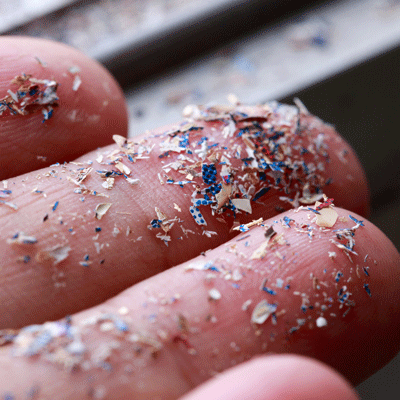
However, the paper notes that dementia patients may have more plastics in their samples due to impaired blood-brain barriers, so researchers believe it is premature to connect microplastics to illnesses like dementia. Nanoplastics are thinner than a strand of human hair, while microplastics are smaller than a pencil eraser.
“Atrophy of brain tissue, impaired blood-brain barrier integrity and poor clearance mechanisms are hallmarks of dementia and would be anticipated to increase micro and nanoplastic concentration. Thus, no causality is assumed from these findings.”
Jason Richardson, a professor of physiology at the University of Georgia who was not involved in the research, told USA Today that the study “gives one pause.”
“They’re at a much larger concentration in the body than many of us would have expected.”
Most of the plastics found in brain tissue samples were nanoplastics from polyethylene. Polyethylene is the most widely used plastic in the world, often found in plastic bags and packaging for food and drinks.
Researchers also studied brain tissue samples taken between 1997 and 2013 to see if the accumulation level was a growing trend. The levels in 2016 were double that of that period, while the levels in 2024 were four times higher.
While talking about the study, Professor Matthew Campen, a lead author of the report from the University of New Mexico, told The Washington Post, “Every time we scratch the surface, it uncovers a whole host of, ‘Oh, is this worse than we thought?’”
The World Health Organization (WHO) issued a report in 2022 and 2019 indicating that, according to studies available thus far, there is “no evidence to indicate a human health concern.”
“Humans have ingested microplastics and other particles in the environment for decades with no related indication of adverse health effects.”
However, numerous studies have consistently demonstrated rising concentrations of microplastics in the environment, like in our oceans and the human body. Tracey Woodruff, a University of California at San Francisco researcher, told The Associated Press, “Microplastics have been measured in pretty much all of the body tissues that have been evaluated.”
Last May, in a separate study, researchers reported the presence of microplastics in every human testicle they examined. These particles have also been detected in livers, blood, and placenta.
Despite ongoing observations, there remains a lack of clear evidence indicating a significant public health impact, particularly regarding mortality rates. Recent statistics indicate a decline in death rates associated with cancer, heart disease, and stroke.

Moumita Basuroychowdhury is a Contributing Reporter at The National Digest. After earning an economics degree at Cornell University, she moved to NYC to pursue her MFA in creative writing. She enjoys reporting on science, business and culture news. You can reach her at moumita.b@thenationaldigest.com.