Los Angeles, California will be hosting the 2028 Summer Olympic Games. In the most recent Summer Games, hosted in Paris, there were major strides made in sustainability and protecting the environment while holding the world’s most anticipated athletic competition.
Throughout the Paris Olympics, the total CO2 emissions equated to 1.59 million tons, which is less than half of the average emissions at both the London 2012 and Rio de Janeiro 2016 Games, according to reports from Forbes Magazine.
Embed from Getty Images
Becky Dale, the Vice President of Sustainability for Los Angeles 2028 said that they’re ready and willing to try to become even more green than the Paris Games, which have become the new standard for sustainability.
“It’s the great thing about the sports industry: everyone wants to win, including sustainability. Every time you host, you want to up the ante.”
Dale cited the 2028 Game’s Impact and Sustainability Plan, which outlines how the city is committed to reducing waste, utilizing materials that can be put back into the community.
Nurit Katz, UCLA’s Chief Sustainability Officer, collaborated with Dale to give a presentation on how they plan on making the Games greener than ever. The two presented the plan at the Energy Innovation Conference at UCLA’s Anderson School of Management.
LA 2028 also released an Impact and Sustainability Plan, “a structured document laying out how organizers plan to maximize the Olympic’s sustainability potential,” Blythe Lawrence for Forbes wrote.
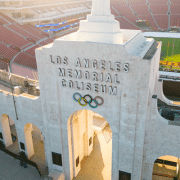
One of the biggest aspects of this plan is that LA is not planning to build any new venues for hosting the event. This is major because the last time the Olympics took place without any new construction being built beforehand was London in 1948.
The sustainability plan wrote: “[LA was] built for large, live-scale events, from the Grammys and the Academy Awards to the FIFA World Cup and the Super Bowl. With the region’s abundance of existing world-class stadiums and arenas ready to host the Games today, athletes at the 2028 Games will have access to exceptional fields of play and fans will enjoy unbeatable spectating.”
Embed from Getty Images
This automatically sets LA up for being much greener than previous Olympic Games. Not only will there be a reduction of carbon emissions from the lack of construction, but it entails that every competition venue will take place within a 35-mile radius of downtown LA, so transport around from the Olympic village to each venue won’t take as much energy/emissions.
Dale went on to explain that almost all of the materials used for the Games will be reused in some way after the Olympics are over.
“The target is to have 90% of materials used for temporary infrastructure reused or recycled. LA will rely on a combination of rentals, buybacks, and donations to ensure reuse of as much material as possible,” she stated.
The plan also noted that the electricity used to power venues will be fully renewable by using the grid to reduce the Games’s carbon emissions.
Dale stated that the organizers will be enhancing public transit to motivate fans to to take it from one venue to another.
“Our big challenge is how do we make public transportation the most attractive option for people coming to the Games? Ultimately people are creatures of free will, but there are ways to create incentives and smooth the path so we can make it a more desirable option,” she said.
Katz also discussed at the conference that the Olympics going green doesn’t necessarily mean that the planning and implementation of the new sustainable measures will be more expensive than the average cost of putting on the Games.
“There’s very much a myth that going green or being sustainable always has to cost more. Some of our initiatives, especially around energy efficiency or around reducing waste, really have operational savings.”
Eric Mastrota is a Contributing Editor at The National Digest based in New York. A graduate of SUNY New Paltz, he reports on world news, culture, and lifestyle. You can reach him at eric.mastrota@thenationaldigest.com.