Posts

mbta

NYC Subways Testing Out AI Technology To Track Fare Evaders 

New York City’s MTA has consistently blamed the design of the subway system and its turnstiles for rampant fare evasion. Now, three companies are fighting to take control over a $1.1 billion contract to redesign the turnstiles.

Embed from Getty Images

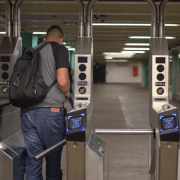
These firms have already installed new fare gates with tall doors as opposed to the more well-known waist-high turnstiles. These doors have been installed at 10 subway stations throughout the last two months as part of a testing period for a pilot program. 

The program is also currently set to expand to 20 different subway stations within the next coming weeks, according to MTA Chair Janno Lieber while she testified at a state budget hearing in Albany this week. 

At least two of the three companies have stated that their designs utilize some level of artificial intelligence technology to track fare evaders. 

Cubic is the company that constructed most of the modern fare gates that are currently installed in the subway, as well as the now-retired MetroCard system. The company, however, has come under fire from MTA officials for delays and bugs with the rollout of the MTA’s new OMNY tap-to-pay system, according to the Gothamist

MTA Chair Janno Lieber stated during the hearing: 

“Cubic has not been a perfect partner and software developer and we ride them every day, all day. So we think most of it has been worked out, but there’s a couple of kinks we’re still working through, to be honest.”

Embed from Getty Images

Anthony Louh, Cibic’s director of business development, stated that the “hiccups” with the OMNY rollout have better prepared the company for taking on the new redesign contract. 

Cubic’s new gates are also currently being tested at busy stations like Atlantic Terminal and Port Authority. They stated their intentions to add them to 125th Street station on the A, B, C, and D lines. 

In terms of the use of AI, the gates have surveillance technology that are automatically meant to issue an alert whenever a fare is evaded. The officials for Cubic said that the equipment has cameras that record a five-second clip when someone doesn’t pay. The AI mechanism writes a physical description of the individual and then sends it to the MTA.

Conduent and STraffic are the other two companies fighting for the contract, and have also installed modern fare gates in subway stations that are currently being used. 

Conduent specifically has its own form of AI technology as well that utilizes sensors to collect data on people who evade fares, according to reports

“The pilot program continues and results will be reviewed at the appropriate time, with the vendors selected to supply fare gates for the future,” MTA spokesperson Eugene Resnick wrote. 

The MTA is hoping to install new entry points at 150 of the subway’s 472 stations.

ai

European Union Begin Landmark AI Law Enforcement With Restrictions 

The European Union has officially begun enforcing a landmark artificial intelligence law this week, setting a new standard for AI restrictions and large fines for violations. 

The EU AI Act is the first-of-its-kind regulatory outline for this growing technology, according to reports. This past Sunday was the deadline for prohibitions on certain AI systems and requirements to guarantee technology literacy among staff members. 

Companies now need to comply with these restrictions and will face penalties if they don’t. The AI Act bans certain applications of AI that are considered to pose an “unacceptable risk to citizens,” CNBC reported.

Embed from Getty Images

Specifically, social scoring systems, real-time facial recognition, and other types of biometric identifications that categorize people by their race, sex life, sexual orientation, and more. The Act also bans what they consider manipulative AI tools. 

If companies are to breach the act they can face fines up to 35 million euros ($35.8 million) or 7% of their global annual revenues, depending on which of the amounts is larger. The size of the penalty will also depend on the size of the company and the specific infringement. 

The Act itself isn’t fully implemented yet, but it’s in its initial stages of developments that are upcoming. 

“It’s quite important to recognize that the AI Act is predominantly a product safety legislation,” said Tasos Stampelos, the head of EU public policy and government relations at Mozilla, to CNBC during a panel in November. 

“With product safety rules, the moment you have it in place, it’s not a done deal. There are a lot of things coming and following after the adoption of an act,” he said.

“Right now, compliance will depend on how standards, guidelines, secondary legislation or derivative instruments that follow the AI Act, that will actually stipulate what compliance looks like.”

Embed from Getty Images

Some technology executives and investors are not happy with the AI Act considering this technology is so new. They fear the Act will deter the development of AI. 

For example, Prince Constantijn of the Netherlands told CNBC last summer that he’s “concerned” over the EU’s focus on regulating AI. 

“Our ambition seems to be limited to being good regulators,” Constantijn said. “It’s good to have guardrails. We want to bring clarity to the market, predictability and all that. But it’s very hard to do that in such a fast-moving space.”

Other leaders, however, believe that these regulations will give Europe a global advantage over the development of AI thanks to the regulations they’re implementing. 

“While the U.S. and China compete to build the biggest AI models, Europe is showing leadership in building the most trustworthy ones,” Diyan Bogdanov, director of engineering intelligence and growth at Bulgarian fintech firm Payhawk, said.

“The EU AI Act’s requirements around bias detection, regular risk assessments, and human oversight aren’t limiting innovation they’re defining what good looks like,” he stated.

Mark Zuckerberg, The Future Of Meta, And The Publics Mixed Reaction To Technological Advancement

Mark Zuckerberg has been a key figure in the realm of technology, social media, and the internet for two decades. During such a transformative period for America, Zuckerberg has continued to announce advancements in his company Meta, parent company to popular social media apps Instagram, Facebook, and WhatsApp. With the incorporation of artificial intelligence, the loosening of fact-checking, and the removal of diversity, equity, and inclusion (DEI) programs, the general public is uncertain about the future of the internet and just how protected their online presence truly is.