
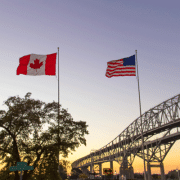
Trump Threatens to Block Opening of US–Canada Bridge
A cross-border bridge meant to symbolize cooperation between the United States and Canada has instead become the latest flashpoint in a widening political and economic confrontation.
President Trump said Monday that he could prevent the long-awaited Gordie Howe International Bridge, built to connect Detroit and Windsor, Ontario, from opening to traffic, tying its fate to broader grievances with Canada.
In a social media post, he declared he would “not allow” the span to open “until the United States is fully compensated for everything we have given them, and also, importantly, Canada treats the United States with the Fairness and Respect that we deserve.”
“We will start negotiations, IMMEDIATELY. With all that we have given them, we should own, perhaps, at least one half of this asset.”
The warning comes amid tariffs, annexation rhetoric, and deepening diplomatic friction between the neighboring countries, whose economies, particularly the auto industry, remain tightly linked by daily cross-border trade.
Canadian business leaders quickly pushed back. The Canadian Chamber of Commerce said in a statement that “whether this proves real or simply threatened to keep uncertainty high, blocking or barricading bridges is a self-defeating move.”
It is not immediately evident how the administration could stop the bridge from opening. Canada financed construction, and operational control will be shared through a public-private arrangement with the state of Michigan, which holds partial ownership.
One theoretical path would be declaring an emergency, allowing Customs and Border Protection to close a port of entry “when necessary to respond to a specific threat to human life or national interests.” Trump has frequently invoked emergency powers in circumstances critics considered routine to access broader executive authority.
The dispute also intersects with long-running tensions tied to the nearby Ambassador Bridge, a privately owned crossing that already carries enormous commercial traffic. Controlled for decades by the Moroun family of Detroit-area trucking wealth, the bridge generates access to more than $300 million in daily cross-border trade or business that the Gordie Howe span would directly compete for. The family had previously urged Trump to halt the new project.
During his first term, Trump promoted the bridge in a joint statement with Canadian officials as “a vital economic link between our two countries.” His latest stance represents a sharp reversal and aligns with a broader pressure campaign targeting Ottawa.
That campaign intensified after Canadian Prime Minister Mark Carney urged middle-power nations at the World Economic Forum in Davos to resist Trump’s America First doctrine and defend the post-World War II international order.
Despite the rhetoric, the president has at times retreated from policies with severe economic consequences. He has previously delayed tariffs that risked harming U.S. industries. And last month, a statement appearing to threaten grounding Canadian-built aircraft in the United States was later clarified by regulators to apply only to new certifications, meaning flights would continue.
Officials closest to the project suggested the bridge would proceed regardless of political pressure. Stacey LaRouche, a spokeswoman for Michigan Gov. Gretchen Whitmer, said the crossing was “going to open one way or another, and the governor looks forward to attending the ribbon cutting.”
Windsor Mayor Drew Dilkens reacted with disbelief, saying, “This is crazy stuff,” while noting that earlier delays had already prompted fears of administration involvement.
Sen. Elissa Slotkin, D-Mich. told The Associated Press that the project is a “huge boon” to the state’s economy.
“You’ll be able to move cargo from Montreal to Miami without ever stopping at a street light. So to shoot yourself in the foot and threaten the Gordie Howe Bridge means that this guy has completely lost the plot on what’s good for us versus just what’s spite against the Canadians.”
Trump’s increasingly confrontational posture has angered Canadian leaders and consumers alike. Some Canadians have begun boycotting U.S. travel destinations and products. In his post, the president complained that “Ontario won’t even put U.S. spirits, beverages, and other alcoholic products on their shelves.”
He also repeated an unfounded assertion that if Canada aligned with China, “the first thing China will do is terminate ALL Ice Hockey being played in Canada, and permanently eliminate The Stanley Cup,” a claim he has made before without explanation.
The bridge is named for Gordie Howe, the Canadian hockey legend known for his Detroit Red Wings career and reputation for playing “elbows up” — a phrase that has recently become a rallying cry among Canadians opposing aggressive U.S. actions during Trump’s second term.
Major construction on the Gordie Howe International Bridge is finished, and engineers have spent months testing the structure, according to the Windsor-Detroit Bridge Authority, the government-backed entity overseeing the project.

Moumita Basuroychowdhury is a Contributing Reporter at The National Digest. After earning an economics degree at Cornell University, she moved to NYC to pursue her MFA in creative writing. She enjoys reporting on science, business and culture news. You can reach her at moumita.b@thenationaldigest.com.