Posts

doe

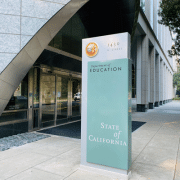
Trump Administration Threatens California Over Transgender Athlete Protections, Citing Title IX Violations

The Trump administration issued a warning to California on Wednesday, accusing the state’s education department of breaching federal law by permitting transgender girls to compete on girls’ sports teams. The U.S. Department of Education has given California ten days to reverse course or face what it calls “imminent enforcement action.”

At the heart of the dispute is Title IX, the federal statute prohibiting sex-based discrimination in educational settings. The Trump administration contends that schools allowing transgender girls to participate in girls’ athletics are infringing upon the rights of cisgender female students.  

The Department of Education pointed to the recent U.S. Supreme Court decision upholding Tennessee’s restrictions on gender-affirming care for minors, including bans on puberty blockers and hormone therapy, as legal grounding for its stance. Officials also referenced comments from California Governor Gavin Newsom, who has expressed public concern about competitive fairness in women’s sports when transgender athletes are involved.

In a sharply worded statement, Secretary of Education Linda McMahon accused California officials of disregarding those concerns and continuing “as recently as a few weeks ago to allow men to steal female athletes’ well-deserved accolades and to subject them to the indignity of unfair and unsafe competitions.”

“The Trump Administration will relentlessly enforce Title IX protections for women and girls, and our findings today make clear that California has failed to adhere to its obligations under federal law. The state must swiftly come into compliance with Title IX or face the consequences that follow.”

Embed from Getty Images

Under the proposed resolution, California would have to inform its schools that transgender athletes should not be allowed on girls’ teams and that all schools must “adopt biology-based definitions of the words ‘male’ and ‘female.'” Additionally, the state would have to inform schools that any divergent interpretations of state law would be considered Title IX violations.

Athletes who have lost awards, titles, or records to transgender competitors would see their honors reinstated. Additionally, the state would be mandated to issue personal apology letters to these athletes.

This is not the first time the Trump administration has taken punitive action under its interpretation of Title IX. A similar determination was made against the state of Maine, where officials attempted to block federal funding intended to support students from underserved communities. The administration has also made moves to withdraw funding from schools that implement diversity and equity initiatives focused on race. However, several of those attempts have been blocked by federal judges.

More than 20 states currently permit transgender student-athletes to join sports teams that correspond to their gender identities. California has protected the rights of transgender athletes since 2014, following legislation signed by then-Governor Jerry Brown.

In response to the latest threat, Izzy Gardon, a spokesperson for Governor Newsom, dismissed the administration’s move with characteristic sarcasm.

Embed from Getty Images

“It wouldn’t be a day ending in ‘Y’ without the Trump administration threatening to defund California. Now, Secretary McMahon is confusing government with her WrestleMania days — dramatic, fake, and completely divorced from reality. This won’t stick.”

California education officials maintain that their approach aligns with existing legal interpretations of Title IX. Earlier this month, the state’s education department issued a statement asserting that inclusive athletic policies promote student well-being.

“Inclusive school athletic programs have been shown to help all students, including transgender students, achieve physical and mental wellness, develop a strong work ethic, values, and sense of belonging, and improve access to academic resources and financial assistance. Conversely, when students are excluded from school sports, they lose the opportunity to enjoy these significant benefits.”

The conservative group Defending Education, which has long criticized diversity, equity, and inclusion efforts in schools, welcomed the Trump administration’s intervention. Erika Sanzi, the organization’s director of outreach, stated, “So many of us have spent years watching in disbelief as leaders in California chose to systematically betray their female athletes, even after Governor Newsom acknowledged publicly how unfair the situation was.”

As the legal and political battle over transgender rights in education continues to intensify, California finds itself once again at the center of a national fight over gender, civil rights, and the boundaries of federal authority.

classroom

Los Angeles School District Hit by Ransomware Attack

A cyberattack targeting the Los Angeles Unified School District caused a significant system outage in the country’s second-largest school district over Labor Day weekend.

The attack disrupted technology used for lessons and attendance and barred students and staff from accessing their emails. Though the attackers used ransomware software for the breach, the school district has yet to receive any monetary demands.

The district confirmed in a statement Monday that the FBI and Department of Homeland Security are assisting local law enforcement in investigating the incident.

“Los Angeles Unified detected unusual activity in its Information Technology systems over the weekend, which after initial review, can be confirmed as an external cyberattack on our Information Technology assets. Since the identification of the incident, which is likely criminal in nature, we continue to assess the situation with law enforcement agencies.”

Authorities believe the attack may have originated internationally and identified three possible countries they have not released to the public.

Ransomware attacks are on the rise in the educational sector. The Los Angeles breach was the 50th cyberattack on educational institutions this year. The migration of school systems to virtual classrooms during the pandemic led to increasingly vulnerable cyberinfrastructures.

Embed from Getty Images

Many schools are underfunded and lack the resources to retain adequate IT staff. Attacks are often planned during holidays when IT security staff is likely to be even sparser. The ideal timeline is often at the beginning of the school year when students return to school, and schools are more likely to pay demands to avoid problems that a catastrophic shutdown could cause.

The hackers did not take any Social Security or medical information and instead targeted systems containing information about private-sector contractor payments. However, the widescale breach points to the continued penetrability of schools’ cyberinfrastructures.

In January, a ransomware extortion attack on the biggest school district in Albuquerque, New Mexico, caused schools to shut down for two days. In May, a data breach in the Chicago Public School system exposed four years’ worth of records of half a million students and 60,000 employees.

One attendance counselor told the LA Times how the shutdown impacted the school’s ability to check on students.

“We do have paper attendance we will be collecting, but I would usually call home or go on home visits to find out students’ whereabouts. Unfortunately, with not having access to their information, I will not be able to find out where those students are. As it is, after the pandemic, we have been working hard to find students.”

Embed from Getty Images

The district implemented a response protocol to avoid immediate widescale impact and to prevent future attacks. The district plans to invest in new IT security technology, hire personnel skilled in technology management, and train employees in cybersecurity responsibility.

Because the attack was detected Saturday, Students could return to class Tuesday morning. Students and teachers had to reset their passwords but could resume their usual schedules.


Young College Student

Biden Administration To Erase Student Debt For 40,000 Borrowers

In an attempt to make good on the promises of federal student debt relief, the Biden Administration — announced by the Department of Education on Tuesday — has made changes to the Public Service Loan Forgiveness Program (PSLF) that would see 40,000 borrowers become eligible to have their debt immediately discharged.

7,000 borrowers with older loans will also see forgiveness under income-driven repayment (IDR) plans. On top of that, 3.6 million more will move closer towards forgiveness by receiving at least three years of additional credit.

Embed from Getty Images

The department, which cited that this move addresses “historic failures” in regards to IDR plans, also aims to take more care of accurately tracking monthly payments for borrowers on IDR, which are typically smaller amounts.

“Student loans were never meant to be a life sentence, but it’s certainly felt that way for borrowers locked out of debt relief they’re eligible for,” U.S. Secretary of Education Miguel Cardona said in a statement. “These actions once again demonstrate the Biden-Harris administration’s commitment to delivering meaningful debt relief and ensuring federal student loan programs are administered fairly and effectively.”

The Biden administration had previously extended the payment pause on student loans  — which was set to end on May 1 — through the end of August. Interest on loans has been paused since the start of the COVID-19 pandemic back in March of 2020.

Since President Joe Biden took office in January 2021, around 725,000 of the 43 million federal student debt borrowers have seen their debt discharged, which totals to over $17 billion in relief. Still, total outstanding student loan debt remains at $1.7 trillion.

IDR plans have had a troubled past. An NPR investigation revealed that the plans — which promise loan forgiveness after 20 to 25 years and manageable monthly payments as low as $0 — had been “badly mismanaged” by the department and loan servicers.

Department documents dating back to 2016 acquired by NPR showed that despite 4.4 million borrowers having repaid for over 20 years, only 32 had their loans canceled under IDR. Meanwhile, some servicers weren’t tracking payments, and didn’t know when borrowers qualified for cancellation unless they were asked by the borrowers to do an intensive records review.

Embed from Getty Images

The department, along with Federal Student Aid (FSA) noted it will address “forbearance steering” by conducting a one-time account adjustment in order to count certain long-term forbearances, which the department considers to be more than 12 consecutive months or 36 cumulative months. Borrowers will then be given credits based on their length of forbearance.

Throughout his election campaign, Biden promised to forgive each borrower $10,000 in loans, which would end up totaling to about $400 billion. However, that claim has yet to flourish, as Biden stated he didn’t have the executive authority to cancel up to $50,000 debt per borrower. White House press secretary Jen Psaki later said the President would be “happy to sign” legislation canceling student debt if Congress passes it.

Along with pausing student debt (and expanding the coverage of the pause) Biden has worked to give relief by targeting smaller groups. One such case includes those who were defrauded by their school, which ended up totaling $2 billion in loan cancellation.