New Dinosaur Species Discovered in Thailand Is Largest Ever Found in Southeast Asia
A gigantic new dinosaur species discovered in Thailand is giving paleontologists a clearer picture of prehistoric life in Southeast Asia and setting a new regional size record in the process.
Scientists have identified the dinosaur as Nagatitan chaiyaphumensis, an enormous long-necked herbivore that roamed the region roughly 100 million to 120 million years ago during the Early Cretaceous period. According to researchers, the dinosaur measured nearly 89 feet long and weighed an estimated 27 metric tons, making it the largest dinosaur ever found in Southeast Asia.
The findings were published Thursday in the journal Scientific Reports by a team from Thailand and the United Kingdom.
The species belonged to the sauropods, a group of massive plant-eating dinosaurs recognized for their towering necks, heavy bodies and pillar-like limbs. Famous members of the group include Brontosaurus and Diplodocus, both among the largest land animals known to have existed.
“One of the many features that we’re kind of excited about is the size of this dinosaur,” lead author Thitiwoot Sethapanichsakul, a paleontologist and Ph.D. student at University College London, told NPR.
While enormous, Sethapanichsakul said the species falls within the “upper middle” range of the largest dinosaurs ever discovered, offering researchers insight into a key moment in sauropod evolution before truly colossal species emerged later in the Cretaceous period.
“It gives us an understanding of the potential kind of evolutionary trends that are beginning to occur” around this time, he said.
Researchers have identified even larger sauropods from later Cretaceous periods, including some estimated to weigh as much as 70 tons.
“In the Middle Cretaceous, we find dinosaurs in China, South America and probably Africa that are super giants. They are the biggest of the biggest. The new discovery essentially represents that kind of on-ramp towards that kind of supersizing.”
One fossil immediately stood out: a humerus, or upper arm bone, measuring nearly six feet long.
“When I first laid eyes on the humerus, it was taller than me, and that was quite surprising,” Sethapanichsakul told CNN. The paleontologist added that fossils of such scale are extremely uncommon in Thailand.
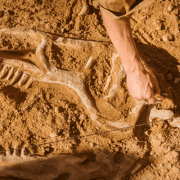
The dinosaur’s remains were first uncovered after a local resident spotted bones near a communal pond in northeastern Thailand during a 2016 drought, when lower water levels exposed the fossils. Excavations continued over several years, with teams conducting fieldwork from 2016 to 2019 before returning in 2024 for additional digs.
Recovered fossils included portions of the spine, ribs, pelvis and limb bones. Scientists later created 3D scans of the remains and determined the animal represented a previously unknown species.
Its name draws from both mythology and geography. “Naga” refers to serpent-like beings in South and Southeast Asian folklore, while “Titan” nods to the gigantic figures of Greek mythology.
“The Nagas are also often associated with water, and considering the dinosaur was found on the side of a communal pond, it just seemed very apt to have a serpent giant be the name.”
The final part of the species name honors Chaiyaphum province, where the fossils were discovered.
For Sethapanichsakul, who is originally from Thailand, the discovery also carried personal significance.
“It fulfills a kind of childhood promise. That, yeah, I’m going to name a dinosaur one day. And I want it to be from Thailand.”
Researchers believe Nagatitan chaiyaphumensis lived in a hot, relatively arid landscape crisscrossed by river systems. The environment would have supported a wide variety of ancient wildlife, including crocodiles, turtles, freshwater sharks and fish.
The dinosaur also likely shared its habitat with smaller herbivorous dinosaurs related to Iguanodon as well as “a kind of very early form of what we would call Ceratopsians, cousins of Triceratops,” Sethapanichsakul said.
He added that Thailand may hold one of the richest dinosaur fossil records in Asia because of its extensive layers of exposed Mesozoic Era sedimentary rock, dating to around 252 million to 66 million years ago.
“These rocks are exposed to less rain and vegetation, which could end up eroding or destroying those bones,” he said.
The discovery site now hosts a research center dedicated to further paleontological work, and scientists continue to study sauropods across Southeast Asia.
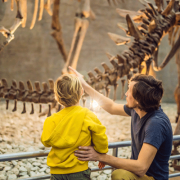
A life-sized reconstruction of the dinosaur is currently displayed at the Thainosaur Museum in Bangkok.

Moumita Basuroychowdhury is a Contributing Reporter at The National Digest. After earning an economics degree at Cornell University, she moved to NYC to pursue her MFA in creative writing. She enjoys reporting on science, business and culture news. You can reach her at moumita.b@thenationaldigest.com.