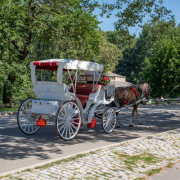
NYC Mayor Supports Bill To Ban Central Park Horse Carriages
New York City Mayor Eric Adams recently announced his support of a proposal to end the horse-drawn carriage rides in Central Park, a fixture that’s been around for over 150 years. Adams has now ordered police to become more strict when it comes to enforcing laws that are already in place to dial back the industry.
There has been an influx in recent years with horses collapsing and dying, or breaking free from their drivers and running loose throughout the park.
“While horse-drawn carriages have long been an iconic fixture of Central Park, they are increasingly incompatible with the conditions of a modern, heavily-used urban green space,” Adams said in a statement.
“It has become abundantly clear that these horse-drawn carriages no longer work for our city.”
AP reports that Adams sent the City Council a “letter of necessity” which gives the lawmakers the authority to expedite the bill’s passage, which would phase out horse-drawn carriages.
Additionally, Adams issued an executive order which orders police to “prioritize enforcement” against horse-drawn carriages that are operating outside of their legally designated areas which illegally solicit fares or impede on traffic.
The mayor’s order also directs city agencies to emphasize new employment opportunities for industry workers and create a process for voluntary return of carriage licenses, AP reported.
“This is not about eliminating this tradition — it’s about honoring our traditions in a way that aligns with who we are today. New Yorkers care deeply about animals, about fairness, and about doing what’s right,” Adams said.
President of the Transport Workers Union of America, John Samuelsen, which represents horse carriage workers, said that the recent announcement was a “desperation act” made by Adams.
“He’s betrayed the blue collar New Yorkers who were relying on him to stand up for their jobs against the real estate developers who want to kill the industry solely to develop those stables into skyscrapers. He should be ashamed of himself,” Samuelsen said.
“The Council appreciates that this is a difficult and emotional issue for many New Yorkers, which has persisted for decades,” Adams’ office said in a statement.
“This bill continues to go through the legislative process, which is deliberative and allows for thorough input from all stakeholders.”
Edita Birnkrant, executive director of New Yorkers for Clean, Livable, and Safe Streets (NYCLASS) praised the announcement from the mayor’s office in the name of animal rights.
“This is a life-saving step for both people and horses, and it makes clear what we and so many New Yorkers have long said: horse-drawn carriages have no place in our city any longer.”
The Central Park Conservancy is a nonprofit that manages the park and is very influential. The group also said it was backing up the calls for a ban over safety concerns.

Eric Mastrota is a Contributing Editor at The National Digest based in New York. A graduate of SUNY New Paltz, he reports on world news, culture, and lifestyle. You can reach him at eric.mastrota@thenationaldigest.com.