Posts

bread

Terry Crews On His Love Of Travel, And The One Dish He’d Fly Across The Ocean For 

Terry Crews is an actor, host, sports enthusiast, and lover of learning about new cultures and cuisines. His long and illustrious career has given him the opportunity to see the world and experience the wonders of travel. Now, he’s revealing some of his favorite destinations, and the one dish he would fly across the ocean for.

candy

FDA To Phase Out Artificial Food Dyes In US Food Supply By The End Of The Year 

The US Food and Drug Administration announced this week that they’re planning on phasing out the use of petroleum-based synthetic dyes in food due to ongoing health concerns.

Mishka Soho: Elevating Traditional Eastern European Cuisine in NYC | Marina Genel

New York City, the culinary capital of the world, is home to a staggering array of restaurants that reflect its unparalleled diversity. Among the crowded landscape of upscale dining, where fusion menus and trendy concepts often dominate, finding authentic Eastern European cuisine is a rarity. Enter Marina Genel, the owner and visionary behind Mishka Soho, a hidden gem in the heart of Manhattan. Combining a passion for tradition with an innovative approach to dining, Marina has created a space that’s as warm and welcoming as the dishes she serves.

ice cream

Taiwan Is Now Home To The Only Michelin-Star Ice Cream Shop In The World 

Taiwan has always been known for its fine dining establishments. In the 2024 Michelin Guide, the island had ten establishments gain stars, bringing their total number of establishments with stars to 49.

In the city of Taichung, Minimal has become the world’s first and only ice cream establishment to receive a Michelin star. The restaurant is two stories and has both a takeaway outlet and a dine-in section that offers a seven-course tasting menu. 

Embed from Getty Images

“Focusing on ice and ice cream, the restaurant skillfully layers flavors and textures through temperature variations and creative combinations, using unique local ingredients from Taiwan,” says the Michelin Guide’s write-up of Minimal.

“The meticulous flavors, delicacy and mature, skilful techniques all impressed us and reached a higher level, warranting a Michelin star.”

Arvin Wan, the founder of Minimal, stated that he’s been obsessed with ice cream since he was a kid. 

“My family had a double-door refrigerator with an installed ice-maker. I’d eat ice cubes every day.”

“I grew up in a single-parent household, after graduating from culinary school, I worked as a chef when my mother was battling cancer. The two shifts in the kitchen meant very long working hours. Every morning, I could see my mother for a short while before heading to work, and she was already asleep by the time I got home,” Wan said. 

“Before her passing, I didn’t spend much time with her. (After that) I reflected a lot — if I continued on my current path, I wouldn’t have time for people I cherish in the future.”

“Desserts often aren’t the most important part of a meal in a restaurant,” he says. 

“They’re more like a finish, a supporting act. I really only love ice. I don’t feel the same way about other desserts. So I just wanted to make ice but that isn’t possible from a restaurant’s perspective — you can’t just serve ice as dessert all year.”

Embed from Getty Images

Minimal first opened in 2021. Wan explained that the name was a reference to the amount of elements within ice cream. “Minimalist design may look very simple, but it’s extremely complex if you understand it,” says Wan.

“Similar to ice cream, it goes through a very complex calculation and planning process to obtain such a state and taste.”

On the ground floor, Minimal offers takeaway ice cream from six different flavors that are regularly updated. The second floor opens up to a 20-seater restaurant that serves a seven-course set menu that serves food at mainly sub-zero temperatures. 

Wan stated that he experiments with his menu ideas at various temperatures with the help of Minimal’s kitchen system, which is made up of many fridges at different settings. He ensures that everything not only tastes good, but smells good as well.  

“Most ice doesn’t have a lot of aroma because fragrance is very inactive below zero,” he says.

“To overcome that, I have to complement it with some other ingredients to create a more complex nose and taste that reminds you of the theme of the dessert.”

“When we were young, most of us loved eating iced desserts. As we grow older, the prospect of eating ice is much less exhilarating – the ice itself hasn’t changed, but the feeling towards it has changed — it’s no longer new and special,” he says.

“I hope that with Minimal, grown-ups can rediscover the joy of eating ice again – as if it was their first ice cream experience.”

processed

Latin American Countries Label Ultra-Processed Foods, Inspiring Others 

Latin America is currently leading the world in a nutritional initiative that puts warning labels on the fronts of ultra-processed food packages. The labels specifically warn consumers if a certain product contains more than the daily recommended value of certain nutrients; mainly salt, sugar, and saturated fats. Some countries have also placed warnings for excessive artificial sweeteners, caffeine, and trans fats. 

Latin America is responsible for some of the most efficient global research into the health impacts of ultra-processed foods. These foods often contain high levels of fats, starches, sugars, and additives like colorings and preservatives. Latin America initially began labeling and researching these additives in the early 2000s, according to reports from The Guardian.

Embed from Getty Images

Research has shown that many Latin Americans get up to 20% to 30% of their daily caloric intake from ultra-processed foods. In the US, the average is as high as 60%. 

The idea for labeling these products was first brought up in the early 2010s at the Pan American Health Organization, a regional office for the World Health Organization. One of the goals of these labels is to combat the rising rates of disease in the region. 

“The initial proposals for front-of-pack labeling emerged because the information for consumers based on the nutrition facts table was completely insufficient for consumers to have a quick and easy understanding”, said Fabio Da Silva Gomes, the regional adviser on nutrition and physical activity for the Americas at the PAHO.

In 2010, Mexico became the first nation in the region to move their “daily guidance amounts” nutritional label to the front of food packaging. In 2014, Ecuador began adding a label that looked like a traffic light to their packaging. Each color of the traffic light (red, yellow, and green) represent a level of different nutrients in the food itself. The same kind of label is also used in parts of Europe. 

Chile also changed how seriously Latin American nations took labeling these foods in 2014/2016. In 2014, they implemented a tax on sugary drinks and began seriously studying proper package labeling. 

Embed from Getty Images

In 2016, they began adding a black, stop-sign shaped label to their ultra-processed foods, after finding that the traffic-light labels were too colorful for consumers to really take in what it was portraying. The Guardian also reported that Chile banned the sale and promotion of products with these warning labels in schools to reduce harmful marketing to children. 

Chile’s warning label implementation quickly spread throughout Latin America. Peru, Uruguay, Mexico, Argentina, and Colombia now all mandate warning labels be placed on ultra-processed foods, and Venezuela is planning to join in December. 

Some of them have even taken it a step further by adding the labels to more food groups that include high levels of artificial sweeteners and caffeine. 

“The evidence suggests that right now in Argentina, in Mexico, in Colombia, with the warning labels that we have applied with nutrient profile models, we can with very good confidence state that these countries are regulating at least 97, 98% of ultra-processed foods,” Gomes stated.

“Although the science around the various components of ultra-processed foods is still emerging, the components still warrant labels because their purpose is simply to make unhealthy foods more appealing. Think of tobacco legislation, we do not necessarily need evidence on the harms of cosmetic additives to regulate them because they are used only for the purpose of stimulating the consumption of products that are harmful,” Gomes says.

sea otter

Sea Otters Use Tools To Combat Food Competition Amid Climate Change, According To Study 

In certain parts of the ocean, sea otters are facing major competition for food, partially due to climate change limiting food supplies. However, they’ve adapted by utilizing “tools” such as rocks or even glass bottles to open tougher prey, like clams, giving them an opportunity to maintain their diet. 

These observations were recently published as a part of a new study published in the journal Science. The study analyzed sea otters in Monterey Bay, California, and was specifically looking at how individual otters used various tools they found, and how utilizing them impacted their health and nutrition. 

The findings also concluded that this skill set could increase sea otters chances of survival in ocean environments that are constantly changing as a result of climate change. 

Embed from Getty Images

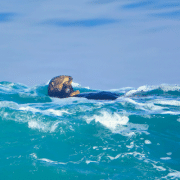
Sea otters often spend their days foraging for food in kelp forests by diving to the bottom of a body of water to grab morsels of food and rocks that they can use as tools. The study stated that they then bring their food and rocks to the surface of the water, float on their backs, and use their stomach as a table to open and eat their snacks. 

“Their preferred prey are usually urchins and abalone,” says Chris Law, a biologist at the University of Texas and the University of Washington involved in the study. 

Law stated that urchins and abalones are a part of sea otters diets and are typically easy for them to break apart and open. 

“Unfortunately, all those prey items have been declining or have declined,” especially in highly populated areas like Monterey Bay, says Law.

A big part of a sea urchin’s diet is kelp, and they can consume a lot at a relatively quick rate. When large groups of urchins go through a kelp forest, they can completely decimate it, which can in turn make the urchins “calorie-poor” with little nutritional value for the otters that consume them. 

“So that means otters have to eat alternative foods. A lot of those alternative foods are those super-hard-shell prey items that really require some kind of external force to break into,” said Law. 

Law added that “snails are abundant in the bay, but they’re low-calorie and basically like a rock that you have to break into to eat the insides.”

Law and his colleagues looked at data from 196 otters in Monterey Bay. They tagged the otters, and volunteers involved in the study monitored the marine mammals closely to see what they were eating, how large and tough their prey is, and if the otter utilized a tool to eat it. 

Embed from Getty Images

According to the report, otters who used tools were able to eat larger prey. Female otters’ use of tools is important for their overall nutrition because they’re smaller than males and don’t have the ability to bite down as hard.  

“They [female otters] typically wouldn’t be able to break into harder prey. But they use tools more than males, so they’re able to gain access to these novel sources of food items,” said Law. 

The use of tools also work to protect otters’ dental health. The otters monitored in the study received dental assessments as well, and the researchers found that those who used tools had less damage to their teeth than those who didn’t use tools, because they just bite down on the hard shells to break them open. 

“Without their teeth, they clearly can’t eat anything. So then they die. What we’re suggesting is that this behavior really allowed them to continue living on despite not having their preferred prey.”

“This is such an important paper,” says Rob Shumaker, president and CEO of the Indianapolis Zoo and one of the authors of a book called Animal Tool Behavior.

According to NPR, he said “scientists have spent decades documenting tool use in dozens of species; tool use in sea otters, for example, has been recognized since the 1960s. But now, studies like this one are showing that this field of research is starting to shift.”

“It’s not about describing the actual tool use or tool manufacture anymore. It’s describing the impact that it has on that animal’s life.”

Tiffany Pisoni

A Journey From Humble Beginnings to Multi-Venture Success in San Francisco’s Hospitality Scene | Tiffany Pisoni

In the heart of San Francisco’s vibrant culinary scene, where tastes, trends, and traditions converge, a remarkable individual has carved an extraordinary path to success. With a determination fueled by passion, creativity, and an unwavering commitment to her dreams, Tiffany Pisoni has risen from humble beginnings to owning two thriving restaurants, a flourishing catering business, and a successful dishware company. Her journey is a testament to the power of hard work, resilience, and an unyielding love for hospitality.

Lecia Duke Quintessential Chocolates

How a Former Architect Chased Her Dreams and Became a Trailblazing Chocolatier | Lecia Duke

Adults and kids alike have a sweet tooth for chocolate, making it the most popular candy in the world. It tastes fantastic, lifts spirits, and is steeped in centuries of tradition. Chocolatier Lecia Duke overcame obstacles to bring innovative chocolates to the American market. Her company, Quintessential Chocolates, offers handcrafted liqueur praliné chocolates.

Celebrity Chef José Andrés’ World Central Kitchen Destroyed By Russian Missile In Ukraine

The World Central Kitchen location providing aid in Ukraine was destroyed by Russian missiles, which hit central Kharkiv, killing two people and injuring 18, many of which were workers for the non-profit.

Dental Care

The Best Foods For Your Dental Health

One of the only silver linings of the Covid-19 pandemic is that more people are putting an intense focus on their personal health and hygiene. According to the nation’s dentists, more and more people are visiting their oral healthcare providers and asking specific questions as to ways they can best protect their teeth and oral health in general. The basic rules still apply, brush twice a day, floss regularly, and using fluoride-based products is always good for promoting enamel health. 

Many individuals have also used quarantine as an excuse to expand their cooking ability and dietary knowledge. So what foods should you be looking out for that are not only healthy for you, but your oral health/hygiene as well? 

Embed from Getty Images

Leafy Green Vegetables: Leafy greens are self explanatory in terms of what they are. Things like romaine lettuce, kale, parsley, etc. all provide your body with prebiotics. Healthy oral bacteria that already live in our mouths feed on these prebiotics and are thus better able to protect our teeth. 

Citrus Fruits: Oranges, grapefruits, lemons, and all other citrus fruits have a complex relationship with oral hygiene. The acidity of citrus fruits is bad for our enamel/can weaken our teeth, however, as long as you’re eating these products in moderation, they all can actually help benefit your oral health. Oranges and grapefruits, for example, are full of Vitamin C which directly helps strengthen the blood vessels in your mouth. This can reduce gum inflammation while also reducing your risk of gum disease. 

Fatty Fish: Fish is one of the more unexpected items on this list, however, fatty and oily fish are rich in Vitamin D and omega-3 fatty acids. Both of these things also work to support gum health, and omega-3 specifically works to reduce sensitivity in our gums which can cause bleeding while we brush or floss. 

Embed from Getty Images

Milk: Milk along with most other dairy products, such as cheese or butter, may not be the best for our bodies health in general in excess, however, dairy products contain Vitamin K2, which is a nutrient that specifically strengthens your teeth. 

Green or Black Tea: Both of these types of tea in their plain form contain polyphenols. Polyphenols are important if you’re someone who has/does suffer from plaque, as they work to hold back the bacteria that builds plaque from spreading while also destroying it. Polyphenols will also combat any acidity that’s present within your mouth, and depending on what water you use to make the tea, it also can be a great source of fluoride. 

You want to focus on finding foods that are rich in calcium, Vitamin D, and magnesium specifically, as all three of these elements are not only building blocks to our teeth, but continuously help them get stronger and healthier. 

While all of these products are general enough to implement into our everyday meals, it’s important to remember the foods that can also reverse all the strengthening effects these food products have. Obviously processed foods and sugary candies/beverages are not great for our teeth. Sugar in general erodes the tooth’s surface and can lead to cavities, gingivitis, and all sorts of other dental issues. 

Continue to practice proper oral hygiene while eating these foods and your next trip to the dentist will surely be a quick one.