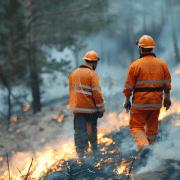
US Struggling With Peak Wildfire Season Due To Major Firefighter Shortage
Extreme climate conditions are fueling dozens of wildfires across the US, and the nation is struggling to respond. Internal data shows that more than 25% of firefighting positions within the United States Forest Service (USFS) are vacant.
The data was reviewed by news agency the Guardian, and it juxtaposes comments from the chief of the USFS, Tom Schultz, who has told lawmakers, and the public, that the agency is fully prepared to handle the ongoing fire activity that the US has been experiencing.
“In terms of firefighting capacity we are there,” he said this month, stating that the USFS hit 99% of hiring goals.
This year, the US has already experienced more than 41,000 wildfires, which is about 31% higher than the 10-year average.
Staffing reports from this month show that over 5,100 positions were left unfilled, which is more than 26%. The Pacific northwest is especially vulnerable due to their high fire risk, and reports suggest that they have a 39% vacancy rate. The Intermountain region of the US, which stretches across parts of Utah, Nevada, Wyoming, Idaho, and California, and stretches across 34 million acres of forest, has a 37% vacancy.
Six federal firefighters, who remained anonymous to protect their positions and are barred from speaking publicly, spoke with the Guardian regarding how difficult it’s been for them to put out larger fires and the increase in injuries that have occurred due to the shortage of firefighters.
“There is definitely a lot of tension in the system this season. It’s sort of like that medieval torture device that stretched people – just one more crank,” said a fire captain.
A squad leader who was aware of the data said that “the agency saying it’s fully staffed is dangerous. Maxing out 19-year-olds with no qualifications isn’t the best strategy.”
“We can’t send [a crew] without supervision because it is unsafe – if they don’t have a qualified supervisor that engine is parked,” said retired firefighter Bobbie Scopa, who was in the service for 45 years.
These vacancies are causing firefighters to experience higher levels of fatigue as they combat extreme weather conditions with little chance to rest and recover.
“Folks are having to fill in and fill holes, and they are going out without all the positions they need for a team.”
Another anonymous firefighter said that he could see the agency using hiring numbers that only show whether or not an offer was accepted, and not that hiring created a vacancy in a different area.
“If people that are already permanent take a different job it still counts as a hiring action, but if the place they leave doesn’t get backfilled, it just means they moved someone, not that they added someone,” he stated.
Another firefighter said the USFS could potentially be exploiting the difference between “minimum” staffing requirements and what would be considered “fully staffed.”
“You can technically play a football game with 11 people on the team. It would be considered negligent, maybe even abusive to the players, but they signed up to play and it’s technically allowed,” he said.
In general, the Forest Service has been struggling to recruit and hire qualified firefighters due to escalating and increased hazards on the job with little pay. Those who have been in the field are also exhausted, and this is one of the worst times in history for a lack of emergency responders and firefighters due to the increase in disastrous weather conditions and events within the last decade.
Between 2021 and 2024, it’s been reported that the USFS has lost about half of their permanent employees.
The Trump administration has also exacerbated this issue as they continue to cut budgets and support staff positions within these departments. Both firefighters and forest experts have expressed their major concerns over the large cuts being made and the removal of incentives for employees.
As a means of shrinking the federal government, the administration offered and had 4,800 USFS workers sign on to a program that offered administrative leave through September of this year if they opted to resign/retire.
While firefighters themselves were exempt from this program, the new gaps in the workforce that supports wildfire planning and mitigation has had a major impact.
The Department of Agriculture has tried to combat this lack of employees with fire qualifications by urging those who took the deal from the Trump administration to voluntarily return for the season and/or until their contracts end.
“We depend on those people to help run the large fires. Teams are not fully functional right now because we have lost so many people,” Scopa stated.
Firefighters have been reporting on the impact of these major cuts, stating a loss of power for weeks due to maintenance cuts, paychecks being late or cut down, and firefighters having to take on other jobs in addition to combatting wildfires.
“I am hearing from firefighters who aren’t getting meals because they are having problems with the contracts for the caterers because we laid off people who worked in contracting. There was no efficiency in this – they just slashed it with an ax.”
Schultz told lawmakers that the Trump administration’s plans to get rid of multiple programs in the agency with “significant funding reductions in programs that remain,” with responsibility now being placed on the states, along with private landowners to fund emergency preparedness, management, and response, the Guardian reported.
Ron Wyden, the senator of Oregon, told Shultz during the committee meeting that “these infernos are not your grandfather’s fires – they are bigger and they are hotter. We need to address this critical preparedness gap.”
The Climate Prediction Center and Predictive Services have forecasted that this fire season is far from over or slowing down, as higher than average temperatures are expected to last throughout the US until October. Extremely dry conditions are also creating a much larger risk for severe wildfires.
“We have reached a critical point in our national response efforts and we must make every resource available,” Schultz said.
“At times like this we know the demand for resources outpaces their availability.”

Eric Mastrota is a Contributing Editor at The National Digest based in New York. A graduate of SUNY New Paltz, he reports on world news, culture, and lifestyle. You can reach him at eric.mastrota@thenationaldigest.com.