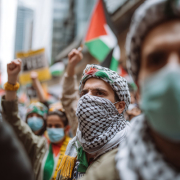
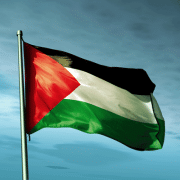
A wave of protests swept through Palestinian territories on Tuesday after Israel approved a new law introducing the death penalty for certain convictions, prompting outrage from officials, activists and residents.
The legislation, passed Monday in Israel’s parliament, establishes execution by hanging as the standard punishment for Palestinians convicted of killing Israelis. It defines such crimes as those carried out “with the intent to deny the existence of the State of Israel,” a formulation that critics say effectively targets Palestinians while excluding most Israeli offenders.
It is set to take effect within 30 days, though court challenges could delay implementation. The law will not apply retroactively to current prisoners.
Its passage marks a sharp shift in Israeli policy, one that has drawn condemnation from Palestinian leaders and human rights groups and sparked demonstrations across the West Bank and Gaza. Several countries, including Australia, Germany, France, Italy and the United Kingdom, warned in a joint statement of the law’s “de facto discriminatory character,” while Spain’s prime minister described it as “another step toward apartheid.”
“The death penalty is an inhumane and degrading form of punishment without any deterring effect. This is why we oppose the death penalty, whatever the circumstances around the world. The rejection of the death penalty is a fundamental value that unites us. We urge the Israeli decision makers in Knesset and Government to abandon these plans.”
In the Israeli-occupied West Bank, where the law carries its broadest impact, military courts that try Palestinians will now be required to impose the death penalty as the default sentence in such cases, unless special circumstances are found. Those courts, which almost exclusively prosecute Palestinians, have a conviction rate of about 96%, according to the Israeli human rights group B’Tselem.
The legislation also lowers the threshold for imposing capital punishment, requiring only a simple majority of judges rather than a unanimous decision, and mandates that executions be carried out within 90 days without the possibility of pardons or commutations.
The move quickly ignited protests. In cities like Nablus, crowds gathered for marches and sit-ins, many carrying signs warning of the consequences of the law.
“Time is running out, and silence is deadly,” read one sign displayed in the city, depicting a prisoner wearing a Palestinian keffiyeh beside a noose. “Stop the law to execute prisoners, before it’s too late.”
Embed from Getty Images
Demonstrators also voiced support for Palestinians already held in Israeli prisons, long seen by many as symbols of resistance.
“You are the symbol of struggle, You are the symbol of steadfastness,” protesters chanted, raising photos of detained relatives and public figures.
Political groups joined the response. The Fatah party called for a general strike across parts of the northern West Bank beginning Wednesday.
In Gaza, dozens of people gathered outside the Red Cross headquarters. Women in hijabs held large framed images of well-known prisoners, including Marwan Barghouti, underscoring the emotional and political weight of the issue.
Palestinian officials condemned the law as a violation of international legal standards and urged foreign governments to act. The Palestinian Foreign Ministry called for sanctions against Israel’s parliament and demanded its suspension from international institutions.
“The law represents a critical turning point in the formalization of extrajudicial killings under a legal guise,” the ministry said, adding that it “stresses that this law, in its essence, constitutes an institutionalized policy of field executions based on discriminatory and racist standards.”
Amnesty International also raised alarms, saying that enforcing the death penalty under the measure could breach international protections, including the right to life and bans on torture and cruel or degrading punishment.
U.N. High Commissioner for Human Rights Volker Türk called the measure a “particularly egregious violation of international law” and warned that applying it in occupied territories would constitute a war crime.
“The death penalty is profoundly difficult to reconcile with human dignity, and it raises the unacceptable risk of executing innocent people,” said the High Commissioner.
“It is deeply disappointing that this bill has been approved by the Knesset. It is patently inconsistent with Israel’s international law obligations, including in relation to the right to life. It raises serious concerns about due process violations, is deeply discriminatory, and must be promptly repealed.”
The law’s passage follows years of advocacy from Israel’s far-right political figures seeking harsher penalties for Palestinians involved in attacks on Israelis. National Security Minister Itamar Ben-Gvir, who led the effort, praised the measure as overdue and framed it as a demonstration of national strength. After the vote, he celebrated by opening a bottle of champagne.
Embed from Getty Images
At the same time, some supporters emphasized its deterrent intent. “The idea is to not allow them to continue to think that by taking hostages they’re going to get a get-out-of-jail-free card because there’s no death penalty,” said Caroline Glick, an adviser to Prime Minister Benjamin Netanyahu.
Others backed the law on personal grounds. “I wish it had been in place earlier, and I’m glad it’s in place now,” said Micah Avni, whose father was killed in an attack and whose assailant was later released in a prisoner exchange. “That terrorist who murdered my father showed absolutely no remorse.”
Mustafa Barghouti, a Palestinian political leader, argues the measure will have the opposite effect.
“This sends another message to Palestinians that there is no place for compromise. This will not deter Palestinians, but it will enhance their struggle for freedom from this oppressive system.”
Advocacy groups also warned of broader implications. “It’s just going to be another tool in the Israeli toolkit to kill Palestinians,” said Shai Parnes of B’Tselem.
The legislation also extends to Israeli civilian courts, granting them authority to impose the death penalty on citizens convicted of what is defined as nationalistic murder. However, legal analysts say the wording effectively limits its application to Palestinian citizens of Israel, excluding Jewish citizens.
Although capital punishment remains technically legal in Israel for crimes such as treason and crimes against humanity, it has been used only twice in the country’s history, most notably in the 1962 execution of Nazi official Adolf Eichmann.
Opposition lawmakers and Israeli rights organizations have already announced plans to challenge the law before the Supreme Court, arguing it should be struck down. As legal battles loom, tensions on the ground continue to rise, with protests expected to persist in the coming days.
Moumita Basuroychowdhury is a Contributing Reporter at The National Digest. After earning an economics degree at Cornell University, she moved to NYC to pursue her MFA in creative writing. She enjoys reporting on science, business and culture news. You can reach her at moumita.b@thenationaldigest.com.