Posts

stairs

Taking the Stairs May Lower Your Risk of Heart Disease and Early Death

Choosing the stairs instead of the elevator may be one of the simplest ways to work more heart-healthy movement into your day, according to new research from the University of East Anglia and the Norfolk and Norwich University Hospital.

night owl

Being A ‘Night Person’ Could Be Bad For Your Heart

If you consider yourself more of a night owl, you may want to ensure you’re taking good care of your heart health. A large study has recently found that people who are more active late at night have poorer overall heart health when compared to the average person who goes to bed at a reasonable hour/gets the recommended amount of sleep every night. 

However, this doesn’t necessarily mean that those who tend to stay up late should be immediately frightened. Research fellow Sina Kianersi of Brigham and Women’s Hospital and Harvard Medical School, who led the study, said that “it’s not like night owls are doomed.” 

Embed from Getty Images

“The challenge is the mismatch between your internal clock and typical daily schedules that make it harder to follow heart-healthy behaviors.”

Kianersi actually considers himself to be “sort of a night owl,” according to AP, and described how he feels a “boost in [his] analytical thinking” after about 7 or 8 at night. 

Heart health is extremely important, and heart disease alone is the leading cause of death in the US. The American Heart Association has a list of eight key factors that every individual should adopt for having and maintaining a healthy heart. These factors include getting enough sleep and having a healthy diet. 

When it comes to individuals who are considered night owls specifically, the impact on the heart has more so to do with the internal body’s circadian rhythm, “our master biological clock.”

That clock follows a roughly 24-hour schedule that regulates when we’re sleepy, and also wide awake, while keeping our organ systems in sync. This regulation impacts our heart rate, blood pressure, stress hormones, and metabolism. 

“Everybody’s circadian rhythm is a little different. Prior research had suggested night owls might have more health problems, as well as risk factors like higher rates of smoking and less physical activity than people with more typical bedtimes,” Kianersi said to AP

Kianersi’s team tracked over 300,000 middle-age and older adults in the UK Biobank, which is a large health database that includes information regarding individual’s sleep-wake preferences. 

Embed from Getty Images

They found that around 8% of those people classified themselves as night owls, specifically meaning they’re more active both physically and mentally in the late afternoon or evening and are up past most people’s bedtime. Around 25% were early-birds and were more productive in the daylight hours and went to bed earlier. 

Over the course of 14 years, the night owls had a 16% higher risk of a first heart attack or stroke compared to the average population, the team found. 

The researchers reported their findings this week in the Journal of the American Heart Association. The report cited that especially in women night owls, there is an overall worse cardiovascular health based on meeting the heart association’s eight key factors. 

“It comes down to the problem of a night owl trying to live in a morning person’s world. They’re getting up early for work because that’s when their job starts but it may not align with their internal rhythm,” said Kristen Knutson of Northwestern University.

Knutson also stated that this impacts more than just sleep. One’s metabolism fluctuates throughout the day as the body produces insulin to turn food into energy, meaning it may be harder for a night owl to handle a high-calorie breakfast eaten earlier in the day. 

Kianersi said that even if you can’t get the ideal of at least seven hours of sleep a night, sticking to a regular bedtime and wake up time can help your body. 

“Focus on the basics, not perfection.” 

running

To Lower Heart Disease Risk, Men Need Twice As Much Exercise As Women

According to new research published in Nature Cardiovascular Research, in order to reduce the risk of coronary heart disease, men need twice as much the amount of exercise as women. The scientists who were a part of the study said that healthy living guidelines need to take more of an account of the biological differences in the sexes to truly help everyone reduce the risk of developing heart disease, or other diseases for that matter. 

Embed from Getty Images

Scientists in the study looked at physical activity records from over 80,000 people, according to reports. They found that the risk of heart disease decreased 30% in women who got up to 250 minutes of exercise every week, while men needed to hit 530 minutes (about nine hours) to have the same effect. 

The study also cited previous research which suggested that women benefit more than men from the same level and amount of exercise, however, it also showed that women are, in general, less physically active and less likely to meet the recommended targets. 

NHS guidelines state that men and women from ages 16 to 64 should do at least 150 minutes of moderate exercise, or 75 minutes of vigorous exercise per week, and also perform muscle-strengthening activities at least twice a week. 

“Compared with male individuals, females derive equivalent health benefits with only half the exercise time. The findings might have potential to encourage females to engage in physical activity,” the authors wrote

Utilizing the UK Biobank project, Dr. Jiajin Chen at Xiamen University in China and his team analyzed data from activity trackers worn by middle-aged volunteers. 

They initially reviewed data from 80,243 participants who did not have coronary heart disease. Within that group, women who did 150-minutes of exercise a week had a 22% lower risk of developing heart disease over eight years of following up when compared to those who did not reach that target. For men, the risk was 17% lower. 

The team revealed that it also showed that women could reduce their heart disease risk by 30% through exercising for 250 minutes a week. Men only achieved this rate by reaching 530 minutes of physical activity weekly. 

Embed from Getty Images

The study also showed that of more than 5,000 men and women who already had coronary heart disease, the risk of dying was three times lower for women who met the weekly exercise target than for active men. 

Professor Yan Wang, a senior author on the paper, said “the work showed both sexes could gain substantial cardiovascular benefit from physical activity.” In general, it’s recommended that everyone gets regular exercise to maintain a healthy lifestyle and reduce the chances of experiencing health ailments and disease. 

“We particularly hope that our findings could encourage physically inactive females to become more active, thereby reducing their cardiovascular risk,” he said.

While the data showed a pattern, there is no conclusive evidence as to why exercise benefits women more than men in these findings. They hypothesized that it could be due to differences in hormone balances, muscle fibers, or digestion. 

In an accompanying article, Dr Emily Lau, a women’s cardiovascular health specialist at Massachusetts General hospital, stated

“This study provides further evidence that one size really does not fit all and challenges us to move from conversation to action. It is time to embed sex-specific strategies into guidelines and to develop tailored interventions to optimize cardiovascular health for women.”

heart

‘Gamechanger’ New Findings On Treating Heart Conditions Presented In Europe 

The 2025 annual meeting at the European Society of Cardiology had doctors, scientists, and researchers presenting new findings on ways to tackle heart conditions, many of which are being considered major “gamechangers.”

healthy

Crucial Lifestyle Choices Can Reduce Chronic Disease And Extend Your Life, New Study States

A new study recently reviewed crucial data regarding Life’s Simple 7 guidelines from the American Heart Association. Those 7 factors are said to greatly improve cardiovascular health and extend your life, even if you have genetic factors playing a part.

wegovy

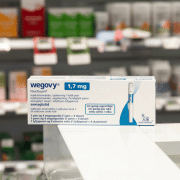
US FDA Approves Weight-Loss Drug Wegovy To Be Marketed For Heart Health Benefits 

The US Food and Drug Administration (FDA) approved an application from drugmaker Novo Nordisk that allows the weight loss drug Wegovy to add cardiovascular benefits to the medicine’s label, according to CNN

This marks the first weight-loss drug to be marketed to reduce the risk of heart attack, stroke, or heart-related deaths in people who are at higher risk for cardiovascular issues and/or events. 

The addition to the label may improve some insurance coverage for Wegovy; the “sister drug” to Ozempic. The drug currently costs around $1,300 per month out of pocket, and many insurers don’t cover weight loss drugs. 

Embed from Getty Images

“The evidence is that they reduce risk and save lives – and so it is indefensible to deny people access, or make it difficult for people to access, medications that will directly improve their health,” Dr. Harlan Krumholz, a cardiologist and scientist at Yale University and Yale New Haven Hospital, said Friday

“The point is that these drugs are not about appearance but about health. By treating obesity, we know we can reduce cardiovascular risk, and that may be only a part of the benefits that accrue.”

The approval occurred after a study involving 17,000 patients. The study, according to reports, showed that the patients who took Wegovy had a 20% lower risk of having a cardiac event than those who took the placebo. 

Wegovy is meant to be used for individuals who are considered to be obese or overweight, meaning they have a body mass index of anything between 27 – 30, as well as have a weight-related health condition such as high blood pressure or high cholesterol. 

“Wegovy is now the first weight loss medication to also be approved to help prevent life-threatening cardiovascular events in adults with cardiovascular disease and either obesity or overweight,” Dr. John Sharretts, the FDA’s director of the Division of Diabetes, Lipid Disorders, and Obesity, said in a news release.

Embed from Getty Images

“This patient population has a higher risk of cardiovascular death, heart attack and stroke. Providing a treatment option that is proven to lower this cardiovascular risk is a major advance for public health.”

The trial performed prior to this classification was done with patients with cardiovascular disease. They’ve either previously had a heart attack, stroke, or symptoms of peripheral artery disease: which is when one has clogged arteries in their arms or legs. 

Wegovy, however, has and is in a shortage currently, and drugmakers are struggling to keep up with the demand. Novo Nordisk released a statement last month that stated it would be gradually increasing the supply over this course of this year.

“The shortages are really, really bad right now,” Dr. Jody Dushay, an endocrinologist at Beth Israel Deaconess Medical Center and an assistant professor of medicine at Harvard Medical School, said Friday. 

“[I hoped] the expanded approval would improve insurance coverage, particularly as generic weight-loss drug alternatives can carry heart risks, but if insurance comes on board with this indication, [I have] no idea how manufacturing will ever catch up,” she said. 

Dushay added, “this might also help prioritize use of [the drugs] among those with highest-risk obesity, those who also have cardiovascular disease.”

iPhone 12

Apple Warns That iPhone’s Should Be Kept 6 Inches Away From Pacemaker’s

Apple is currently warning customers that its smartphones could potentially interfere with certain medical devices, including pacemakers. In a notice published on Apple’s support page, the company expanded upon previously issued safety warnings against holding your iPhone close to pacemakers or defibrillators due to the fact that the phones contain magnets and radios that emit electromagnetic fields that could “interfere” with the medical devices. 

The notice specifically warns users about “the magnets inside all four iPhone 12 models, as well as MagSafe accessories. iPhone 12 versions contain more magnets than prior iPhone models, but they don’t pose a greater risk of magnetic interference with medical devices than earlier models.”

Embed from Getty Images

In the update Apple explained that medical devices such as pacemakers contain sensors that could react to magnet or radio waves that come in extremely close proximity to it. The company recommends keeping iPhone’s and MagSafe chargers at a “safe distance away from medical devices, which would be at more than 6 inches apart, or 15 inches apart when wirelessly charging.”

When Apple initially announced the iPhone 12 last fall, they also unveiled the return of MagSafe charging for the iPhone and wireless charging docks that would allow users to charge their devices more easily. Other magnetic accessories such as cases and wallets were also released and meant to attach to the back of the phones. 

Apple didn’t respond to questions over why it was specifically expanding upon their safety guidelines now, however, many believe it’s due to the fact that the Heart Rhythm Journal released a report earlier this month that claimed the magnets in the iPhone 12 that make it compatible with MagSafe accessories could interfere with an implanted defibrillator. 

Embed from Getty Images

These warnings, however, aren’t that new within the medical community. Health experts have always cautioned patients with implanted medical devices not to hold cell phones too close to where the implantation is; this was in response to a slew of individuals who held their smartphones in their front shirt pocket.  

Apple warned in the notice that users should “consult your physician and medical device manufacturer for information specific to your medical device and whether you need to maintain a safe distance of separation between your medical device and iPhone or any MagSafe accessories. Manufacturers often provide recommendations on the safe use of their devices around wireless or magnetic products to prevent possible interference.”

Apple also said if a user feels like any of their devices are interfering with their medical implantation’s then they should immediately stop using their phone or MagSafe accessory and speak with a physician. Another warning issued by the company claimed that iPhone 12 users specifically should avoid placing credit cards, security badges, or passports between your phone and MagSafe charger, as the magnets could damage the magnetic strips and readers on those items.

Olive Oil

Half A Tablespoon Of Olive Oil A Day Can Improve Your Heart Health

According to the 2020 U.S. and World Health Report, the Mediterranean diet was voted the best diet to try for healthy eating as well as the easiest diet to follow. Now, thanks to some new research, we have greater insight into why that may be. Olive oil is one of the diets main components, in fact, it’s involved in pretty much every dish you could make if you’re following the proper recipes. Thanks to some new research presented at the American Heart Association’s (AHA) annual Lifestyle and Cardiometabolic Health Scientific Sessions, we’ve learned that olive oil helps boost heart health and contains a myriad of other positive health benefits. 

The data itself that was presented at these sessions analyzed research dating back to the early 1990’s. One of the biggest conclusions proved that ingesting more than ½ tablespoon of olive oil every day can lower the risk of cardiovascular disease by up to 15%; it also can reduce the risk of coronary heart disease by 21%!

Embed from Getty Images

This isn’t the first time that scientists have found that olive oil has amazing benefits for heart health, however it is the first time that all the research was done strictly analyzing subjects living in the United States. Marta Guasch-Ferre, PhD and lead author of the study claimed that “mostly, these associations have been shown in the past in Mediterranean and European populations, but until now, there was no previous study that showed results in a U.S. population.”

“Olive oil is a simple way to replace unhealthy, saturated, and trans-fatty acids of animal fats with a source of omega-3 fatty acids that reduce inflammation and improve cholesterol. It has also been associated with improved vascular function, heart health, and survival,” according to Dr. Benjamin Hirsh, who also was involved in the study.

These health benefits have already been understood amongst individuals in the medical industry, however, they just weren’t aware of the full extent of it all especially within the US population. Olive oil can be used to replace practically all animal-based fats; such as butter or mayonnaise which are obviously much less healthy when it comes to digestive/heart health. 

Embed from Getty Images

What also surprised the researchers behind the study was that these benefits are not exclusive to just olive oil. In fact, many other plant derived oils also have positive effects on overall heart health such as corn, safflower and soybean oil. However Guasch-Ferre wanted to emphasize in her findings that not nearly the same amount of research has been done with other plant oils compared to olive oil, especially in regard to heart health specifically, but the initial findings are still promising. 

“While olive oil was better than animal fat when we did the substitution analysis, they were not superior to vegetable oils. This means that other vegetable oils could be a healthy alternative compared to animal fat, especially because they tend to be more affordable in the U.S. compared to olive oil,” Guasch-Ferre stated.

One thing that Guasch-Ferre also wishes they could’ve done more analysis on was studying the different effects of different types of olive oil, such as virgin or extra virgin. There’s already been some evidence that shows extra virgin olive oil is much better at helping your body with protein production, as well as helping reduce intestinal inflammation, so it would be interesting to see the concrete data between different varieties of olive oil and their different health outcomes. 

The final point of this study was to emphasize the heart health benefits of olive oil, but also reinforce that good heart health in general is the result of good diet, physical activity, and frequent visits to the doctor. The Mediterranean diet is still the most recommended among healthcare professionals, as it doesn’t limit the options of what one can have, but does enforce healthier ingredients and lifestyle choices.