Posts

heat wave

Europe’s Worst Heatwave On Record Raises Debates Over Air Conditioning Culture 

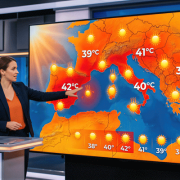
Europe is currently enduring its worst heatwave on record, and it’s bracing for it to get even hotter as the summer progresses. The continent’s lack of air conditioning has often been a major point of contention for travelers and residents alike during the summer months. Now, health experts are entering the conversation over the culture of air conditioning, especially for vulnerable groups. 

The head of the World Health Organization’s Europe office, Hans Kluge, said that “much of Europe’s investment has rightly gone into longer-term solutions like shade, insulation, and cooling centers, rather than mechanical cooling.”

The WHO office also recommends a “nuanced adoption” of air conditioning that specifically works to protect those at high risk, “both have a role,” Kluge said. 

Embed from Getty Images

The Guardian recently reported on studies that suggest Europe’s efforts to adapt to modern cooling systems have decreased the death toll by 75% for the kind of heat that was considered to be extreme 20 years ago. However, it’s clear now that all over the world heatwaves and dangerously high temperatures have gotten even worse within the past two decades. 

The WHO estimates that over 200,000 people have died from the heat in Europe within the last four years. In June, record-breaking heat levels will likely “yield a death toll in the thousands, if not low tens of thousands,” the publication reported.

These numbers are also well above the levels that are experienced in the US, where historic heatwaves are also occurring, but air conditioning is used in 90% of homes. 

Although most political parties in Europe agree that hospitals, care homes, schools, and public transport should all have proper air conditioning, many mainstream parties are also blocking air conditioning services due to not viewing climate change as a serious concern. 

For example, this year, the day after Germany broke their heat record, Marc Bernhard, the construction spokesperson for the far-right Alternative für Deutschland (AfD) stated that his party would stop people “being sacrificed on the altar of mainstream climate ideology. Climate hysteria is leading to more heat-related deaths due to ideological construction errors such as abstaining from air conditioning.”

In France, on the other hand, Marin Le Pen’s National Rally has been fighting against renovations to make buildings energy-efficient and even has tried to block wind turbines and solar panels. However, the rally has also made air conditioning a main focus while simultaneously going against policies to combat climate change. 

In some of the world’s richest nations, including the US, Australia, and Japan, air conditioning is normalized, however, only around 15% of the 3.5 billion people living in regions with some of the highest global temperatures own an AC unit. 

The demand for global cooling is expected to increase significantly within the next decade and beyond. For example, in south-east Asia, the International Energy Agency expects the number of air conditioners to “rise ninefold” between 2020 and 2040 if current policies remain. 

While air conditioning can impact climate change due to the fact that it expels hot air into surrounding streets and the energy use can increase the risk of blackouts, in Europe the risk of these detrimental effects is significantly lower than other urban areas around the world. 

Embed from Getty Images

Additionally, although there are laws in some areas that make it difficult to install air conditioning in private buildings, there isn’t a lot of data to back up that this is the driving reason for the low amounts of air conditions adopted throughout the continent. 

Despite all of this, there are many citizens throughout Europe that are protecting themselves from the extreme heat and cooling their homes. Reports indicate that the share of households in Italy and Spain with air conditioning has grown to more than 50%, and in France it’s risen to 24%.

 On the opposite end, Germany has some of the lowest air conditioning installations in Europe. This is partially due to a large proportion of renters, but a lot of it has to do with homeowners not being able to justify the cost even with record-breaking temperatures and dangerous conditions. 

Gabriele Werner, a worker in the tourist information office of Neuzelle, said that they’d “consider getting air conditioning if the summers keep getting hotter, but when it’s just a few days [they] can bear it.”

The Guardian actually visited Neuzelle and their neighboring district of Neißemünde, where they reported that the response to the recent heat wasn’t met with any urgency or sympathy for those suffering. 

Reinhard Lang, a retired electrician who lives in a 150-year-old house, told the publication that “climate change is just a word that gets trumpeted. Back when I was a child, it was also warm. It just wasn’t played up.” 

Kluge stated that Europe’s strong emergency response to their recent heat has saved lives. 

“The priority now is ensuring AC reaches people for whom it’s a medical necessity, while continuing to build out the infrastructure – trees, green roofs, cooler buildings – that protects everyone, including people who simply can’t fit a unit in their home.”

Dr. Chloe Brimicombe, a climate scientist at Oxford University who focuses on extreme heat gave some of the other solutions that are being looked into as well. “We are currently focusing a lot of our energy and water resources during heatwaves on cooling data centers.”

“Lives are more valuable to us than AI – or at least they should be right?” 

coral

Florida Just Recorded The Hottest Ocean Temperatures In History 

This summer has been breaking heat records all over the world. Most recently, Florida saw an ocean temperature reading of 101.1 degrees Fahrenheit on Monday, and 100.2 degrees on Sunday. The previous world record for hottest ocean temperature was 99.7 degrees in Kuwait Bay, according to a study from 2020. 

“This is shocking, it’s unprecedented, it’s actually quite frightening.” Stefanie Sekich, of the Surfrider Foundation, an ocean-protection advocacy group, told Yahoo News.

Embed from Getty Images

July as a whole has seen the record for the hottest average global temperature broken multiple times as a result of climate change which has caused a multitude of heat waves across the country. 

The oceans have absorbed 90% of the increased heat from climate change, leading to global ocean surface temperatures to reach the highest temperature ever in 174 years of data. 

“These ocean temperatures over the globe have been increasing for the past month. In the North Atlantic, parts of Europe have seen the ocean temperature increase of 7 degrees [Fahrenheit] more than it usually is at this time of year,” Sekich said. 

One of the negative impacts to the ocean’s many ecosystems is coral bleaching, in the US specifically, Florida has been experiencing severe bleaching events since July. Coral bleaching occurs when the corals release algae due to warmer temperatures, causing the coral to turn white. 

On July 20th, the Coral Restoration Foundation reported that Sombrero Reef, near the Florida Keys, experienced a coral bleaching event with a 100% mortality rate. 

Embed from Getty Images

“On July 20th, CRF teams visited Sombrero Reef, a restoration site we’ve been working at for over a decade. What we found was unimaginable — 100% coral mortality. We have also lost almost all the corals in the Looe Key Nursery in the Lower Keys,” said Phanor Montoya-Maya, restoration program manager at Coral Restoration Foundation, in a statement. 

“Sea grasses are another vital ecosystem, they’re an essential fish habitat, they’re the primary food source for manatees, which have been plummeting in recent years. Sea grasses are very vulnerable to warmer waters,” Chris Robbins, associate director of science at Oceans Conservancy, an environmental advocacy group, told Yahoo News.

“The last time we saw a massive seagrass die-off resulting from high water temperatures, high salinities, low oxygen was during the El Nino event in 2015, and of course we’re now in an El Nino event in 2023,” said Robbins.

When it comes to what we can do in order to improve, Sekich explained that “obviously, we need to get off fossil fuels. If we keep putting greenhouse gases into the atmosphere we’re going to keep seeing these effects of climate change.”

Robbins also explained how the state and federal governments need to take charge and implement policies and infrastructure investments to reduce pollution and decrease the use of fertilizer and upgrading wastewater systems.

“If and when these things happen, we’ll potentially need to reduce other stressors on these systems,” Robbins said.

heat wave

Record High Temperatures Hit Europe, Prompting Multiple Heat Warnings 

The UK and other parts of Europe are gearing up for one of the hottest summers to date. Multiple countries, including France and Britain, have issued extreme heat warnings and are working to combat the spreading of multiple wildfires.

British authorities have declared a national emergency and issued a “red extreme” heat warning for the first time in England’s history. Meteorological services in France have placed a majority of the country under the highest possible alert level for heat. 

Forecasters are predicting that Monday and Tuesday will see record-high temperatures in Britain, rising up to 106 degrees Fahrenheit (41 Celsius); the current record is 101.7 degrees Fahrenheit (38.7 Celsius) which occurred in 2019. 

Embed from Getty Images

Nikos Christidis, a climate attribution researcher in the UK, recently spoke to the media stating that climate change is making extreme heat events much more common, especially in the summer months. 

“The chances of seeing 40°C days in the U.K. could be as much as 10 times more likely in the current climate than under a natural climate unaffected by human influence,” he said in a statement. 

Spain, Portugal, and France are evacuating thousands of their residents due to the threat of ongoing wildfires caused by the extreme temperatures. Authorities have also been warning of degrading air quality in these areas as well, especially in more heavily populated cities. The north of Italy is currently experiencing a state of emergency as well due to the heat and the droughts it’s causing. 

The hospitals in these countries are also becoming overwhelmed due to the additional services they need to provide to help combat the negative impacts of the heat. Additionally, rising Covid-19 cases are putting extra pressure on the hospitals and healthcare services in these nations. 

Embed from Getty Images

Spain’s public Carlos III Health Institute estimate data showed that 350 people died in the country last week due to the heat. Over 800 heat-related deaths were reported by the institute in June, where temperatures reached levels between 104 and 110 degrees Fahrenheit (40-43 Celsius). 

The UK Health Security Agency has issued a level four heat alert, the highest possible level, which warns of illness and possible death even for the healthiest of individuals due to the heat. 

People throughout Europe who live in poorer areas are more likely to live in buildings without access to air conditioning or greener spaces which have trees to offer natural cooling through shade. Christian Huyghe, scientific director at France’s National Institute of Agricultural Research discussed that this is likely just the beginning of the damage the world will experience from climate change. 

“What we see now is just the very beginning of the potential impact of climate change.”

Emergency orders and evacuations will likely continue this week as temperatures remain high.

This Company Is Using New Technology With Nature To Combat Excessive AC Use

The heat waves in the US have become more and more common as climate change has worsened in recent years. SkyCool Systems is a relatively new company attempting to combat the harmful greenhouse gases emitted from excessive air conditioning use throughout the country through new technology. 

“Our planet naturally cools itself by sending heat out in the form of infrared light or radiation. We’re using that effect to essentially radiate heat out during the day and at night, even under direct sunlight.” 

Eli Goldstein is SkyCool’s co-founder and CEO who explained that this process is known as radiative cooling. SkyCool uses rooftop panels made using nanotechnology and optical film that radiates infrared light and cools itself in the process. 

Embed from Getty Images

According to the company these panels work in the opposite way that traditional solar panels do by reflecting about 97% of the sunlight that hits them, and cooling the surface below. 

The SkyCool model involves an embedded network of pipes that are below the panels. These pipes are filled with water that’s kept cool by the panels and then can flow into a refrigeration or air conditioning system. The goal is to take pressure off the AC or fridge cooling systems which can use a lot of energy. 

The panels also cool themselves naturally and don’t require any external power to function, which helps the entire house use less electricity during times of extreme heat. 

Jesus Valenzuela is the store manager at a grocery outlet store in Stockton, California which recently adopted the SkyCool system technology. 

“After we had our SkyCool system installed, our electricity company increased their rates on us. We actually didn’t see our bill go up at all. In fact, we saw it go just a little bit down. I estimate that the panels have saved the store roughly $3,000 a month.”

Goldstein’s co-founder and UCLA professor Aaswath Raman is one of many scientists who have been researching the benefits of radiative cooling for years now. Raman is an expert in the field who claims that while several similar solutions have appeared in recent years, there have also been challenges, like how well the technology works without sunlight. 

Embed from Getty Images

“Our technology works best in hot, dry climates where the sky is clear, so when you have clouds, that blocks that radiative cooling window. In the same way that [carbon dioxide] blocks light and sort of has that heat trapping effect, water vapor also will block infrared light.”

“The biggest obstacle to making the technology ubiquitous is its relatively high cost. Most radiative cooling solutions suffer from a high manufacturing cost and large-scale production limits,” researchers at China’s Fudan University wrote in a paper published in the journal Nature.

Goldstein claims that SkyCool’s panels do cost more than solar panels, but didn’t disclose the actual cost. 

“New technologies like radiative cooling are often more expensive. People are very sensitive to first cost, and so that is another barrier to getting new things out there.”

“Much of that is because of low production volumes. Scaling up production could help bring the cost down, particularly for developing countries in Asia and Africa where we hope to eventually expand. For now, we’re focused on commercial applications of the technology, though we hope to start installing panels on the roofs of individual homes.”

“We’re just excited to be able to use this new technology for good,” Goldstein said.

Heat Wave Temps

Heat Waves And Thunderstorms In California Spark Multiple Wildfires

This past Sunday a rare summer thunderstorm in Los Angeles, California brought on an obscene amount of lightning that has now led to several small fires to break out in Northern California, and a huge wildfire that caused hundreds of individuals to evacuate their homes in northern Los Angeles. 

Firefighters are continuing to fight the fire in northern LA which is now burning towards the Angeles National Forest. The forest is known for being extremely dense, thick, and dry, which is the perfect condition for a wildfire to spread and expand to an unfathomable level. More than 4,500 buildings are also currently under threat of burning due to their close vicinity to the forest. 

Embed from Getty Images

Reports claim firefighters are struggling to manage not only the steep, and rugged terrain of the hot forest, but also 15 mph winds and continued lightning, which is pushing the fire even further north. Fire spokesperson Jake Miller recently spoke with the press about what safety measures they currently have in place while they try to contain the fire further. 

“We set up a containment line at the top of the hills so the fire doesn’t spill over to the other side and cause it to spread, but it was obviously difficult given the erratic wind and some other conditions.” 

So far, The Lake Fire has been 12% contained as of Sunday, and has already burned through 28 square miles of dry brush and trees. 33 buildings, including at least a dozen homes, have been completely destroyed. Fire spokesman Tom Ewald claimed that temperatures reached more than 110 degrees Fahrenheit, creating an even more deadly environment for the wildfire to grow and spread. 

The thunderstorms and excessive heat wave only further fueled the now 4 square miles of fire in the foothills above LA. That particular fire was thought to be accidentally started by a homeless individual on Thursday, and is currently only 3% contained due to the environmental conditions in LA right now. 

Embed from Getty Images

A majority of the state saw triple-digit temperatures this past weekend, which when combined with the heat and smoke of the fires created an atmosphere of increased ozone pollution; which has apparently now reached levels not seen in a decade for some areas. This also means that air quality may reach very unhealthy levels in many regions of Southern California specifically, where ozone pollution is already a major problem. 

The tropical storms in Northern California knocked out power for a majority of the San Francisco Bay Area with wind speeds up to 75 miles per hour, according to the National Weather Service. Daniel Swain, a climate scientist, claimed that the conditions have become extremely deadly in parts of California, creating an environment of complete natural destruction. 

“This is probably the most widespread and violent summer thunderstorm event in memory for the Bay Area, and it’s also one of the hottest nights in years.”

A massive fire cloud, scientifically known as a pyrocumulonimbus, formed over a fire that was started east of the town of Loyalton, near the California-Nevada border. This cloud collided with the intense winds of the storm to create a “tornado of fire,” which burned through 45 square miles of land and triggered evacuation orders all along State Route 395. 

None of the fires have been fully contained as of Monday morning, and strong winds and storm patterns continue to threaten firefighters’ efforts to stop the spread.