Posts

flood

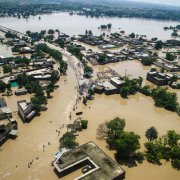
As Floods Hit Pakistan, Millions Are In Search For Help

In over a decade, millions of Pakistanis are fighting for their lives and searching for aid as they are overwhelmed by the scale of the disaster. 

Many authorities have claimed that this recent disaster and the scale of it could be considered a “serious climate catastrophe.”

With the recent flash flood on Friday, it destroyed at least 10 bridges, over a dozen buildings and killed nearly 75 people. 

“We’ve had to deploy the navy for the first time to operate in Indo-Pakistan, because much of it resembles a small ocean,” said Climate change minister Sherry Rehman.

The monsoon ended up affecting all four provinces of Pakistan. Almost a million homes have been destroyed or severely damaged, numerous roads can no longer be traveled on and electricity outages are everywhere.

Embed from Getty Images

These damages have affected at least 33 million people throughout the entire country. 

According to the National Disaster Management Agency (NDMA), the fatalities of this disaster have also continued to increase since mid-June up to at least 1,061 people and the fear continues to rise as more death follows.

“By the time this is over, we could well have one quarter or one third of Pakistan under water,” said Rehman. 

According to CNN, Foreign Minister Bilawal Butto-Zardari stated this past Sunday that this year’s monsoons in Pakistan have been “absoultely devastating.”

“I haven’t seen any destruction or devastation of this scale. I find it very difficult to put into words the phraseologies that we are used to, whether it’s monsoon rains or flooding, doesn’t quite seem to encapsulate the ongoing devastation and disaster that we are still witnessing.”

Pakistani Prime Minister Shehbaz Sharif has joined in to help for relief efforts by dropping off supplies via helicopter in areas that have been hard to reach either by boat or on foot.

“Visiting flood affected areas and meeting people. The magnitude of the calamity is bigger than estimated. Times demand that we come together as one nation in support of our people facing this calamity. Let us rise above our differences and stand by our people who need us today,” Sharif recently tweeted.

Embed from Getty Images

The International Rescue Committee profit group reached out on Monday and stated that more than 30 million people were in “urgent need” because of the monsoons. 

The United States and United Kingdom governments have stated that they will pledge around $1 million in emergency relief and that the first wave of foreign aid will start to come into Pakistan on Monday to help citizens find some relief from the disastrous floods.

flooding

Pakistan’s Largest City Experiences Torrential Rain And Major Flooding Due To Climate Crisis 

Karachi, Pakistan’s largest city, is experiencing extreme torrential rain and flash flooding causing a multitude of public services and businesses to close down over safety concerns. Infrastructural damage and flooding has left at least 15 individuals dead since this weekend. 

This past Sunday, Karachi experienced 2.3 inches of rain, which is equivalent to the average of an entire month’s worth of rainfall for the area. Every summer Pakistan endures heavy monsoon rains, but more recently experts have been warning that climate change is accelerating and intensifying existing weather patterns. 

Sherry Rehman, Pakistan’s climate change minister, issued flash flood warnings for citizens in more than 14 cities and townships. 

Embed from Getty Images

“Since the monsoon season began last month more than 300 people have been killed by heavy rains across Pakistan,” according to Pakistan’s National Disaster Management Authority. 

The 16 million residents of Karachi have witnessed entire neighborhoods become partially submerged from flooding. Photos from the area show individuals knee-deep in muddy flood water with vehicles left completely stranded and submerged. 

“Infrastructure including bridges, highways and roads have been damaged, disrupting traffic and upending the lives of millions across the city. Many have stocked up on fuel for their generators in case of power outages,”  said Afia Salam, a climate change advocate in Karachi.

“Climate change is a threat. We are a coastal city. It’s happening so fast and we will bear the brunt. People need to see the situation beyond individual events like a bridge falling or a road getting flooded.”

“The rapidity of these events is increasing and our response is not keeping pace. We are being reactive to individual events. Strategies need to be put in place, the poorest and most vulnerable are on the front line of the crisis,” said Salam.

Embed from Getty Images

“Karachi, the country’s financial capital, boasts luxury hotels, malls and upmarket gated communities. But disparities in wealth and development remain, and an estimated 50% of its residents are forced to live in informal settlements,” according to the World Bank.

“Karachi’s infrastructure is highly vulnerable to climate-related disasters,” according to the World Bank.

Experts are stating that the climate crisis in Pakistan is also being exacerbated by poor flood management and ineffective disaster response. 

Extreme weather events in South Asia are becoming more frequent due to climate change, with temperatures in parts of India and Pakistan reaching record highs during a heat wave in April and May. 

According to a 2022 report by the Intergovernmental Panel on Climate Change (IPCC), they had “medium confidence that heat waves and humidity stress would become more intense and frequent, and annual and summer monsoon precipitation will increase.”

According to the IPCC India and Pakistan are among the countries that are expected to be the most affected by climate change.

Swarm of Locusts

China To Deploy 100,000 Ducks To Combat Swarms Of Locusts

When it comes to the detrimental effects of global warming on our planet, one of the most unexpected issues that needs combating is the plagues of locusts that are currently ravaging through the planet’s farmlands in countries such as Pakistan and Uganda.  Swarms of locusts are not uncommon in certain areas of the world, in fact, when they appear at their expected time in their expected numbers it actually benefits the planet and the species living in these areas.   

Most recently, Pakistan has declared a state of emergency regarding the swarms of locusts clouding the skies. Officials are stating that the numbers are the worst they’ve been in two decades for the country. This is a huge problem as locusts eat through vegetation so fast you can blink and an entire field will be cleared. Even a small swarm of locusts can eat enough food to feed over 35,000 individuals in just a day. 

Embed from Getty Images

A single swarm of locusts can contain up to 150 million individual insects per square mile of farmland, where they like to feed the most. Some countries are attempting to combat the issue by using drones to spray pesticides amongst the plagues of locusts, and others are taking a more creative and predatory approach. 

China is looking to help aid Pakistan with this infestation problem by deploying 100,000 ducks to the country. Agricultural experts claim that a single duck can eat more than 200 locusts in a single day, and are much more effective, not to mention safer, than spraying pesticides from the sky and into the atmosphere.  

“The ducks are biological weapons, while chickens could eat about 70 locusts in one day a duck could devour more than three times that number. Ducks like to stay in a group so they are easier to manage than chickens,” Lu Lizhi, a senior researcher with the Zhejiang Academy of Agricultural Sciences claimed. 

Embed from Getty Images

Lu went on to explain how within the coming months the Chinese government will begin trial runs of duck deployment as a means of combating the locust issue. After they test how well the ducks do in western Xinjiang, they will be sent to Pakistan; specifically the provinces of Sindh, Balochistan, and Punjab, where the locusts populations are the highest. 

On paper, bringing a locusts predator to them to combat overpopulation sounds like a smart idea, however, there are still concerns, the main one being that the arid desert environment in Pakistan is not equipped to handle ducks, who rely heavily on water. 

“Ducks rely on water, but in Pakistan’s desert areas, the temperature is very high. Although ducks have been used against locusts since ancient times, their deployment hasn’t yet entered the government assistance programme and is an exploratory method,” said Zhang Long, a professor from China’s Agriculture University. 

The United Nations reports that this heavy infestation was likely caused by the 2018-19 cyclone season in the areas that are being affected. Heavy rainfall in arid environments creates the perfect breeding ground for locusts, so when climate change causes natural disasters, such as cyclones, to become more frequent and intense, and unprecedented amount of locust breeding is the result. 

Currently parts of China, the Middle East, South Africa and South America are trying to deal with these “unprecedented” swarms of locusts clouding their skies and consuming their resources, only time will tell if the world’s troops of ducks can actually help.

Gender Inequality

Report Suggests Gender Equality Still a Century Away

While the push for women’s equality has made substantial progress over the last several years, a new report released by the World Economic Forum suggests that civilization is still a long way away from ensuring equal treatment of the sexes. Entitled the “Global Gap Gender Report 2020,” the report analyzes 153 countries and ranks them according to how successfully they enable gender parity. While the report found many areas in which societies have made progress, such as ensuring that girls have access to educational resources in developing countries, it also remarks that the pace of progress has been slow, as only a handful of countries in the world were determined to even approach reaching full gender equality. The report predicts the milestone of achieving global gender parity to be 99 years in the future, with the areas of Economic Participation and Political Empowerment being where the gender gap will likely take the longest to close.

The countries ranked as the most gender-equal include Iceland, Norway, Finland, and Sweden, as the Nordic countries have some of the most progressive gender policies in the world. Finland, for instance, recently elected the world’s youngest female leader, Prime Minister Sanna Marin, and their Parliament contains an almost equal number of men and women. Finland and other Nordic countries also have policies like several months of paid parental leave, sophisticated sex education programs, and widespread access to abortion and birth control, which help to reduce the social gender gap in these countries. The World Economic Forum’s report focused on four main themes: economic participation, educational attainment, health and survival, and political empowerment; and the Nordic countries were found to perform among the best in these areas.

Embed from Getty Images

On the other end of the list, Middle-Eastern countries like Syria, Pakistan, Iraq, and Yemen were ranked lowest. In these countries, according to the report, women’s rights are severely limited, particularly in the areas of “divorce, inheritance, asset ownership, access to justice and freedom of movement.” In some of these countries, women are almost entirely absent from political life, and the rates of literacy are much lower for women than for men as a result of unequal access to education. And when it comes to employment, women in these countries are routinely discriminated against, resulting in a low level of female involvement in the workforce.

Though different parts of the world are making progress in closing the gender gap at vastly different rates, the overall social gap between the genders is gradually narrowing, albeit very slowly. The report found that the world has almost achieved 100% gender parity in the categories of Health and Survival and Educational Attainment, but has only achieved 58% parity in Economic Participation and Opportunity and 25% parity in Political Empowerment, leaving the Global Gender Gap Index at a combined percentage of 69% of full parity between the sexes. The report stresses the urgency of increasing the pace of progress towards gender equality, saying, “without the equal inclusion of half the world’s talent, we will not be able to deliver on the promise of the Fourth Industrial Revolution of society [or] grow our economies for greater shared prosperity… at the present rate of change, it will take nearly a century to achieve parity, a timeline we simply cannot accept.”

Embed from Getty Images

Even developed, industrialized countries like Japan display shocking deficiencies in the area of gender equality. Women in Japan, for instance, perform four times the amount of unpaid labor as men do, and despite government initiatives to expand female participation in the workplace, women often have difficulty advancing into senior work positions. There’s no question that the project of achieving gender equality is a difficult and complicated one, as gender issues stem from social, economic, and political factors, but countries like Finland show that with enough effort these barriers can in large part be overcome.
