2024 Olympic Games Brought Tourism To Paris, But Some Business Owners Reported Their Worst Summer Yet
Businesses and hotels in Paris were expecting a major rise in profits this summer with the 2024 Olympic Games and influx of tourists, athletes, journalists, and more in the city.
However, now that both the Olympics and Paralympic Games are over, many individuals throughout the Paris service industry stating they’ve had their worst summers ever due to security restrictions throughout the city during the Games, according to the Associated Press.
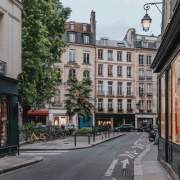
Tom Denaive is a Paris resident who runs a jewelry store between the Louvre and Place de la Concorde where many Olympic events were hosted. For him, this was a great hindrance to his business as the city closed multiple metro trains around the area, and many pedestrian and commercial routes were also blocked.
“It was a dead street, I felt like we were back to the COVID days,” Denaive said to AP.
The Louvre Museum also reported a 22% drop in visits during the Olympic Games, as well as a 45% drop during the two weeks prior to the Games starting.
“I have all the records from last year and we didn’t match a single one,’’ said Marina Orlando, store manager at French luxury candle brand Diptyque.
“We were given a whole serenade about the Olympics, that it was going to be incredible. … Some of us didn’t go on vacation, it was a huge logistical effort so that we could all be present on D-Day. In the end, the store was largely empty of customers,” she said.
The Paris government released data that showed there were around 1.7 million international visitors to the city during the Olympic Game period. Those numbers are up 13% when compared to tourist rates from last year.
“I think that our country’s bet has paid off,” said. Olivia Grégoire, who leads the ministry charged with companies, tourism and consumption.
Grégoire said “France as a whole was on track to maintain — and potentially surpass — last year’s record-breaking tourism numbers.”
Denaive said tourists “spent so much on hotels, flights, tickets … they didn’t have much of a budget left for shopping.”
Instead of building an Olympic park outside of the center of the city, Paris chose to host the Games in the heart of the capital, which made it difficult for visitors to get to various shops or restaurants.
An increase in police and security presence and checkpoints also added another layer of difficulty. Only individuals with a specific QR code could pass certain police checkpoints, making it essentially impossible for regular people to commute throughout the city unless they took the metro.
In June, the Parisian government announced that it would be creating a commission for businesses that were negatively affected by the Games. The commission will handle, and ideally fulfill, compensation requests from businesses located in areas where security measures were put in place. The commission will begin assessing those requests in January.

Eric Mastrota is a Contributing Editor at The National Digest based in New York. A graduate of SUNY New Paltz, he reports on world news, culture, and lifestyle. You can reach him at eric.mastrota@thenationaldigest.com.