Posts

phones

Phone Bans Increase Throughout US Schools To Better Student Engagement 

Throughout the US, school districts are implementing bans and restrictions on cellphones in the classroom in order to better student engagement and behavior. In fact, according to a new survey from Education Week’s Research Center, 95% of educators say that their school or district has an official policy restricting students’ access to their phones during school hours. 

The survey was conducted from mid-February to mid-March and included 596 teachers and school and district leaders. 

Embed from Getty Images

The report showed that, in general, teachers, principals, and district leaders reported positive results from their restrictions, specifically pointing out improvements in student participation and behavior. 7 in 10 educators said that phone limits have had a positive impact within those two areas. 

“A lot of educators are seeing benefits from the cellphone restrictions on engagement, behavior, well-being, and learning,” said Bridgette Whaley, an associate professor of education at West Texas A&M University. 

“The survey also made it clear to me that having a policy is not the same thing as implementing it well. How the policy is designed and how consistently it’s enforced really seem to matter a lot.”

On the other end, educators said that attendance is one area where cellphone restrictions are not impacting student behavior. 7 in 10 reported that cellphone restrictions didn’t have a positive nor negative impact.

A district-level administrator in Oklahoma who participated in an open-response section of the survey discussed how the state recently “mandated a cellphone policy that restricts the usage of personal devices during the school day.” 

“It has been a game changer regarding student engagement, focus, and minimizing poor student behavior.” 

A high school teacher in Tennessee said that for them, “the state, district, and school policies have helped to foster more person-to-person interaction and people skills. The policies have also focused student attention more on learning content.”

In recent years there has been a very rapid increase in policy and lawmakers from both parties placing restrictions on cellphones in schools in the US. Education Week reported that at least 37 states and the District of Columbia require school districts to ban or restrict students’ use of cellphones in school. Some of the other states not in that group are either incentivizing or recommending local districts enact their own policies. 

Embed from Getty Images

Whaley pointed out that many schools do not require students to lock their phones away in lockers during the day. 

“Instead, they seem to be relying more on compliance-based approaches, like keeping [phones] turned off or placed in backpacks or maybe somewhere else in the classroom,” she said. 

“That really matters because it suggests that many schools may have restrictions on paper, but the actual enforcement often depends on the people rather than the policy or the structure.”

The survey also showed that some educators don’t see cellphone rules being enforced with 64% saying they are and 36% saying they were not. 

“A policy can look consistent from a leadership perspective, but not be as consistent in classrooms. That’s why I think that the teacher’s perspective matters so much to the conversation,” Whaley said

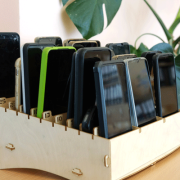
A high school teacher in California: “While the school rule is no cellphone use in the classroom except for at the teacher’s discretion, not all teachers enforce this rule. Last year, fed up with fighting students’ cellphone use, I bought and began using cellphone pockets. For the most part, this has eradicated the cellphone distraction in my class, but not all teachers do this.”

“We are starting to make changes to reduce technology usage across the district and implementing a stricter cellphone policy due to parent [and] community requests,” a Minnesota high school teacher said. 

“The enforcement is what is the most difficult. We are not consistent in classrooms.”

“With our cellphone policy, we see very few cellphones in classes, but many students still don’t turn them in like they are supposed to,” said a school leader of a middle school in Massachusetts. 

“I think students are still definitely using phones in the bathroom and during breaks. One of the biggest challenges that I see with phones is what happens outside of the school building that then is brought in here.”

flag

‘The US Refugee Program Changed My Life, Now Its Future Is Uncertain’

“Despite these troubling political developments, I still love my country and wouldn’t want to live anywhere else. Historically, generosity, welcoming and caring for people fleeing violence, war and persecution have been America’s core values.”

roblox

Roblox Will Extend Age Verifications To Further Prevent Adults Talking To Children

Popular gaming website Roblox is working to limit and prevent adult strangers from talking to children by the end of this year in an effort to remove “bad actors” from the platform. 

Roblox currently has more than 110 million users daily. There’s been multiple child safety concerns brought up, especially within the last year, as experiments showed children as young as five may be able to communicate with adults while they play certain games. 

Embed from Getty Images

The company also announced that it was banning online vigilantes who were trying to catch predators. Last year Roblox also submitted more than 24,000 reports to the US National Center for Missing and Exploited Children which is responsible for handling suspected child sexual exploitation in the US.

On Wednesday, Roblox announced that by the end of 2025 they will start requiring all users who use the text and chat communication tools to go through age checks. If they cannot prove that they’re 18 or older they will have to then prove that they already know the person they want to talk with. 

At the moment, Roblox only requires proof that a user is over 13-years-old in order to communicate with the tools. 

Matt Kaufman, chief safety officer at the games company, said: “We’re making two fundamental changes.”

“By the end of the year, we will require all users who have access to communication on Roblox to go through an age check process or age estimation process.”

“What that process does is it gives us more information about how old the user actually is without relying on their self-reported age at sign up.”

Embed from Getty Images

“That’s important, both for young users, so that we know whether they’re really at the right age to be able to use communication features. And it also helps address bad actors who may try to impersonate younger users. The second thing we’re doing is we’re implementing limits so that younger users cannot talk to adults who they do not know in real life.” 

Roblox has grown in popularity rapidly. Recently they also began allowing movie, TV, and other gaming companies such as Netflix, Lionsgate, and Sega to create games using their intellectual property on Roblox, attracting even more users. 

In spring this year, the Guardian reported research that they deemed “deeply disturbing.” The reports showed how easy it was for children to encounter and interact with inappropriate content and interact with adults unsupervised. 

Within the report one parent stated that they discovered adult strangers had been able to approach their child on the platform and coaxed them into sharing nude images of themselves. 

In a blog post, Roblox stated:

“Our users, creator community, parents, partners, legislators all want the same thing we do: to help keep young people safe while they play, learn, or explore on Roblox.”

“We’re continually innovating on this front – refining and optimising our safety systems, policies and moderation tools,” the post stated.

ai

Facebook And Instagram To Start Labeling Digitally Altered Content ‘Made With AI,’ Meta Says

Meta, the owner of Facebook and Instagram, announced that they would be making major changes to its policies on digitally created and/or altered media. 

Meta will start adding “Made with AI” labels to posts that use artificial intelligence to create photos, videos, and audio published on Facebook and Instagram. The apps will begin adding this label in May. 

Vice president of content policy, Monika Bickert, stated in a blogpost that Meta would “apply separate and more prominent labels to digitally altered media that poses a particularly high risk of materially deceiving the public on a matter of importance, regardless of whether the content was created using AI or other tools,” according to the Guardian

A spokesperson also stated that Meta will begin applying more prominent high-risk labels immediately. 

Embed from Getty Images

This approach will overall shift the way Meta treats manipulated content. Instead of removing the content altogether, posts made to Facebook and Instagram will not provide viewers with the information about how the image was edited.

A company spokesperson said the “labeling approach would apply to content posted on Facebook, Instagram and Threads. Its other services, including WhatsApp and Quest virtual-reality headsets, are covered by different rules.”

In February, Meta’s oversight board said the company’s existing rules on manipulated media were “incoherent” after reviewing a video of President Joe Biden posted on Facebook last year that had been digitally altered to make it seem as though the president was acting inappropriately.

The board said the “policy should also apply to non-AI content, which is not necessarily any less misleading than content generated by AI, as well as to audio-only content and videos depicting people doing things they never actually said or did,” according to the Guardian.

tiktok

US House Of Representatives Banned From Using TikTok On Their Electronic Devices 

According to an internal notice sent to the staff of the House of Representatives – obtained by CNN from the Office of the Chief Administrative Officer – TikTok has been banned from any and all electronic devices used and owned by members of the House of Representatives and prospective staff.

The notice stated that the app must be uninstalled from any House mobile device if it’s already installed. This is due to the government’s view of TikTok being a “high risk to users due to a number of security risks.” 

Embed from Getty Images

The US government has also been in talks to ban TikTok from all federal devices in the near future. This ban is a part of a piece of legislation included in the omnibus bill recently signed by President Joe Biden. More than a dozen states throughout the US have also already implemented their own restrictions and prohibitions on TikTok on government devices.

While TikTok hasn’t made any official comment regarding this recent ban on House devices, the company previously stated that the government’s moves to ban the app is a “political gesture that will do nothing to advance national security interests.”

One of the biggest concerns coming from lawmakers regarding TikTok involves the social media app’s parent company, ByteDance. 

US policymakers are concerned about national security and the risk of the Chinese government pressuring either TikTok or its parent company into acquiring, using, and sharing personal information specifically from its US users. 

This information is thought to be potentially used for Chinese intelligence operations or the sharing of disinformation backed by China’s government. 

Embed from Getty Images

While there hasn’t been any direct instances or attempts of these security breaches occurring, the platform did confirm last week that four employees were fired for accessing user data on TikTok from two journalists. 

The battle between the US government and TikTok has been ongoing since 2020, when the app truly began rising in popularity; partially due to the pandemic and quarantine restrictions that left citizens at home yearning for entertainment. 

Both the government and the platform have been working on negotiations to resolve any potential national security risks so that the app can continue to be used by US citizens. 

“The potential agreement under review covers key concerns around corporate governance, content recommendation and moderation, and data security and access,” TikTok has stated

For now, the US government is moving forward with its plans to ban the social media platform from all government used/connected devices, with the potential for wider bans to be implemented in the future.

Lying About High-Risk Travel In England Can Get You Up To 10 Years In Prison 

England announced new Covid-19 travel and border policies this Tuesday that state anyone arriving in the country and found to have lied about a recent trip to a country on the British government’s travel ban list could face up to 10 years in prison as a means of curbing the spread of the virus and all the new variants appearing throughout the world. 

Health Secretary Matt Hancock told citizens this Monday that all UK residents, as well as those in Ireland, arriving into England from places on the governments “Red List” will have to purchase a quarantine package that costs around $2,400 per person. This package covers accomodation, virus testing, and other essential services. 

Embed from Getty Images

Individuals who choose not to abide by these restrictions, including those arriving from a Red List country without a hotel already booked to quarantine in, could be subject to a series of heavy fines in addition to a potential prison sentence, according to Hancock.

“I make no apologies for the strength of these measures because we’re dealing with one of the strongest threats to our public health that we’ve faced as a nation. People who flout these rules are putting us all at risk.”

There are about 33 countries on the UK’s Red List for travel due to the slew of new variants appearing. If you enter into the UK from a country not on the list, you can simply quarantine at home, for those who do, however, must buy the coronavirus package mentioned above, and will be placed on “variant surveillance testing” as well. 

Embed from Getty Images

Hancock claimed that all of these policies will be going into effect as of Thursday of this week, and the government has created contracts with 16 hotels to give them an additional 4,600 rooms for the quarantining measures.

“Anyone who lies on a passenger locator form and tries to conceal that they’ve been in a country on our red list in the 10 days before arrival here will face a prison sentence of up to 10 years.”

Scotland is also tightening its rules on international travel, requiring all citizens entering into the nation on an international flight to quarantine in a designated hotel. “Airports and airlines are battling to survive with almost zero revenue and a huge cost base, and practically every week a further blow lands. Aviation-specific financial support is urgently needed to ensure our sector can get through the year,” Karen Dee, chief executive of the Airport Operators Association, and Tim Alderslade, chief executive of Airlines U.K, said in a statement. 

All of these measures will be indefinitely enforced until more citizens are vaccinated and the pandemic seems to subside more in general. 12.6 million UK residents have received their first dose of the Covid-19 vaccine so far, and the British government is set to announce the next phase of its vaccine rollout program at the start of next week.

How President-Elect Joe Biden Plans To Fight The Covid-19 Pandemic

Citizens of the US can expect a national mask policy, increase in Covid-19 testing sites, and the possibility of a nationwide lockdown once President-elect Joe Biden takes office in January. The Biden-Harris campaign laid out a step-by-step plan for addressing the pandemic which includes a detailed list of new policies, protections, and processes that will help frontline workers and the American people curb the spread and hopefully minimize the amount of new cases/hospitalizations. 

The campaign also announced its own specific Covid-19 advisory board co-chaired by former FDA Commissioner Dr. David Kessler, former Surgeon General Dr. Vivek Murthy and  Dr. Marcella Nunez-Smith, the associate dean for health equity research at the Yale School of Medicine. The timing of this transition of power couldn’t have come at a better time, as the US has surpassed 100,000 new Covid-19 cases a day all last week, projecting a very difficult winter for the nation. 

While potential vaccines around the world are showing great promise in their ability to combat and protect against Covid-19, the process and time it will take to widely distribute those vaccines is too uncertain not to start making changes now. Biden has also said he would be listening to scientists like Dr. Anthony Fauci, the head of the National Institute for Allergy and Infectious Diseases, who current President Trump has demonized throughout the pandemic. 

Embed from Getty Images

“I would be prepared to do whatever it takes to save lives. In order to keep the country running and moving and the economy growing, and people employed, you have to fix the virus. I would shut it down. I would listen to the scientists.”

Up until now the Trump administration has allowed state governments to decide whether or not they wanted to shut down, reopen, impose mask requirements, and purchase their own testing materials and personal protective gear. This has led to America being one of the most infected countries in the world that has seen little to no improvement in terms of case numbers and deaths dropping. As of today there have been over 10 million cases and 238,000 deaths in the US. 

Biden’s plan will call for a coordinated national strategy that would use the Defense Protection Act to actually ensure the US has all the proper healthcare equipment it needs to handle the rest of this pandemic. Testing sites will also likely double throughout the county, and at-home testing will be made more widely available. Biden also claims that he would establish a US public health job corps to “mobilize at least 100,000 Americans across the country to support contact tracing efforts, which has largely been left for the states to arrange, and assist populations at higher risk.”

Embed from Getty Images

It’s unclear how it will be executed, but Biden will likely also call for a national mask requirement in all public settings/spaces. It will likely start with masks being required in all federal buildings and interstate transportation systems. The CDC will also be directed to provide communities with all the evidence-based guidance they have for combatting the virus. The CDC will also have more of a say in terms of school and business reopenings, as well as stay-at-home orders nationwide. Dr. Howard Koh is a professor at Harvard’s T.H. Chan School of Public Health and the former assistant secretary for health at the Department of Health and Human Services during the Obama administration who recently spoke with the press about how hopeful he was for the future of this pandemic under the Biden administration. 

“I would expect that under President Biden, he would reinstitute regular briefings with Fauci, galvanized by the White House, but empowering the top scientists to convey their knowledge and guidance on behalf of the American people.”

Biden will also repair the damaged relationship that’s been created between the US and the World Health Organization. His administration hopes that the American people will see this pandemic is not political, and every move and decision that will be made will be based on science and with the greater interest of the American people’s health and safety at heart. 

Experts also expect that by the time Biden takes office there will likely be initial doses of a coronavirus vaccine made available to priority populations like health-care workers. The initial plan there would involve how to distribute and manage the administering of the vaccine when it first appears, so for now America will have to continue to wait as these policies and treatments come to life.

Corona virus Testing

Wuhan, China To Continue Testing Residents For Covid-19 As Lockdown Lifts

Wuhan, China is where the coronavirus pandemic initially began. Now, China has begun to loosen their two-month lockdown policy as the virus has slowed down its spreading exponentially compared to where the country was even a couple of weeks ago. Even though China is seeing a decrease in positive cases for covid-19, they will continue to test residents vigorously to avoid any kind of resurgence in case numbers; their overall goal is to loosen the lockdown enough so that they can begin to rebuild their economy, while still enforcing distancing measures.

One of the biggest concerns among all healthcare professionals and government officials worldwide is being able to detect patients who are asymptomatic and may not even know that they’re carrying/spreading this virus. This is the number one issue when it comes to Wuhan loosening their policies, as they’re worried they’ll just end up right back where they were a few months ago. 

Embed from Getty Images

Feng Jing is a Wuhan resident who lives in the Tanhualin neighborhood in the city. Jing has been running a group of community workers who have looked after the Tanhualin neighborhood and ensured that everyone was following the proper lockdown protocols and keeping themselves healthy and safe; sort of like a pandemic neighborhood watch group. 

“We carry out comprehensive health checks everyday and keep detailed records of [our residents] health conditions. Currently our neighbourhood is an epidemic-free community – it’s been 45 days so far, so we don’t have this situation. There is [also] no likelihood of asymptomatic cases in this community,” Jing Said. 

Jing’s neighborhood isn’t the only Wuhan territory that’s seeing improvement in terms of new coronavirus cases. Leaders in China recently reported that this past Thursday only 42 new cases appeared throughout the entire country, to compare on both Wednesday and Thursday 60+ new cases appeared. 

Embed from Getty Images

As previously stated, China’s government’s main goal is to accelerate the country’s economic recovery, which they will do by loosening how many “non-essential” workers will be able to return to work in the coming weeks. It’s difficult, however, to make those types of decisions, as the government is also focusing on ways to ensure that infected individuals still aren’t able to come into China from other countries. So while there’s a huge focus on economic growth, there’s also an even larger focus on keeping the country healthy.

In general, the coronavirus has infected over 1.4 million people worldwide, and over 87,000 individuals have died, and while this virus may have originated in Wuhan, it’s unfair to blame one city for the world’s overall unpreparedness for a pandemic such as this. 

In Wuhan specifically, the city is looking to spend what equates to $28.4 million on upgrading the city’s 400+ farmers’ markets, where it’s believed the virus first appeared. Several of the earlier cases of Covid-19 were linked to seafood markets in Wuhan that sold exotic species of animals as well, leading many to believe cross-contamination was the culprit of it all.

“Once reopened, the farmers markets should ensure no trade in wild animals and no trade in live poultry. Infrastructure in the markets should also be improved and become more similar to supermarkets.” Hong Zhihua, vice director of Hubei’s Patriotic Health Campaign Committee Office, said.

Many Wuhan residents share Zhihua’s perspective, and so does the government. Hopefully within the coming weeks, we’ll all see China improve massively in terms of coronavirus recovery, and the rest of the world will follow suit. For now, it’s imperative that we all stay inside as much as possible to stop the spread.

Survey

Pew Survey Reveals Global Citizens’ Views on World Leaders

In the United States, the president’s approval rating is historically low, hovering at about 42% while his disapproval rating rarely falls below 50%. However, the opinion of the United States president held by people around the world is even lower, as a recent Pew survey shows that almost two-thirds of people surveyed in 33 countries express “no confidence” in President Trump, whereas just 29% of those surveyed express confidence in him. The results vary widely by country, but only a handful of countries, including Israel, India, the Philippines, and Kenya, have a majority of citizens who approve of the president. Unsurprisingly given the president’s rhetoric about building a wall on the southern border of the United States, a whopping 89% of Mexicans surveyed expressed no confidence in the president, and the president has similarly high disapproval ratings across much of Europe, in particular Germany, Sweden, France, Spain, and the Netherlands. Interestingly, the percentage of global citizens Pew surveyed who approve of President Obama exactly matches the percentage of those surveyed who disapprove of President Trump at 64%.

Embed from Getty Images

That being said, a majority of respondents surveyed worldwide, 54%, expressed favorable views of the U.S., whereas 38% had an unfavorable view. This suggests that people around the world separate their view of the president from their view of the country as a whole, perhaps reflecting a view that the presidency of Donald Trump is a fluke rather than a genuine reflection of the general attitudes of Americans. Trump ranked dead last among five of the world’s most influential leaders; by contrast, German chancellor Angela Merkel took first place, at a confidence level of 46%. Interestingly, none of the world leaders drew a global confidence level greater than 50%, suggesting that people around the world are skeptical of the world’s leadership as a whole.

Citizens of the world not only disapproved of President Trump as a leader, but also of many of the specific policies he has implemented or proposed. 68% of people in the survey disapproved of the president’s practice of putting tariffs on goods imported from other countries, and 66% of people disapproved of America’s withdrawal from the Paris Accords and its position in the fight against climate change more broadly. People also generally disliked the idea of building a wall on the border between Mexico and the United States, as well as the country’s withdrawal from the Iran nuclear deal. In fact, the only policy that people more people approved of than disapproved of was the opening of talks between the United States and North Korea, though even in this case less than half, 41%, of respondents approved of it whereas 36% disapproved.

Embed from Getty Images

The U.S. president was ranked more favorably in right-leaning countries than in left-leaning ones, which is unsurprising given that U.S. politics is generally further to the right than those of the rest of the world. In countries that have displayed authoritarian tendencies, like the Philippines and India, Trump had the highest approval rating. In general, men were more likely than women to have a favorable opinion of Trump. In Ukraine, a country which has become relevant to the United States in the wake of the scandal that led to Trump’s impeachment, 73% of people surveyed had a positive view of the United States, although just 46% of people had a positive view of Trump specifically. His popularity in Israel specifically likely has to do with his decision to move the U.S. Embassy to Jerusalem as well as his decision to terminate the Iran nuclear deal, which is unpopular in Israel.

Though the survey reveals broadly negative views of Trump around the world, the president’s approval rating has actually increased since 2017, when just 22% of respondents expressed confidence in Trump. Given the tumultuous nature of modern-day global politics, it’s difficult to predict how these numbers will change as time goes on.

Finland Flag

Finnish Politician Sanna Marin Set to Become Youngest World Leader

Finland, like many other Nordic countries, is known for its progressive social and political environment, as countries in this part of the world tend to favor policies associated with socialism and other liberal forms of government. Finland recently held an election that resulted in the election of a historically young and mostly female parliament, led by the 34-year-old Sanna Marin. When she is sworn in later this week, she will become the youngest prime minister in the world. Additionally, young women in Finland will soon hold many high-level government positions, with five women holding top spots in parliament, four of whom are younger than 35.

Embed from Getty Images

In an interview with a Finnish publication, Marin commented that she had “not actually ever thought about [her] age or gender,” adding that she thinks the reason her party won the election have more to do with their policies and their ability to connect with their electorate. While such a comment from a nation’s future leader might be unimaginable in many parts of the world, not the least of which is the United States, which has had a predominantly male government for the entirety of the country’s history. However, Finland and other Nordic countries has a far more egalitarian culture than much of the Western world, as many of the barriers preventing women from holding positions of power are mitigated. The country elected its first female prime minister in 2003, and women make up almost half of its parliament after this year’s election.

In fact, the country’s political landscape is so progressive that its former prime minister, Alexander Stubb, who is a conservative, praised his country for its modern and progressive stance on female political representation, saying that one day “gender will not matter in government.” In Finland, the fact that these newly elected leaders are so young may actually be more culturally significant than the fact that they are mainly female, as the country has for years had a large percentage of women in its government. Whereas roughly half of Finland’s government officials are women, less than a quarter of American representatives and senators are female, and hopes for the country’s first female president were dispelled after Hillary Clinton lost to Donald Trump, in an apparent rejection of progressive social policies like gender equality.

Embed from Getty Images

A number of potential explanations exist for why Finland and other Nordic countries are so far ahead of the rest of the world in this area, many of which have to do with social policies that enable women to advance in their careers at a similar rate as their male counterparts. For instance, Finland has a generous paid parental leave policy, which applies to both mothers and fathers, which makes it easier for women to keep their careers while also raising families. The country has had robust reproductive health policies since the 1970s, including widespread access to abortion and birth control as well as comprehensive sex education in public schools.

While Finland should be commended for its success in promoting gender equality, it’s also important to point out that the country also has problems with discrimination, like virtually everywhere in the world. Specifically, immigrant women and indigenous women are the most likely to face discrimination, as these populations have much greater difficulty finding employment, and growing rates of immigration to Nordic countries from places like Afghanastan and Russia are fueling anti-immagrant sentiment. Still, the country has taken tremendous steps from the point of view of its embrace of progressive policies and representation, and serves as a model for gender activists in the rest of the world who are fighting for equality and fair representation.