Posts

monorail

Egypt Debuts Driverless Monorail as New Capital Expansion Continues

A train built in England, financed partly through the British government and designed by a French rail giant, is now carrying passengers above Cairo’s streets, linking Egypt’s crowded capital with one of the country’s most ambitious desert megaprojects.

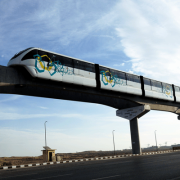
The Cairo Monorail began welcoming riders on May 6, opening the first section of what is expected to become the world’s longest driverless monorail network once complete. The launch introduced Africa’s first driverless monorail system and added a new layer to Egypt’s effort to modernize transportation around one of the continent’s largest urban centers.

Early passengers largely praised the experience. Mohammed Adel, a 48-year-old sales manager who tested the line shortly after it opened, told Al Jazeera that the trains were clean, comfortable and well air-conditioned. Another rider, teacher Hind Tarek, described traveling above Cairo’s streets as “close to the feeling of flying,” highlighting the elevated views the system offers.

The first operating route, the East Nile line, runs 35 miles (56.5 kilometers) from Cairo International Stadium in Nasr City to the New Administrative Capital, a vast city under construction east of Cairo. Rides were free during the first three days of service before a zone-based fare system took effect.

A one-way trip across the full East Nile route costs 80 Egyptian pounds, or about $1.51. Quarterly passes, each valid for 180 trips, range from 1,800 EGP, about $34, for travel within one zone to 7,200 EGP, about $136, for access across all four zones.

A second line remains under construction west of the Nile. That 27-mile (43.8-kilometer) route will connect 6th of October City, a satellite city in the greater Cairo region, with Giza.

Together, the two lines are expected to total about 62.3 miles (100.3 kilometers). That would edge past China’s Chongqing monorail, a 61.2-mile (98.5-kilometer) system currently recognized as the world’s longest. Egypt’s network would exceed it by 1.1 miles (1.8 kilometers).

The system is projected to move roughly 500,000 passengers a day, a significant promise in a city where transportation has long been defined by heavy congestion, fragmented roads and pressure on existing public transit. Cairo’s three Metro lines already carry around 500 million passengers annually, while the city’s roads remain notoriously clogged.

Transportation Minister Kamel Al Wazeer has said the monorail was selected in part because it could be built more cheaply and with less disruption than an underground metro system, avoiding the need to demolish existing buildings while minimizing impacts on surrounding streets during construction.

Embed from Getty Images

The project grew out of a 2019 $3 billion contract awarded to Alstom. The French rail manufacturer is leading the project alongside Cairo-based Orascom Construction and Arab Contractors. The consortium is not only building the network but is also committed to 30 years of operation and maintenance after construction is completed.

Alstom produced 272 monorail cars for the Egyptian system at its Derby factory in England. The final train left the East Midlands for Egypt in January 2024. UK Export Finance, the United Kingdom’s export credit agency, provided partial financial backing.

In total, the network uses 68 trains capable of transporting up to 45,000 passengers per hour in each direction. The trains can travel at 50 mph (80 km/h) along elevated precast concrete beams.

Egyptian officials have said the project is expected to create approximately 20,000 jobs once fully operational.

The monorail is fully electric and uses Alstom’s Innovia platform, which the company has also deployed for systems in Bangkok, Singapore and Los Angeles. The East Nile line is also designed to integrate with several of Cairo’s other transportation projects, including Metro Line 3, the Light Rail Transit system and the city’s Bus Rapid Transit network, as officials work to create a more connected public transit system.

Notably, the Cairo system is designed to run without a driver, with train movement, door operation and emergency functions handled through automated signaling that relies on high-bandwidth radio communications to locate trains.

Alstom has promoted the system as quieter and cleaner than many older forms of urban transit, as it produces low emissions, limits noise pollution and can recover up to 99% of braking energy, reducing its energy needs.

A representative for Alstom told CNN via email that the monorail was designed for Cairo’s future growth, with capacity that can be increased over time.

“Its architecture allowed capacity to be progressively increased — through service frequency, system optimization and fleet expansion — without compromising reliability or requiring disruptive infrastructure changes. This makes it fundamentally different from legacy systems that are often fixed in capacity from day one.”

Six of the route’s 22 stations are still not operating, and the line arrived later than expected. It had originally been scheduled to launch in 2023 but was delayed several times.

Those setbacks have unfolded against a broader debate over Egypt’s infrastructure spending. The country has poured money into large-scale domestic projects during an economic downturn, including the New Administrative Capital itself.

Embed from Getty Images

According to the US International Trade Administration, Egypt invested about 1.7 trillion EGP, or $106.3 billion, in infrastructure between 2023 and 2025. The country’s external debt rose above $163 billion last year.

The New Administrative Capital remains central to both the promise and the criticism surrounding the monorail. Affordability has emerged as one of the most common concerns among riders and transportation experts.

While supporters point to the monorail’s speed, comfort and air-conditioned trains, critics have questioned whether fares are practical for many Egyptians who would need to rely on the system for daily commuting.

Osama Aqeel, an international transport expert and professor of road and transport engineering, told Al Jazeera that mass transit systems should remain accessible to people across income levels, arguing that transportation costs should not place an excessive burden on household budgets.

“The state drew up a plan to solve traffic problems and expand roads and transport. The monorail, the metro, the LRT, and the BRT are four projects launched as a model of mass transit, because cities the size of Cairo face enormous traffic crises. The solution, in capitals and major cities, depends fundamentally on mass transit, not private cars.”

The Egyptian government has projected that the 270-square-mile city could eventually house 6.5 million people and generate roughly 2 million jobs. But large portions of the area are still under construction, and some residents have questioned whether the monorail will meaningfully reduce commute times for Cairo’s existing workforce in the near term.

The project has also prompted debate about who stands to benefit most from the new line. The monorail links older parts of Cairo with newer desert developments built around government offices, business districts and residential compounds.

Some observers argue the system primarily serves residents and workers connected to those emerging communities, while supporters contend the infrastructure is necessary to accommodate future population growth and economic development.

Alstom, however, has framed the East Nile launch as a long-term investment in smart urban mobility rather than a short-term traffic fix. Testing and commissioning were carried out by local engineering teams, and Alstom Egypt’s managing director, Ramy Salah Eldeen, said in a press release that 98% of the workforce came from Egypt.

“The East of Nile Monorail marks a major milestone in Egypt’s Vision 2030 journey toward smart, sustainable, and future-ready urban mobility,” Eldeen said.

The company has also positioned the Cairo Monorail as a possible example for other rapidly growing African cities seeking cleaner, high-capacity transit. Alstom is involved in other projects in Morocco, Ivory Coast, Algeria and South Africa, and said the need for this kind of transport infrastructure is increasing.

“The demand is there, and it will only grow.”

mbta

NYC Subways Testing Out AI Technology To Track Fare Evaders 

New York City’s MTA has consistently blamed the design of the subway system and its turnstiles for rampant fare evasion. Now, three companies are fighting to take control over a $1.1 billion contract to redesign the turnstiles.

Embed from Getty Images

These firms have already installed new fare gates with tall doors as opposed to the more well-known waist-high turnstiles. These doors have been installed at 10 subway stations throughout the last two months as part of a testing period for a pilot program. 

The program is also currently set to expand to 20 different subway stations within the next coming weeks, according to MTA Chair Janno Lieber while she testified at a state budget hearing in Albany this week. 

At least two of the three companies have stated that their designs utilize some level of artificial intelligence technology to track fare evaders. 

Cubic is the company that constructed most of the modern fare gates that are currently installed in the subway, as well as the now-retired MetroCard system. The company, however, has come under fire from MTA officials for delays and bugs with the rollout of the MTA’s new OMNY tap-to-pay system, according to the Gothamist

MTA Chair Janno Lieber stated during the hearing: 

“Cubic has not been a perfect partner and software developer and we ride them every day, all day. So we think most of it has been worked out, but there’s a couple of kinks we’re still working through, to be honest.”

Embed from Getty Images

Anthony Louh, Cibic’s director of business development, stated that the “hiccups” with the OMNY rollout have better prepared the company for taking on the new redesign contract. 

Cubic’s new gates are also currently being tested at busy stations like Atlantic Terminal and Port Authority. They stated their intentions to add them to 125th Street station on the A, B, C, and D lines. 

In terms of the use of AI, the gates have surveillance technology that are automatically meant to issue an alert whenever a fare is evaded. The officials for Cubic said that the equipment has cameras that record a five-second clip when someone doesn’t pay. The AI mechanism writes a physical description of the individual and then sends it to the MTA.

Conduent and STraffic are the other two companies fighting for the contract, and have also installed modern fare gates in subway stations that are currently being used. 

Conduent specifically has its own form of AI technology as well that utilizes sensors to collect data on people who evade fares, according to reports

“The pilot program continues and results will be reviewed at the appropriate time, with the vendors selected to supply fare gates for the future,” MTA spokesperson Eugene Resnick wrote. 

The MTA is hoping to install new entry points at 150 of the subway’s 472 stations.

traffic

New York City Becomes First US City To Implement Congestion Pricing

New York City has finally implemented its highly-debated and long-awaited congestion pricing strategy in Manhattan, and other cities in the US are watching closely.

LA

Los Angeles Is Aiming For A ‘No-Car’ Olympics For 2028 Games

The mayor of Los Angeles, Karen Bass, has pledged to make the 2028 Olympic Games car-free, an announcement that has many Californians curious as to how it will be pulled off in a city known for its public transit and gridlock traffic.

How The Covid-19 Vaccine Will Impact Future Travel Plans

With the Biden Administration officially inaugurated into the White House, however, many are expecting his new “lead with science” approach to help the US finally get on the right track with this pandemic.

Mid-Autumn Festival

Rising Covid-19 Concerns Appear In China As Nation Gears Up For Mid-Autumn Festival

With the arrival of the month of October comes the widely celebrated Mid-Autumn festival in Asia. On October 1st, hundreds of millions of individuals are expected to flood public transportation in what’s known as one of the busiest travel times in the world’s most populated country. The eight-day festival marks China’s first major holiday celebration since the coronavirus pandemic began. 

While life in China has almost completely returned to normalcy in terms of the pandemic, this week will be a true test to how successful they were at taming the virus/will continue to keep case numbers down. The festival, however, is projected to bring in a lot of money, as it does every year, which would be a great boost for China’s dwindling economy. 

Embed from Getty Images

Last year 782 million domestic trips were made during the festival week in China, which generated around $95 billion in tourism revenue. This year, the ministry of culture and tourism in China is projecting 550 million domestic trips, while China’s largest online travel agency, Ctrip, is predicting the number to be more around 600 million. 

The thought of that many individuals moving within such a short time period seems unfathomable for most citizens across the world also still battling this virus. But in China, the virus is less of a concern for the holiday week, as the nation has had close to zero local transmissions and has continued to implement some of the world’s strictest border control measures for international travelers. 

While Wuhan, China acted as the initial epicenter for Covid-19, the country has since been able to contain the virus and has only dealt with smaller-scaled outbreaks that occasionally would flare up. There haven’t been any locally transmitted symptomatic cases since mid-August, and any individuals coming into China from overseas have to go through a vigorous screening process.

Embed from Getty Images

China’s overall restrictions on domestic movement have for the most part been able to lift. Some cities are requiring their citizens to show a green health code on their smartphones at certain public transportation facilities, but the implementation of that policy has been relatively relaxed as of late. International leaders view this week’s festivities as a sign of China’s confidence, especially considering they’ve been one of the countries most on top of enforcing their health and safety measures. 

The Chinese Center for Disease Control and Prevention released a statement last week in which they claimed all domestic travel for the country can be arranged as normal for the upcoming holiday week, as long as all cities in mainland China maintain their low risk status. Travelers are still encouraged to protect themselves with facial coverings and social distancing.

China’s Culture and Tourism Ministry has also ordered prominent tourist sites to restrict capacity to 75% during the festival week, and to better facilitate potential contact tracing efforts in the future, all visitors are required to register which sites they’re going to visit online before being granted entry. 

While the Mid-Autumn Festival typically sees a massive spike in international travel among various celebrating Asian countries, this year all overseas trips will likely be impossible due to border restrictions heavily being enforced within most Asian countries. On major Chinese highways it’s expected that massive traffic jams will be occurring as they do every year, as it’s predicted that an average of 51 million highway trips happen per day during the week-long festival. 

Transgender Flag

Massive Protests Erupt In Response To Multiple Murders Of Black Transgender Women In America

Riah Milton was 25 and Dominique Fells was 27; both were black trans women, and both were murdered. The two victims were discovered a couple of weeks ago within the same week of eachother in what advocacy groups are calling the latest deaths in an epidemic facing transgender people; but more specifically black trans women.

Olympics

Want to Attend the 2020 Olympic Games? Here’s What You Should Know

Next year, the Olympics are scheduled to be held in Tokyo, the first time the Olympics will be held in this city since 1964. Like all Olympic events, the 2020 Olympics are expected to be a massive tourism and economic opportunity for its host city, and over 11,000 athletes from 206 nations plan on participating. Millions of people from around the world have entered a lottery, hoping for the opportunity to buy tickets to the two-week event. The massive event, preparations for which are already well underway, is funded by a 400 billion Japanese yen fund set aside by the Tokyo Metropolitan Government, which is paying for the construction of massive venues and infrastructure, including a temporary “Olympic Village” where athletes live during the duration of the event.

The opening ceremony for the 2020 Olympics will take place in Tokyo, on July 24th, and preliminary soccer and softball matches begin July 22nd. A record 339 events in 50 sports will be held throughout the 2020 Olympics, with the sports of karate, climbing, surfing, and skateboarding appearing for the first time. Additionally, baseball and softball will make their debut in the 2020 Olympics, which is appropriate considering the massive popularity of these sports in Japan. Though most of the events will be held in Tokyo, a number of events will also be held in surrounding areas, including the Sapporo Dome on the island of Hokkaido and the Fukushima Azuma Baseball Stadium.

Embed from Getty Images

A total of 7.8 million tickets will be sold, and even this number is insufficient to meet demand, as tickets have been sold via a lottery system, with most tickets being reserved for local fans. As such, it is difficult, yet still possible, to purchase tickets to the 2020 Olympics. Though all available tickets have already been sold, additional rounds of ticketing will occur throughout next year. Additionally, the Tokyo Olympics organizing committee will allow customers to resell their tickets, with the maximum ticket price being the original face value, to prevent scalping. If you miss out on getting tickets to the Olympics, there are other ways to enjoy the Olympics in and around Tokyo by attending so-called “Live Site” venues, where televised sports broadcasts will be featured and other programs will take place. 

Overall, travelling to Tokyo for the Olympics is sure to be an expensive, complex, and crowded operation, ideal for die-hard fans of Olympic sports but perhaps not for casual sports fans.

Owing to its massive size, security at the event will be strict. Drones are banned from flying over the events, and police have implemented facial recognition technology and other advanced surveillance technologies to combat the threat of terrorism and violence. Tokyo, fortunately, is considered one of the safest cities in the world, and has been relatively unaffected by violent extremism; however, the tremendous scale of the undertaking has raised concerns about cyberattacks and other threats to safety, including the possibility of a natural disaster, resulting in the implementation of security measures on an unprecedented scale. 

Additionally, the Olympic Committee has instituted a controversial policy of disallowing audio and video recordings made at the event from being posted to social media, and organizers are expected to rapidly issue takedown notices on social media networks for any violations. Photos, however, are allowed to be posted, but the intellectual property rights of photos taken at the event will be transferred to the Committee.

Embed from Getty Images

Tokyo’s public transit system is sprawling and complex, a necessity to handle the city’s densely-packed population. This system will be put to the test during the Olympics, as the number of expected visitors far exceeds the system’s ordinary capacity. As such, Tokyo is making a tremendous investment in its public transportation infrastructure to handle the influx of tourists, but the system is complex enough that visitors are advised to perform extensive research about how best to navigate the city, using online tools like Hyperdia

Perhaps one of the greatest challenges for tourists, however, is affordable lodging. Prices for hotel rooms have skyrocketed, and the tiny “capsule” hotel rooms for which the city is well-known have quintupled in price during the Olympic season. Making matters worse, Japanese hotel rooms are small compared to those throughout most of the world, and under Japanese law, hotels charge per-person, not per-room. Other options include AirBnBs, which are gaining popularity in the country but nonetheless remain expensive, and cruise ships, which are set to function as “floating hotels” during the Olympic games.

Overall, travelling to Tokyo for the Olympics is sure to be an expensive, complex, and crowded operation, ideal for die-hard fans of Olympic sports but perhaps not for casual sports fans. For these people, attending local events where the Olympic games are rebroadcast and other activities are held can be a cheaper and less stressful way to enjoy this upcoming historic event.