The Curious Case of ‘SuperAgers’: How Some People Over 80 Keep Minds as Sharp as Ever
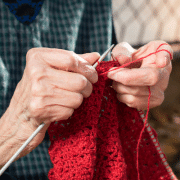
At 85, Sel Yackley is busier than most people half her age. Her days are filled with civic organization meetings, choir practice, book clubs, gym workouts, and knitting scarves for the homeless. She even finds time to get 7.5 hours of sleep a night, according to her Fitbit.
She’s also a SuperAger — a rare class of individuals 80 or older whose memory performance rivals that of people decades younger. As researchers at Northwestern University’s Mesulam Center for Cognitive Neurology and Alzheimer’s Disease explain, Yackley is more than just a high-functioning anomaly. She’s a living clue in a scientific mystery that may reshape how we understand aging.
When most people think of aging, they picture cognitive decline, memory lapses, and slower recall. But the SuperAgers at the center of Northwestern’s long-running study defy these expectations.
Since 2000, nearly 300 older adults have participated in the Northwestern University SuperAging Program (NUSAP), which focuses on individuals whose memory — particularly their delayed word recall — remains robust well into their 80s, 90s, and even beyond.
Yackley, who moved to Chicago from Turkey, credits both her genes and her spirit. Her parents lived into their late 80s, and she maintains a lifestyle rich in engagement and purpose.
“I think it’s partly your determination to live a long life and your activities that enable you to do so,” she told NBC News. She also encourages older adults to “pursue things that make you proud.”
So what exactly makes a SuperAger tick? That’s the question researchers at the Mesulam Center have been asking for the past 25 years. Their latest findings, published this week in “Alzheimer’s & Dementia: The Journal of the Alzheimer’s Association,” shed light on both the lifestyle habits and biological features that distinguish SuperAgers from their peers.
Dr. M. Marsel Mesulam first coined the term “SuperAger” in the late 1990s. Since then, his team — now led, in part, by Dr. Tamar Gefen, a neuropsychologist and associate professor at Northwestern — has taken a multi-pronged approach, including cognitive testing, lifestyle analysis, and post-mortem brain studies.
Interestingly, Gefen notes that most SuperAgers have one major thing in common: connection.
“I don’t know if it’s necessarily social connections, it’s just connections in general. There are people who are connected to the land, there are people who are connected to their ancestry, people who are connected to their grandchildren, who are connected to their art. You don’t see a lot of detached SuperAgers.”
To explore the neuroscience behind this phenomenon, researchers have autopsied nearly 80 brains of SuperAgers and compared them to those of neurotypical older adults. They focused on two biological markers heavily linked to Alzheimer’s disease: amyloid plaques and tau tangles.
SuperAgers had significantly fewer tau tangles in memory-critical regions of the brain — despite having similar levels of amyloid buildup.
This raises a provocative question, Gefen says: “Are we really targeting the right target if SuperAgers and their peers have similar amounts of amyloid?”
Their brains also feature larger entorhinal neurons, which play a key role in memory, and an abundance of von Economo neurons — rare cells believed to be associated with social intuition and complex emotions.
While some scientists believe these neural traits may be present from birth, researchers are now digging deeper into the cellular and genetic makeup of SuperAgers to understand how these advantages are maintained over time.
Of course, lifestyle alone doesn’t paint the full picture.
“Genetics is a part of it, definitely,” Gefen explains. For instance, some SuperAgers lack the high-risk gene variants associated with Alzheimer’s, such as APOE4. People of European descent who inherit two copies of APOE4 have up to a 60% chance of developing Alzheimer’s by age 85, but SuperAgers often don’t carry that burden.
“Our guess is that [SuperAgers] are probably born with these kinds of structural protections, but we’re now going really deep into the molecular mechanisms of the cell in order to figure out what is keeping that cell strong.”
Gefen is interested in whether the genes that SuperAgers harbor can prevent the development of Alzheimer’s disease.
“Is there a gene, let’s say, that’s related to the immune system, that is over-expressed in SuperAgers that can be manipulated to then help individuals protect themselves?”
SuperAgers are rare — at least for now. During the program’s initial recruitment period, only about 10% of participants met the criteria for being a SuperAger. Today, 101 active participants, aged 81 to 111, continue to contribute data, perspective, and even their eventual brain tissue to science.
And they come from all walks of life. Some are health nuts; others still enjoy the occasional vice. Some had stable, happy lives; others endured serious trauma and hardship. What unites them isn’t a perfect past — it’s resilience, purpose, and cognitive performance that stand out against the odds. “These SuperAgers know that they have a gift,” Gefen says.
Sel Yackley has already arranged for her brain to be donated to Northwestern’s Brain Bank — and, she hopes, her organs as well.
“Hopefully, maybe my heart or my kidneys can be used for transplanting. I don’t want to be underground.”
She’s still got things to do, though. The retired journalist and travel agent is currently tackling a scrapbook of her life. She logs about 4,200 steps a day and keeps her social calendar full. Her next goal? Making it to 90.

Moumita Basuroychowdhury is a Contributing Reporter at The National Digest. After earning an economics degree at Cornell University, she moved to NYC to pursue her MFA in creative writing. She enjoys reporting on science, business and culture news. You can reach her at moumita.b@thenationaldigest.com.