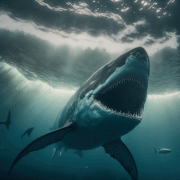
Scientists Find The Megalodon Was Even Longer Than Humans Initially Believed
The megalodon is one of our planet’s most iconic ancient giants. When we picture a megalodon in our head, we all have an image of an unfathomably large shark that likely ran the ocean. Many movies and other forms of media have given us a fictional idea of what the beast looked like, however, the actual size of megalodons have been a mystery, as no full fossils have ever been discovered.
Paleobiologist Dr. Kenshu Shimada and his team of coauthors/researchers recently published a study in the journal Palaeontologia Electronica that suggests the megalodon could have reached a length of up to 80 feet, and was much more slender than previously believed.
“Megalodon is not a simple, gigantic version of a great white shark. I think that we really have to move away from that concept.”
Dr. Shimada said that these findings can help scientists get a clearer picture of what the megalodon truly looked like, as well as how certain species that exist today evolved to be the size that they are.
While scientists have never found a complete megalodon fossil, the various pieces that have been discovered indicate that the species lived between 15 million and 3.6 million years ago, long before human beings existed.
Dr. Shimada explained how the megalodon is a part of the cartilaginous fish family, which means “they have a very poorly mineralized skeleton. There are no true bones that make the skeleton hard. On the other hand, their teeth are very hard, so they’re durable.”
Due to the fact that the megalodon grew new teeth continuously throughout their whole life, finding their teeth has been one of the easier acquisitions. Their teeth also greatly resemble a great white shark, which is why scientists have often stated the two sharks likely had a similar “stout” body shape, according to CNN.
Dr. Shimada and his team of colleagues began to question this observation after reviewing a paper published in August 2022. The paper showed a built digital 3D model of the megalodon where Shimada found that some of the mathematics behind the proportions didn’t seem correct.
“We kind of realized — click— that (the) great white shark is not a good model,” Shimada said.
In order to reach their new conclusions, Dr. Shimada and his team reviewed the anatomy of 145 living shark species and 20 extinct shark species to create a comprehensive database specifically of the heads, bodies, and tails.
“We have a vertebral column that’s known, and if we assume that that’s the complete trunk length, then why can’t we estimate the head length and a tail length based on modern day?” Shimada said.
Utilizing their research, the team found that the megalodon’s body was likely more like a lemon shark and less round.
“Inadvertently, we discovered the mystery of why some vertebrates can get large, but some cannot. If you stay in a skinnier body, there is a better chance of being able to grow larger,” Shimada said.
Dr. Stephen Godfrey, the curator of paleontology at the Calvert Marine Museum in Solomons, Maryland, who was not involved with the study, said: “The argument that they make, that a long, slender animal that size is more hydrodynamically efficient than if they’re really kind of fat and chunky, like if you scale up a living great white — that argument is a good one. But still, I’m not saying it gets stuck in my craw, but wow. I mean, that’s twice the size.”
“What we really need is the discovery of the complete skeleton. The real test comes when we really have the complete skeleton, and then it will support or refute whether it was really skinny or stocky,” Shimada concluded.

Eric Mastrota is a Contributing Editor at The National Digest based in New York. A graduate of SUNY New Paltz, he reports on world news, culture, and lifestyle. You can reach him at eric.mastrota@thenationaldigest.com.