Posts

soda

Sugary and Diet Beverages Both Tied to Liver Damage, Researchers Find

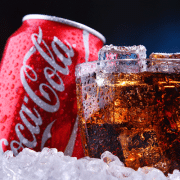
A new study has found that drinking even one can of diet soda a day may sharply raise the risk of developing nonalcoholic fatty liver disease, a growing condition that already affects nearly 40% of adults in the United States.

Researchers reported that participants who regularly consumed low or no-sugar soft drinks faced a 60% higher risk of liver fat buildup compared with non-drinkers. In comparison, those who opted for sugary beverages had a 50% higher risk. The findings challenge long-held assumptions that diet sodas are a healthier alternative.

“Sugar-sweetened beverages (SSBs) have long been under scrutiny, while their ‘diet’ counterparts have enjoyed a reputation as the better choice,” said lead author Lihe Liu, a graduate student in the department of gastroenterology at the First Affiliated Hospital of Soochow University in Suzhou, China.

The research, which has not yet been published in a peer-reviewed journal, was presented Monday in Berlin at the United European Gastroenterology Week, an annual meeting of digestive health specialists.

Nonalcoholic fatty liver disease, or NAFLD, occurs when fat accumulates in the liver despite little or no alcohol use. The condition, now increasingly referred to as metabolic dysfunction–associated steatotic liver disease (MASLD), can lead to inflammation, scarring (cirrhosis), and even liver cancer.

“Our study shows that LNSSBs (low or non-sugar-sweetened beverages) were actually linked to a higher risk of MASLD, even at modest intake levels such as a single can per day.”

Embed from Getty Images

The damage mirrors what doctors often see in heavy drinkers, but in this case, diet and lifestyle are to blame. Over the past three decades, NAFLD rates have surged by around 50% in the U.S., with nearly 38% of Americans now living with the disease. Globally, researchers say, MASLD has become a major driver of liver transplants and cancer cases.

“These findings challenge the common perception that these drinks are harmless and highlight the need to reconsider their role in diet and liver health, especially as MASLD emerges as a global health concern.”

The study followed nearly 124,000 adults without liver disease who were part of the UK Biobank, a large-scale biomedical database that tracks participants’ health and lifestyle habits over time. Over roughly ten years, researchers collected detailed 24-hour dietary questionnaires to track beverage consumption patterns.

Results showed that both regular and diet soft drinks were linked to higher rates of MASLD and liver-related death. However, participants who replaced either type of sweetened beverage with water saw a significant drop in risk, with reductions of nearly 13% for sugary drinks and 15% for diet drinks.

Switching between sugary and diet sodas made no difference. The only meaningful protective factor was water.

The study offers “direct evidence of dietary behaviors influencing MASLD,” said Dr. Sajid Jalil, a clinical associate professor of gastroenterology and hepatology at Stanford University School of Medicine, who was not involved in the research.

“The study showed that both regular and diet soft drinks may harm the liver over time, while choosing water or unsweetened drinks could help protect it. For me, this study has a lot more weight than previous studies because of its prospective design, involving a large number of subjects, a validated test for the diagnosis of MASLD and a long follow-up.”

Embed from Getty Images

The study also sheds light on how these drinks may damage the liver through different biological pathways.

Sugary beverages, packed with high-fructose corn syrup or refined sugars, cause sharp spikes in blood glucose and insulin. Over time, this can lead to insulin resistance, weight gain, and fat accumulation in the liver.

“They can change the gut microbiome, interfere with feelings of fullness, increase preference for sweet foods and even stimulate insulin secretion,” Liu told CNN in an email.

“Water, however, hydrates the body without affecting metabolism, helps with satiety and supports overall metabolic function. That’s why the risk reduction is similar no matter which sweetened drink is replaced — it shows that water is the healthiest default beverage.”

While the findings have not yet undergone peer review, experts say they add to a growing body of evidence linking beverage habits to long-term liver health. As NAFLD and MASLD become more prevalent,  particularly in younger adults, researchers are urging public health authorities to focus not just on sugar consumption, but also on the widespread reliance on “zero-calorie” alternatives.

The message, researchers say, is clear. There’s no truly safe soda. Whether sweetened with sugar or artificial substitutes, both appear to take a toll on the liver, and the simplest fix might already be in your glass.

coke

Coke Adds Cane Sugar Option Amid Health Debate Over Corn Syrup, Trump Claims Influence

Coca-Cola has announced it will launch a new soda made with U.S. cane sugar this fall, expanding its portfolio with an alternative sweetener amid renewed scrutiny of high-fructose corn syrup (HFCS). The update was announced as part of the company’s quarterly earnings report on Tuesday and arrived just days after President Donald Trump took credit on social media for influencing the switch.

In a statement, the beverage giant described the new product as “an offering made with U.S. cane sugar” that aligns with its “ongoing innovation agenda.” While Coca-Cola already uses cane sugar in certain regional or specialty products, such as Mexican Coke, which is available in the U.S., and in beverages like its lemonade and coffee lines, this marks the first major U.S. release of a cane sugar cola in recent years.

“This addition is designed to complement the company’s strong core portfolio and offer more choices across occasions and preferences.”

In the U.S., Coca-Cola has been made with corn syrup since 1984, when the company announced its switch from cane sugar and sugar beets. Analysts suggest that the change occurred because the corn replacement was more cost-effective, and the sugar industry was weakening as more people began using artificial sweeteners.

CEO James Quincey emphasized that the new drink is about meeting consumer demand rather than replacing the classic formula. “We appreciate the President’s enthusiasm for our Coca-Cola brand,” Quincey said during a call with analysts, “We are definitely looking to use the whole toolkit of available sweetening options where there are consumer preferences.”

Embed from Getty Images

Trump had claimed on Truth Social last week that he had “convinced” Coca-Cola to ditch HFCS in favor of cane sugar, a declaration that, while partially grounded in timing, doesn’t reflect the reality of the company’s plans.

“I have been speaking to Coca-Cola about using REAL Cane Sugar in Coke in the United States, and they have agreed to do so. I’d like to thank all of those in authority at Coca-Cola. This will be a very good move by them — You’ll see. It’s just better!”

The president allegedly has a button at his desk in the Oval Office that requests a Diet Coke. It resembles a small wooden box with a red trigger, which notifies a staff worker to deliver a drink.

Despite speculation stirred by Trump’s comments, the classic Coca-Cola recipe in the United States will not be altered; it will continue to contain high-fructose corn syrup. Instead, the cane sugar version will be a separate product aimed at diversifying choices on the shelf rather than changing the brand’s most iconic offering.

The conversation around sugar in American beverages has become increasingly charged in recent years, with health advocates raising concerns about the prevalence of HFCS. One of the loudest critics is Robert F. Kennedy Jr., Trump’s Secretary of Health and Human Services, who has railed against artificial and ultra-processed ingredients in the U.S. food system.

In a recent appearance on Dr. Jordan Peterson’s podcast, Kennedy described HFCS as “a formula for making you obese and diabetic,” advocating for its removal from widely consumed foods and beverages. HFCS, while cheap and shelf-stable, has long been associated with America’s rising rates of obesity and metabolic disease.

Kennedy praised the Steak ‘n Shake restaurant chain over the weekend for announcing that it would begin selling Coca-Cola with real cane sugar rather than high-fructose corn syrup. Kennedy declared on X, “MAHA is winning,” in reference to the news and his “Make America Healthy Again” messaging.

Embed from Getty Images

However, public health experts caution that swapping out sweeteners may be more cosmetic than meaningful in terms of health outcomes. “Excess consumption of sugar from any source harms health,” Eva Greenthal, senior policy scientist at the Center for Science in the Public Interest, told CNN. “To make the U.S. food supply healthier, the Trump administration should focus on less sugar, not different sugar.”

Nutritionist and professor of food studies at New York University, Marion Nestle, told Associated Press last week that the switch was insignificant.

“For all practical purposes, they’re the same. I find the switch to be nutritionally hilarious. They taste the same. They have the same number of calories. They do exactly the same things in the body. Everybody would be healthier eating less of both of them.”

Coca-Cola’s move comes as the market sees a modest uptick in interest around more “natural” or “cleaner” sweeteners, particularly among younger consumers seeking transparency and simplicity in their food choices. Still, cane sugar is notably more expensive in the U.S. than HFCS, a fact that has kept many manufacturers from making the switch on a broad scale.

PepsiCo, Coca-Cola’s biggest rival, isn’t altering its flagship product but has dipped into the trend with new cane sugar-based offerings in its growing health-oriented lineup. Its prebiotic soda, as well as products from its recently acquired Poppi brand, use cane sugar as their primary sweetener.

PepsiCo CEO Ramon Laguarta recently weighed in on the economics of sugar reform during an interview on CNBC.

“Sugar is more expensive in the US than in many parts of the world, so I think there is a conversation with the government probably on how do we make sugar more affordable in the US, how do we have a farming strategy probably that reduces the cost of sugar and that will facilitate a lot of the transition for us and for the whole industry.”

drinks

New Study Reveals Sugary Drinks Linked To Millions Of New Diabetes And Heart Disease Cases 

According to a new study published in Nature Medicine, sugary drinks are responsible for more than 2.2 million cases of diabetes and 1.1 million new cases of heart disease a year around the world. 

The study highlighted rising health inequalities, citing that Latin America and the Caribbean say sugary drinks contribute to about 24% of new type 2 diabetes cases in 2020. 

In sub-Saharan Africa, they had the greatest percentage increase in diabetes cases from 1990 to 2020, and sugary drinks led to 21% of new diabetes cases and 11% of new heart disease cases. 

Embed from Getty Images

Columbia, Mexico, and South Africa also experienced major rises. Half of new diabetes cases in Columbia were connected to sugary drink consumption. One-third of new diabetes cases in Mexico were also linked with 27.6% of cases in South Africa also being connected. 

Part of the science behind this connection has to do with how quickly sugary drinks are digested. The speed causes a spike in blood-sugar levels and provides little nutritional value. 

“Sugar-sweetened beverages are heavily marketed and sold in low- and middle-income nations. Not only are these communities consuming harmful products, but they are also often less well equipped to deal with the long-term health consequences,” Dariush Mozaffarian, one of the paper’s authors, said.

Around 830 million people have diabetes around the world. A majority of these individuals live in low to middle income countries. Type 2 diabetes can be prevented, unlike type 1. Cardiovascular disease is the leading cause of death around the world with about 17.9 million people dying from the disease annually. 

Embed from Getty Images

“We are seeing a rise in the popularity of sugary drinks fuelled by influencer culture online. In urban centres, young people are targeted by social media influencers that are paid to promote branded sugary drinks to them, filling an information gap left by the lack of school-based nutrition education,” Dr Catherine Kanari, a non-communicable diseases specialist for Amref Health Africa in Kenya, said.

“Ultimately, a rise in diabetes cases risks straining our health system to beyond its limits.”

The authors of the study are hoping that their research will spark greater conversations about the measures that can be taken to help prevent this consistent increase in diabetes and heart disease. They’re calling for more public health compaigns as well as greater regulation on sugary drink advertisements.

“Much more needs to be done, especially in countries in Latin America and Africa where consumption is high and the health consequences severe,” said Mozaffarian. 

“As a species, we need to address sugar-sweetened beverage consumption.”

Milk Bottle

What Drinks Hydrate You The Most? The Answer Will Definitely Surprise You…

Water is known to be the source of life. Whenever we’re feeling under the weather, the number one tip that’s repeated to us is to keep our bodies hydrated. Well, according to a study completed by St. Andrew’s University in Scotland, water isn’t even the most hydrating beverage compared to other drinks hydration responses in the human body.  

The research showed that beverages that contain a little bit of sugar, fat, or protein do a better job than water at keeping us hydrated for longer periods of time. It’s all about the bodies natural response to certain drinks compared to others. The volume of the drink, for example, is a major factor. Obviously with water, and drinks in general, the more you drink, the faster it empties from your stomach and into your bladder, and the faster our bloodstream absorbs the hydration.    

Nutritional composition is the main factor that determines how hydrating a beverage is. For example, the study found that milk contains little amounts of sugar, protein and fat, these three components make milk even more hydrating than plain water because it causes it to stay in your system for a longer period of time, prolonging the length of time your body is being hydrated. The protein, sugar, and fat found in milk has a more complex molecular composition, which causes our bodies to process and digest it for a longer period of time. Water is simply hydrogen and oxygen, hence why it goes through our body so easily. It’s simple composition quickly tells our body what to absorb into our bloodstream and what to send out. The official research from St. Andrews University came to the official conclusion below, which is provided by CNN

“The research team at St. Andrews University tested 13 common beverages to see how they impact hydration. Here’s what they found, ranked from most hydrating over a four-hour period to least.

  1. Skim milk
  2. Oral re-hydration solutions (like Pedialyte or Liquid I.V.)
  3. Full fat milk
  4. Orange juice
  5. Cola
  6. Diet Cola
  7. Cold tea
  8. Tea
  9. Sports drink
  10. Still water
  11. Sparkling water
  12. Lager
  13. Coffee”

Embed from Getty Images

“This study tells us much of what we already knew: Electrolytes — like sodium and potassium — contribute to better hydration, while calories in beverages result in slower gastric emptying and therefore slower release of urination,” said Melissa Majumdar, a registered dietitian and personal trainer, also to CNN

However, don’t let these results fool you, just because certain beverages are more “hydrating” for a fixed amount of time compared to water, that doesn’t mean that they’re better for you. For example, some of the beverages listed above water, such as Cola, sports drinks, and orange juice, contain concentrated sugars that actually take longer for the body to process. Once these sugars enter into our intestines, the water that was absorbed from the same beverage the sugars came from, is used to dilute and break down the sugar molecules to be absorbed. So your body is essentially dehydrating through hydration. 

It’s important to point out that the list above does not mean that things like juice and soda are better for your body to absorb when you need hydration. The hydration process is a lot more intense and prolonged with the beverages listed above water, but it’s a give and take. The fact is these beverages can help ASSIST with hydration and keeping your body consistently hydrated through the day, but water is always going to be your best bet.

It’s the same thing with the coffee and alcoholic beverages on the list. Alcohol and caffeine both are diuretics, which means it will cause you to pass more urine more often. So both of these drinks work the same way that a juice would. In moderation, they can help your body sufficiently and slowly absorb the water components in them, but in excess, you’ll be expelling liquids so often from your body that you’re actually going to lose hydration through the dilution process your body will go through from digesting so many complex beverage molecules.

To conclude – water is your best friend and will always keep your body properly hydrated and functioning. However, if you’re tired of having to drink eight glasses a day, thus leading to an endless cycle of going to the bathroom every 45 minutes, there are definitely hydrating alternatives that you should feel free to treat yourself to, without feeling so guilty about the extra sugar.