Posts

kids

Health Of US Kids Has Deteriorated Over The Past Two Decades, New Study Finds 

According to a new study recently published in the Journal of the American Medical Association, the health of children growing up in America has deteriorated over the past 17 years. The study showed that US kids today are more likely to have obesity, chronic diseases, and mental health problems. 

The researchers findings in regards to the cause of this declining health among US children is nothing new, however, the information found was much more comprehensive than previous studies, providing a better understanding for parents and guardians. 

Embed from Getty Images

“The surprising part of the study wasn’t any with any single statistic; it was that there’s 170 indicators, eight data sources, all showing the same thing: a generalized decline in kids’ health,” said Dr. Christopher Forrest, one of the study’s authors.

Health Secretary Robert F. Kennedy Jr. has made children’s health a major focus of his work in the White House. In May, Kennedy Jr. released a report entitled “Make America Healthy Again” which described American children as undernourished, overmedicated, and lacking physical activity. 

Outside health experts have stated, however, that the Trump administration’s cuts to federal health agencies, Medicaid, and other health research is not helping the kids of America to become healthier and more active. 

“The health of kids in America is not as good as it should be, not as good as the other countries, and the current policies of this administration are definitely going to make it worse,” said Dr. Frederick Rivara, a pediatrician and researcher who co-authored an editorial accompanying the new study.

In order to make the conclusions within their study, Forrest and his colleagues analyzed surveys, utilized health records from 10 pediatric health systems as well as international mortality statistics.

The study cited obesity rates in US children aged 2-19 has risen from 17% in 2007/2008, to 21% in 2021 – 2023. 

In 2023, a child in the US was 15% to 20% more likely to have a chronic condition such as anxiety, depression, or sleep apnea when compared to a child in 2011.

Throughout the entire study period, children reported an increase in trouble sleeping, limited physical activity, higher depression rates, and more. 

Embed from Getty Images

AP reported the study showed American children were around 1.8 times more likely to die than kids in other high-income nations from 2007 to 2022. US infants are more likely to be born prematurely and succumb to sudden unexpected death. 

“The research points to bigger problems with America’s health,” said Forrest.

“Kids are the canaries in the coal mine. When kids’ health changes, it’s because they’re at increased vulnerability, and it reflects what’s happening in society at large,” he said.

“The timing of the study is completely fortuitous,” Forrest added.  

The previously mentioned editorial published with the study said “while the administration’s MAHA movement is bringing welcome attention to chronic diseases, it is pursuing other policies that will work against the interests of children.” 

The administration is eliminating injury prevention, maternal health programs, investments in a campaign addressing sudden infant death, and is “fueling vaccine hesitancy among parents that may lead to a resurgence of deadly vaccine-preventable diseases,” the authors wrote.

Forrest said that while “risks highlighted by the MAHA report, such as eating too much ultra-processed food, are real but miss the complex reality driving trends in children’s health.”

“We have to step back and take some lessons from the ecological sustainability community and say: Let’s look at the ecosystem that kids are growing up in. And let’s start on a kind of neighborhood-by-neighborhood, city-by-city basis, examining it,” he said.

influencer

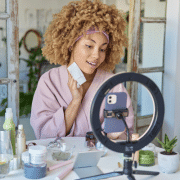
Experts Weigh In On Children’s Fixation With Anti-Aging And Skin Care 

The children and young tweens of generation Z are becoming obsessed with their skin care routines, and anti-aging, despite being so young. Generation Alpha, which includes children as young as 10-years-old, are buying expensive skin care products that contain ingredients that could actually damage their skin in the future due to the fact that they simply don’t need anti-aging and other ingredients on their skin. 

The Guardian recently interviewed multiple experts on this concerning trend of children being obsessed with their self-image, specifically regarding their views on aging. 

Embed from Getty Images

We have seen an increase in teenage girls using skincare … prematurely using anti-ageing products and increasingly valuing beauty and looking young. Access to social media will be a big influence here. TikTok, in particular, has millions of videos dedicated to this topic and we are starting to see the younger generations of influencers coming through: it’s now the children of the Kardashian family sharing skincare routines online,” said Josie O’Brien, health and beauty consumer insights director at consumer analysts Kantar.

“Kantar data tells us that teens are specifically using social media for skincare and makeup recommendations. So they have access to that information, whether it is appropriate or not.

Another factor is the in-store experience. The ability to try samples, products that stand out on the shelf, and nice smells are big deciding factors for young people when choosing skincare. Brands such as Drunk Elephant and Sol de Janeiro are viral among this demographic at the minute, and if you look at the products you can see why they would appeal to younger people,” O’Brien explained

“Certain aspects of this are positive and other elements less so. The rise in people wearing sunscreen younger is positive and that awareness will hopefully bode well in adulthood,” said Dr Ross Perry, medical director of Cosmedics skin clinics.

“Why are young people more interested in anti-aging products? A big factor is social media. Everything is pointing towards looking as good as we can. There is that pressure now in marketing, and social media massively influences how we perceive ourselves. If people see perfect skin and perfect routines they are more likely to follow them,” said Dr. Perry.

Embed from Getty Images

“Feminine identity is very much positioned in terms of appearance and looking a certain way and the beauty standards culture and societies put upon us. We know girls and women, as well as gender-diverse people, are particularly affected by this. Historically, there is pressure on women to look a certain way as they are objectified in culture. There is a lot of pressure to manipulate and modify their bodies,” said Phillippa Diedrichs, professor of psychology at the University of the West of England.

“As a result, we see a high rate of self-objectification among women and increasingly young girls. They have internalized this societal pressure and see their bodies as objects to be modified. They spend a lot of time focused on their appearance. That gets distilled down to girls being silly and vain or trivial, but there is a cultural pressure to do it, and they see people who conform to these standards. They are often held up as the most rewarded in society.

Cosmetic procedures are also more accessible financially and in terms of who offers them. For example, Botox is now advertised at the dentist,” Diedrichs stated. 

“Unlike smoking or drinking, skincare is seen as an innocent way of playing with being older. It is not as obvious as makeup. I think brands encourage it, and like the fact it has become a luxury accessory and there are a lot of myths being peddled. People are told they must do certain things to keep their skin healthy and that exposure is good for brands sometimes,” explained Dr Emma Wedgeworth of the British Cosmetic Dermatology Group.

“It’s reflective of our obsession with aging as a society. We are supposed to as a society evolve and become more enlightened but we are failing in terms of how we value older people and maturity.”