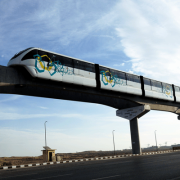
Egypt Debuts Driverless Monorail as New Capital Expansion Continues
A train built in England, financed partly through the British government and designed by a French rail giant, is now carrying passengers above Cairo’s streets, linking Egypt’s crowded capital with one of the country’s most ambitious desert megaprojects.
The Cairo Monorail began welcoming riders on May 6, opening the first section of what is expected to become the world’s longest driverless monorail network once complete. The launch introduced Africa’s first driverless monorail system and added a new layer to Egypt’s effort to modernize transportation around one of the continent’s largest urban centers.
Early passengers largely praised the experience. Mohammed Adel, a 48-year-old sales manager who tested the line shortly after it opened, told Al Jazeera that the trains were clean, comfortable and well air-conditioned. Another rider, teacher Hind Tarek, described traveling above Cairo’s streets as “close to the feeling of flying,” highlighting the elevated views the system offers.
The first operating route, the East Nile line, runs 35 miles (56.5 kilometers) from Cairo International Stadium in Nasr City to the New Administrative Capital, a vast city under construction east of Cairo. Rides were free during the first three days of service before a zone-based fare system took effect.
A one-way trip across the full East Nile route costs 80 Egyptian pounds, or about $1.51. Quarterly passes, each valid for 180 trips, range from 1,800 EGP, about $34, for travel within one zone to 7,200 EGP, about $136, for access across all four zones.
A second line remains under construction west of the Nile. That 27-mile (43.8-kilometer) route will connect 6th of October City, a satellite city in the greater Cairo region, with Giza.
Together, the two lines are expected to total about 62.3 miles (100.3 kilometers). That would edge past China’s Chongqing monorail, a 61.2-mile (98.5-kilometer) system currently recognized as the world’s longest. Egypt’s network would exceed it by 1.1 miles (1.8 kilometers).
The system is projected to move roughly 500,000 passengers a day, a significant promise in a city where transportation has long been defined by heavy congestion, fragmented roads and pressure on existing public transit. Cairo’s three Metro lines already carry around 500 million passengers annually, while the city’s roads remain notoriously clogged.
Transportation Minister Kamel Al Wazeer has said the monorail was selected in part because it could be built more cheaply and with less disruption than an underground metro system, avoiding the need to demolish existing buildings while minimizing impacts on surrounding streets during construction.
The project grew out of a 2019 $3 billion contract awarded to Alstom. The French rail manufacturer is leading the project alongside Cairo-based Orascom Construction and Arab Contractors. The consortium is not only building the network but is also committed to 30 years of operation and maintenance after construction is completed.
Alstom produced 272 monorail cars for the Egyptian system at its Derby factory in England. The final train left the East Midlands for Egypt in January 2024. UK Export Finance, the United Kingdom’s export credit agency, provided partial financial backing.
In total, the network uses 68 trains capable of transporting up to 45,000 passengers per hour in each direction. The trains can travel at 50 mph (80 km/h) along elevated precast concrete beams.
Egyptian officials have said the project is expected to create approximately 20,000 jobs once fully operational.
The monorail is fully electric and uses Alstom’s Innovia platform, which the company has also deployed for systems in Bangkok, Singapore and Los Angeles. The East Nile line is also designed to integrate with several of Cairo’s other transportation projects, including Metro Line 3, the Light Rail Transit system and the city’s Bus Rapid Transit network, as officials work to create a more connected public transit system.
Notably, the Cairo system is designed to run without a driver, with train movement, door operation and emergency functions handled through automated signaling that relies on high-bandwidth radio communications to locate trains.
Alstom has promoted the system as quieter and cleaner than many older forms of urban transit, as it produces low emissions, limits noise pollution and can recover up to 99% of braking energy, reducing its energy needs.
A representative for Alstom told CNN via email that the monorail was designed for Cairo’s future growth, with capacity that can be increased over time.
“Its architecture allowed capacity to be progressively increased — through service frequency, system optimization and fleet expansion — without compromising reliability or requiring disruptive infrastructure changes. This makes it fundamentally different from legacy systems that are often fixed in capacity from day one.”
Six of the route’s 22 stations are still not operating, and the line arrived later than expected. It had originally been scheduled to launch in 2023 but was delayed several times.
Those setbacks have unfolded against a broader debate over Egypt’s infrastructure spending. The country has poured money into large-scale domestic projects during an economic downturn, including the New Administrative Capital itself.
According to the US International Trade Administration, Egypt invested about 1.7 trillion EGP, or $106.3 billion, in infrastructure between 2023 and 2025. The country’s external debt rose above $163 billion last year.
The New Administrative Capital remains central to both the promise and the criticism surrounding the monorail. Affordability has emerged as one of the most common concerns among riders and transportation experts.
While supporters point to the monorail’s speed, comfort and air-conditioned trains, critics have questioned whether fares are practical for many Egyptians who would need to rely on the system for daily commuting.
Osama Aqeel, an international transport expert and professor of road and transport engineering, told Al Jazeera that mass transit systems should remain accessible to people across income levels, arguing that transportation costs should not place an excessive burden on household budgets.
“The state drew up a plan to solve traffic problems and expand roads and transport. The monorail, the metro, the LRT, and the BRT are four projects launched as a model of mass transit, because cities the size of Cairo face enormous traffic crises. The solution, in capitals and major cities, depends fundamentally on mass transit, not private cars.”
The Egyptian government has projected that the 270-square-mile city could eventually house 6.5 million people and generate roughly 2 million jobs. But large portions of the area are still under construction, and some residents have questioned whether the monorail will meaningfully reduce commute times for Cairo’s existing workforce in the near term.
The project has also prompted debate about who stands to benefit most from the new line. The monorail links older parts of Cairo with newer desert developments built around government offices, business districts and residential compounds.
Some observers argue the system primarily serves residents and workers connected to those emerging communities, while supporters contend the infrastructure is necessary to accommodate future population growth and economic development.
Alstom, however, has framed the East Nile launch as a long-term investment in smart urban mobility rather than a short-term traffic fix. Testing and commissioning were carried out by local engineering teams, and Alstom Egypt’s managing director, Ramy Salah Eldeen, said in a press release that 98% of the workforce came from Egypt.
“The East of Nile Monorail marks a major milestone in Egypt’s Vision 2030 journey toward smart, sustainable, and future-ready urban mobility,” Eldeen said.
The company has also positioned the Cairo Monorail as a possible example for other rapidly growing African cities seeking cleaner, high-capacity transit. Alstom is involved in other projects in Morocco, Ivory Coast, Algeria and South Africa, and said the need for this kind of transport infrastructure is increasing.
“The demand is there, and it will only grow.”

Moumita Basuroychowdhury is a Contributing Reporter at The National Digest. After earning an economics degree at Cornell University, she moved to NYC to pursue her MFA in creative writing. She enjoys reporting on science, business and culture news. You can reach her at moumita.b@thenationaldigest.com.