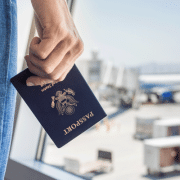
U.S. Passport Falls Out of Global Top 10 for the First Time in 20 Years
For the first time in two decades, the U.S. passport no longer ranks among the world’s ten most powerful, according to the Henley Passport Index, which measures how freely citizens can travel without a visa.
The 2025 ranking crowns Singapore, South Korea, and Japan as the most travel-friendly passports, offering their holders visa-free entry to 193, 190, and 189 destinations, respectively. The United States, by contrast, has fallen to 12th place, tied with Malaysia, granting visa-free access to 180 of the 227 destinations tracked by Henley & Partners.
The London-based firm compiles the index using data from the International Air Transport Association, and because countries with equal scores share a single rank, the U.S. passport technically trails 36 other nations this year.
Back in 2014, the U.S. topped the chart. Even as recently as mid-2025, it managed to cling to the top 10. But a series of shifting visa policies worldwide has changed the landscape dramatically.
Brazil’s decision in April to revoke visa-free access for Americans, Canadians, and Australians, citing a lack of reciprocity, dealt an early blow. Meanwhile, China has been opening its doors wider, granting visa exemptions to European nations like Germany and France, but not to the United States. Papua New Guinea and Myanmar have also made entry rule changes that improved their own standings while pushing the U.S. further down.
According to Henley’s report, the latest setback came when Somalia launched a new eVisa system and Vietnam excluded the U.S. from its latest batch of visa-free additions.
“The declining strength of the US passport over the past decade is more than just a reshuffle in rankings — it signals a fundamental shift in global mobility and soft power dynamics,” said Christian H. Kaelin, chair of Henley & Partners.
“Nations that embrace openness and cooperation are surging ahead, while those resting on past privilege are being left behind.”
The United Kingdom, which topped the index in 2015, has also reached its lowest-ever position, falling from 6th to 8th since July. In contrast, several countries have made rapid climbs. China has jumped from 94th place in 2015 to 64th today, gaining visa-free access to 37 new destinations.
Henley attributes that rise to Beijing’s expanding diplomatic outreach, including visa-free deals with Russia, Gulf states, South America, and Europe. The United Arab Emirates is another success story, soaring 34 spots over the last decade—from No. 42 to No. 8—thanks to a slew of reciprocal agreements.
At the other end of the spectrum sits Afghanistan, holding last place at No. 106, with visa-free access to just 24 destinations, down two since the start of the year. Syria (26) and Iraq (29) follow just above it. That leaves a 169-country gap between the most and least mobile passports on earth.
Henley’s current top 12 are as follows:
- Singapore (193 destinations)
- South Korea (190)
- Japan (189)
- Germany, Italy, Luxembourg, Spain, Switzerland (188)
- Austria, Belgium, Denmark, Finland, France, Ireland, Netherlands (187)
- Greece, Hungary, New Zealand, Norway, Portugal, Sweden (186)
- Australia, Czech Republic, Malta, Poland (185)
- Croatia, Estonia, Slovakia, Slovenia, UAE, UK (184)
- Canada (183)
- Latvia, Liechtenstein (182)
- Iceland, Lithuania (181)
- United States, Malaysia (180)
Back in July, CNN Business editor-at-large Richard Quest noted that new entry requirements, such as ESTAs in the European Union and the UK, were further limiting Americans’ mobility.
“Can we make a linkage, if you will, to immigration policies of the Trump administration? Yes, you probably can, at some level, say there is a direct relation between one and the other.”
Still, he said, elite passports remain coveted assets. “There are certainly citizenships that give greater access and availability to travel,” Quest explained. Wealthy individuals often pursue such documents through investment schemes—like the $5 million “gold card” program once floated by Donald Trump.
“But for the average person, it’s not a jot of difference. You’ve got your passport, you’ve got where you are. Learn and live with it.”
The Henley Passport Index isn’t the only global mobility scoreboard. Financial consultancy Arton Capital publishes its own Global Passport Power Rank, updated in real time by tracking government portals. Arton’s 2025 ranking currently puts the United Arab Emirates in first place, with a visa-free/visa-on-arrival score of 179, followed by Singapore and Spain (each at 175).

Moumita Basuroychowdhury is a Contributing Reporter at The National Digest. After earning an economics degree at Cornell University, she moved to NYC to pursue her MFA in creative writing. She enjoys reporting on science, business and culture news. You can reach her at moumita.b@thenationaldigest.com.