Posts

wildfire

Thousands Under Evacuation Notice In California And Oregon Amid Intense Wildfires

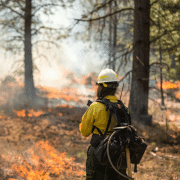
Thousands of homes and their residents in northern California and central Oregon entered evacuation orders as firefighting crews continue to battle wildfires in dry, hot weather. The Pickett fire has burned through more than 6,800 acres of Napa county, and was only 13% contained by Monday morning, according to the California department of forestry and fire protection (Cal Fire). 

Embed from Getty Images

Around 150 people were ordered to leave their homes with another 360 under evacuation warnings. Reports show that the wildfires are threatening around 500 structures near Aetna Springs and Pope Valley, which is 80 miles north of San Francisco, according to Cal Fire spokesperson Jason Clay. 

In Oregon, the Flat fire in Deschutes and Jefferson counties has around 4,000 homes under various levels of evacuation notice, including 1,000 homes ordered to leave immediately, according to the state fire marshal’s office. 

Officials stated that firefighters were able to cut containment lines and suppress fires in some residential areas, however, they’re finding it difficult to combat the fires on more vulnerable terrains with low humidity and triple-digit temperatures. 

More than 1,230 firefighters with 10 helicopters are working to battle the California fire which initially began on Thursday last week after seven days of extremely hot temperatures. There is no known cause of the fire at the moment or where it began. 

Western US residents have been combating major heatwaves and an intense wildfire season. Residents have been hospitalized throughout California, Washington, Oregon, Nevada, and Arizona. 

When the heatwaves subside, officials say that the risks will continue as these areas have minimal moisture, increasing the danger for more fires in the coming month and into October. 

Embed from Getty Images

In parts of Nevada, California, Utah, Arizona, Colorado, and Wyoming, risks are also increased by vegetation that are dangerously dry and overgrown. 

The heat alone bakes moisture out of already dehydrated landscapes, increasing the potential for ignitions, rapid fire spread, and threats to public health. Extreme heat is often referred to as the “silent killer” and is the most lethal weather-related disaster in the US. 

Heatwaves throughout the US are getting longer, larger, and more intense due to climate change which is intensified by concrete city landscapes. 

The Pickett fire began in the same area as the Glass fire in 2020, which entered into Sonoma county and burned around 105 square miles and more than 1,500 structures. 

The Oregon fire is in a high desert climate where dried vegetation, grasses, and juniper trees are burning rapidly, causing the fire to spread throughout canyon areas “where it is challenging to create containment lines,” said Jason Carr, Deschuted county sheriff’s spokesman. 

The fire has been growing due to hot and gusty wind conditions. Fire officials are also looking out for isolated thunderstorms, specifically in southern Oregon which could travel north, according to state fire marshals spokesman Chris Schimmer.

“If we get thunderstorms that roll through, it can … cause the fire to jump [containment] lines,” said Carr.

Firefighters are keeping a close eye on the fires and working hard to combat them to prevent spreading.

volcano

Underwater Volcano On The West Coast To Erupt This Year

A large undersea volcano hundreds of miles off the coast of Oregon is showing signs of an impending eruption later this year, and it’s set to be publicly livestreamed.

garden

Sustainable Fire-Resistant Home Gardens Are On The Rise In The West Coast

Recent wildfires in Los Angeles and the west coast have prompted many homeowners to think differently about the ways in which they organize their outdoor spaces. Specifically, residents are looking for ways to create the most sustainable and fire-resistant gardens to thrive on their property.

Firefighters Around The US Are Working To Contain Wildfires On Both Coasts

Wildfires are currently burning throughout both the East and West coast of the US. Firefighters throughout the nation are working to combat the massive blazes being fueled by historic droughts, strong winds, and dry conditions.

California Wildfires Growing At Rapid Pace, National Forests Close As A Result 

Millions of acres of national forest space in Northern California are being closed due to dangerous conditions created by wildfires that have already destroyed hundreds of homes. The US Forest Service announced this week that it would be closing nine national forests stretching from Lake Tahoe to the Six Rivers National Forest. 

The Eldorado National Forest has already been closed due to the Caldor Fire which greatly damaged over 100 square miles of land. In two days the wildfires in California have grown 10 times their original size. 

Embed from Getty Images

25,000 Californians are currently under evacuation orders due to the fires as well. More than 650 firefighters and 13 helicopters were recently battling a deadly blaze near Lake Tahoe.

“The hope is with the additional resources and personnel on scene, we can really start to build that box around this fire and start the containment,” said Keith Wade of the California Department of Forestry and Fire Protection.

“The fire wants us bad because it’s made every attempt it can to get out of that canyon and up this way,” Thurman said. “So they keep beating it down. And it’s just … it’s resilient, it’s stubborn, it won’t go away. That’s all we can do,” said Thurman Conroy and his wife, Michele, who stayed behind to protect their house and their business, Conroy General Store. 

Evacuees from the Caldor fire found refuge in places like the Green Valley Community Church in Placerville, where a multitude of tents and trailers have been set up. Over a dozen fires have been threatening thousands of homes, and the recent heat waves in America have forced small communities to evacuate into safer spaces away from the fire’s path. 

Embed from Getty Images

More than 10,000 firefighters have been deployed throughout the state to minimize the damage. Authorities claim the Dixie Fire, which began on July 13th in the northern Sierra Nevada and southern Cascades area, has spread over 1,060 square miles and has only been 35% contained. 

The fire completely gutted the town of Greenville two weeks ago, destroying over 1,200 buildings, including 649 homes, according to ongoing damage assessments from the state. 

So far no deaths have been reported in these fires but a handful of injuries have come up. One small but destructive fire completely burned through a mobile home park, destroying about 50 homes. 

Climate change in general has made the West coast much warmer and drier within the past couple of decades, which makes it much easier for these fires to start and spread uncontrollably. Scientists claim the weather will only continue to become more destructive as climate change continues to worsen and be ignored by our government. 

The US Forest Service has contacted Canada, Mexico, and Australia for wildfire assistance, however, all of their services are currently being occupied by their own climate disasters and wildfires.

Silicon Valley Projected To See Rise In Commercial Real Estate Transactions This Year

Silicon Valley is currently projected to be a hot market for commercial real estate development and transactions as the coronavirus slump in business begins to dissipate with the release of multiple vaccines and new health and safety protocols implemented by the new administration in the White House. 

The San Jose metropolitan area, defined as Santa Clara County, is known as the nation’s number one market for the future development of commercial office spaces. It’s also being looked at as an amazing market for retail and apartment development as well. This shift is likely going to be partially caused by a greater desire to leave the suburbs after the pandemic and get back to the hustle and bustle of city life. 

Embed from Getty Images

The East Bay and San Francisco-San Mateo metro regions are also being seen as prime spots for future office, retail, and apartment development, according to a report published by CBRE, a commercial real estate firm. Senior Manager at CBRE’s Silicon Valley office, Mark Schmidt, recently discussed this projected rise with the media. 

“Companies appreciate that a San Jose-area location is accessible to a wide swath of top-tier talent and affords room to grow.” 

The report ranked which of the 50 major markets in the US offered the best potential development opportunities post-Covid. The report considered all property types – office, retail, multifamily, and industrial – as well as all contributing factors to cost, such as land and construction. Santa Clara County was ranked at number 17 nationwide for development opportunities.

The San Francisco-San Mateoregion was ranked at number 22 and the East Bay ranked at number 23. Santa Clara County is ranked as the best region for office development opportunities, according to CBRE’s data and report; the group ranked the area as number 1 out of 50 metro areas in the US. 

Embed from Getty Images

The South Bay also trumped other major office markets such as New York City, Chicago, Seattle, and Austin. The East Bay was ranked at number 16 for industrial development opportunities, number 20 for office, number 21 for retail, and number 26 for multifamily opportunities. 

“The East Bay has benefited as the more affordable neighbor of San Francisco, with industry advantages in information technology, professional business services, and a sizable construction labor force.”

CBRE is projecting that “the San Jose metro area will have the fastest growing economy post-recession, driven by an unparalleled high-tech ecosystem that takes advantage of research universities, abundant capital, and a strong start-up and entrepreneurial culture. New commercial properties will require enhanced amenities. Developers are prioritizing new features that promote health and safety, tenant flexibility and ease of access in response to COVID-related concerns.”

Nationwide the hopeful end of the Covid-19 pandemic is expected to shift the way a lot of industries develop and expand in the future. Time will tell how accurate these projections actually are, but based on past economic data, the US’s real estate industry should do just fine this year.

California Wildfires

Increase In Hospital Visits Resulting From West Coast Wildfires Has Doctors Concerned

The Northern California health system has reported a major surge in cases involving toxic smoke and its alarming health effects.

Los Angeles California

Underrated Things To Do In Los Angeles

The East and West Coasts of the United States hold a lot of notoriety. Los Angeles versus New York is a tale as old as time, however, both coasts and both cities are a hub for diversity, culture, and entertainment. While New York City is the city that never sleeps, Los Angeles is the city referred to as La La Land (no, not the movie, but the concepts are similar), but it’s often overlooked as just a city of Hollywood snobs and Beverly Hills housewives. However, there’s plenty to do in LA beyond just TMZ bus tours and posting pictures of smoothie bowls on Instagram.

One of the most underrated parts of Los Angeles is the fact that it’s home to over 150 museums. One of the most notable museums would have to be the Getty Center, which is basically LA’s version of the MET in NYC. The center holds art from a whole slew of artists/artistic periods that defined our world’s culture throughout history; such as pieces by Van Gough, and sculptures from Ancient Greece. Other museums, that hold historical artifacts beyond the art world include LA’s own Museum of Natural History, the Petersen Automotive Museum, the Hollywood Bowl Museum, and Madame Tussauds Hollywood; for the more whimsical celebrity-obsessed LA resident inside us all. 

Embed from Getty Images

From coast to coast, most Americans can agree that if you’re going to visit either NYC or LA, you’re going to need to go shopping. LA especially is known for its wealthy, elitist, high-profile residents, so why not join that same status for the time being on your visit? The “treat yourself” mentality should always be activated on a vacation, but especially when that vacation is to the City of Angels. 

The Beverly Center in LA is over 800,000 square feet of store upon store upon store. It’s basically a super-mall that has retailers ranging from high-end designers, such as Gucci and Balenciaga, to more affordable and feasible options, such as Macy’s and Bloomingdale’s. Beyond the center, the Third Street Promenade in Santa Monica is an outdoor pedestrian mall that has a multitude of shopping, dining, and entertainment options to fill your day. 

For more family-friendly daily activities, you really can’t go wrong with a trip to Legoland or Universal Studios. These are the obvious mainstream choices, but they’re popular for a reason, especially amongst kids. Both options range between $100-$200 per day depending on the activities within each, and each also offers places to stay on your visit. 

Embed from Getty Images

Another more underrated experience that’s perfect for the constantly moving traveler is a multi-day California tour. These tours begin in Los Angeles, but show you a whole range of experiences in the Golden State that you wouldn’t have access to if you just stayed in LA. One 3-Day California Coast tour takes you on a three-day, two-night journey along the west coast where you’ll stop in other famous California cities such as Santa Barbara, Yosemite National Park, San Francisco, and more! This specific tour costs $500, and most are around the same range. 

According to Tripadvisor, other multi-day tours include a longer 8-day tour that covers the same cities as mentioned above and an extra state; the tour starts in Los Angeles, and ends in Las Vegas, Nevada. In fact, Las Vegas is the destination for a few of the multi-day tours California and LA has to offer.

If you want to lead a more active life while on your trip, there’s yet again a whole bunch of activities that the city has to offer. Some stereotypical California experiences you can sign up for include surfing lessons, helicopter tours that stretch beyond just LA, and hiking/biking groups that will show you the more hidden, natural side of an otherwise extremely metropolitan area. 

Regardless of your coastal preferences, both LA and NYC have plenty of activities that any kind of vacationer would want to embark on. 

Fishermen

How Fishermen And Environmentalists Are Working Together To Save The Oceans

Unless you’re a fisherman yourself, you most likely have never heard of a bottom trawler fisherman. In the fishing industry, this type of fisherman has been quite controversial within the past two decades, but now, they’re making a huge comeback, and helping the environment along the way.

Bottom trawler fishermen are the type of individuals working in the industry who use large nets to capture deep-dwelling fish that typically remain on the ocean floor. These type of fish can include rock fish, Pacific Ocean perch, sole, etc., and this type of fishing is fairly residential to the Pacific Coast. However, twenty years ago bottom trawler fishermen were more or less banned from a majority of the west coast. 

“Trawling vessels” would be used to drag massive weighted nets across the floor of the Pacific Ocean in order to scoop up all the fish who live down there. This method made taking in large quantities of fish much easier, but it also caused extensive damage to the rocky underwater terrain that many different species used as a home. Additionally, the large quantity of fish that trawlers were bringing in monthly was becoming extremely excessive, creating an over-fishing problem on the west coast. 

Embed from Getty Images

According to ABC News, in the 1980’s there were up to 500 of these trawling vessels spread out between California, Oregon, and Washington, and these vessels were bringing in over 200 million pounds of ground-fish annually. This type of fishing was so crucial to the industry because ground-fish stay on the coast all year round, as opposed to other species, giving bottom trawlers a constant source of income. However, by the 1990’s regulators began noticing that the excessive way in which these vessels would uproot whole entire habitats, and place certain species in the ground-fish community in danger, was problematic. 

“By 2005, trawlers brought in just one-quarter of the haul of the 1980s. The fleet was down to 75 boats. We really wiped out the industry for a number of years. To get those things up and going again was and is not easy. In 2011, trawlers were assigned quotas for how many of each species they could catch. Mandatory independent observers accompanied the vessels and hand-counted their haul. Fishermen quickly learned to avoid areas heavy in off-limits species and began innovating to net fewer banned fish,” said Brad Pettinger, former director of the Oregon Trawl Commission who developed part of the plan to reopen fishing grounds.

Embed from Getty Images

Since these stricter regulations have been implemented, ground-fish populations have rebounded much faster than conservationists predicted. So much so that on January 1st of this upcoming year, regulators of the fishing industry will be reopening a large area on the Pacific Coast specifically for bottom trawling. The best part? The reopening has even been approved by state-wide environmentalist groups, the same ones who were able to create the trawling bans in the first place. 

The collaboration between fishermen and environmentalist’s has been years in the making. Throughout the past five years the two groups have created a long-term plan that would permanently protect certain areas on the Pacific Coast that formerly fell victim to over-fishing caused by trawlers. These areas will be taken over by other conservationist groups that will work on rebuilding the coral reef/ocean floor ecosystems that have been lost. Additionally, trawlers still have regulations in terms of how much they can fish, but with a reduced amount of vessels on the west coast, fishermen are able to make their living without all the second hand environmental guilt. In response both groups are, surprisingly, very satisfied with the result of their teamwork, and how much they both are able to benefit. 

“A fair number of fishermen thought it was a good deal and if it was going to happen, it was better for them to participate than not. It’s right up there with the best and most rewarding things in my career — and I’ve been at it 50 years,” said Tom Libby, a fish processor who was instrumental in crafting the agreement.

“It’s really a conservation home run. The recovery is already decades ahead of schedule. It’s the biggest environmental story that no one knows about.” said Shems Jud, regional director for the Environmental Defense Fund’s ocean program.

Snow Storms

Historic September Snow Storms Slam the West

It’s been one week since one of the hottest summers the planet has ever seen ended. What better way to celebrate the end of one extremely hot season than with a historically early snowstorm hitting the West? California, Oregon, Montana, Washington, Idaho, Nevada, and Utah we’re all hit with record breaking low temperatures, extreme winds, heavy snowfall, and overall intense blizzard conditions. So much so that parts of Montana have already given their kids their first snow day of the school year less than a month after school came back into session. 

“Many daily record low maximum temperature records are possible through Tuesday, especially across the Northern Great Basin, Rockies, and Northern California, where we’re already seeing temperatures hit 30 degrees lower than their normal average for this time of year” according to the National Weather Service

The extreme weather began on Saturday the 28th and continued into Monday the 30th. Power Lines and large trees were knocked down all over the west states, closing multiple main roads and delaying many individual’s Monday morning commutes, a delay they weren’t expecting for at least another month. The National Weather Service reported that while September snowfall is not that uncommon for many of these areas, the massive volume of snow is, especially in areas with lower elevations and altitudes. For example, the town of Great Falls, Montana averages 1-2 inches of snow every September and by this past Sunday they reached 19 inches, breaking the town record that was held for nearly 70 years!

Embed from Getty Images

Montana in general saw the worst of the early storms. The town of Browning, Montana saw the worst of it country wide, some areas receiving up to 48 inches, prompting all school districts to shut down for the day. Dupuyer, 40 miles southeast of Browning, saw 37 inches of snow. Dan Pydynowski, a senior meteorologist for Accuweather, in an interview with USA Today, said that “less populated areas all throughout Montana doubtlessly were slammed with more than 4 feet of snow, but it just won’t ever be officially measured.” 

Montana’s Governor Steve Bullock declared an official winter storm emergency for the state through until Tuesday, as the state along with Northern California, Nevada, and Colorado, is still expected to reach record breaking low temperatures through Monday night and into Tuesday morning. Browning School Districts are already debating cancelling classes for Tuesday the 1st because of how severe the weather continues to be, some areas in the town/state as a whole have been left without power and cell service due to downed power lines across the state.  

According to information from the National Weather Service also given to USA Today, “more than a foot of snow fell in parts of northeastern Washington. Spokane, Washington got much less, but it was the city’s first recorded September snowfall since 1926! Temperatures are forecast to dip below freezing by Monday Night, into Tuesday morning. This is prompting a huge expansion of the city’s homeless shelter capacity. In Oregon we reported wind damage from gusts up to 55 miles per hour in Portland, where hail was also reported. The Cascade Mountains also got up to 10 inches of snowfall.”

Experts are urging families to stay indoors and not use their vehicles unless the area they’re in hasn’t been hit that severely, as the conditions are expected to continue for the next 24 hours.