Webb Telescope Detects Potential Signs of Life on Distant Exoplanet
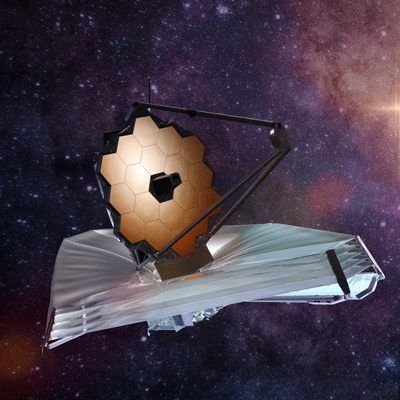
Scientists utilizing NASA’s James Webb Space Telescope (JWST) have captured what they describe as compelling indicators of potential life on an exoplanet beyond our solar system. The telescope detected gases in the atmosphere of exoplanet K2-18b that, on Earth, can only be produced by living organisms.
Specifically, the gases identified, dimethyl sulfide (DMS) and dimethyl disulfide (DMDS, are predominantly produced by marine phytoplankton, a form of algae. Although the findings are promising, scientists emphasize caution, highlighting that these gases represent potential biosignatures rather than direct evidence of extraterrestrial life.
“These are the first hints of a world that is possibly inhabited,” explained astrophysicist Nikku Madhusudhan from the University of Cambridge’s Institute of Astronomy at a press briefing on April 15. Madhusudhan was the lead author of the study, which was published in The Astrophysical Journal Letters.
“This is a transformational moment in the search for life beyond the solar system, where we have demonstrated that it is possible to detect biosignatures in potentially habitable planets with current facilities. We have entered the era of observational astrobiology.”
K2-18b is a sizable planet, approximately 8.6 times Earth’s mass and has a diameter about 2.6 times as large as our planet. It orbits its host star, a red dwarf smaller and cooler than our sun, in the “habitable zone,” where liquid water could potentially exist—a critical factor for life as we understand it.
Situated about 124 light-years away in the constellation Leo, K2-18b falls into a category scientists refer to as “Hycean” worlds, planets hypothesized to possess vast oceans conducive to microbial organisms beneath hydrogen-rich atmospheres.
Prior studies using Webb had already revealed the presence of methane and carbon dioxide in K2-18b’s atmosphere, marking the first identification of carbon-based molecules on an exoplanet within a habitable zone. “This is an independent line of evidence, using a different instrument than we did before and a different wavelength range of light, where there is no overlap with the previous observations,” Madhusudhan said. “The signal came through strong and clear.”
“The only scenario that currently explains all the data obtained so far from JWST, including the past and present observations, is one where K2-18b is a Hycean world teeming with life. However, we need to be open and continue exploring other scenarios.”
Madhusudhan clarified that while these environments suggest simple microorganisms, they do not yet indicate the existence of more complex or intelligent life forms.
Still, he described the findings as “potentially one of the biggest landmarks in the history of science,” stating, “I know this sounds grand, and it’s not my intention to make it sound grand, but there’s no other way to put it.”
DMS and DMDS were detected at atmospheric concentrations exceeding 10 parts per million by volume, much higher than those found naturally on Earth.
“For reference, this is thousands of times higher than their concentrations in the Earth’s atmosphere and cannot be explained without biological activity based on existing knowledge.”
However, the scientific community remains skeptical. Christopher Glein, principal scientist at the Southwest Research Institute’s Space Science Division in Texas, underscored the necessity of cautious optimism.
“The rich data from K2-18b make it a tantalizing world. These latest data are a valuable contribution to our understanding. Yet, we must be very careful to test the data as thoroughly as possible. I look forward to seeing additional, independent work on the data analysis starting as soon as next week.”
Astronomers determine the composition of exoplanet atmospheres using the transit method, analyzing starlight filtering through planetary atmospheres as the planet passes in front of its star. This technique allowed Webb to confirm the gases’ presence with a 99.7% confidence level, still leaving a slight possibility of 0.3% that the findings are a statistical anomaly.
Addressing the ultimate goal of exoplanet research, Madhusudhan deems discovering life on an Earth-like planet beyond our solar system as the “Holy Grail” of astronomy, noting humanity’s long-standing quest to answer whether we are alone in the universe.
“When you are seeing something like this, it’s like—this is a question humanity has been asking for thousands of years, and if you’re witnessing it for the first time, it is a shock to the system. And it takes a while to recover from that, from the enormity of it.”
Nevertheless, he emphasized the importance of rigorous validation, calling for repeated observations and further studies to rule out non-biological origins of these gases.
“First, we need to repeat the observations two to three times to make sure the signal we are seeing is robust and to increase the detection significance” to the level at which the odds of a statistical fluke are below roughly one in a million, Madhusudhan said.
“Additionally, further research is required to verify “whether or not there is another abiotic mechanism to make DMS or DMDS in a planetary atmosphere like that of K2-18b. Even though previous studies have suggested them [as] robust biosignatures even for K2-18b, we need to remain open and pursue other possibilities.”
For now, the discovery remains cautiously promising, marking an unprecedented step forward in our search for life among the stars.

Moumita Basuroychowdhury is a Contributing Reporter at The National Digest. After earning an economics degree at Cornell University, she moved to NYC to pursue her MFA in creative writing. She enjoys reporting on science, business and culture news. You can reach her at moumita.b@thenationaldigest.com.