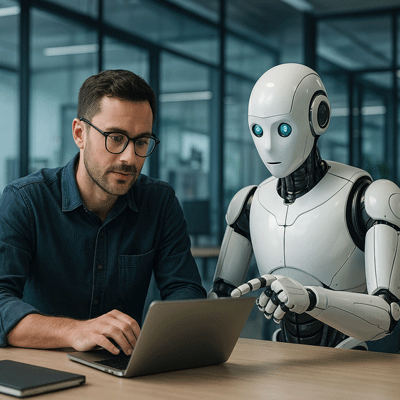
Amazon Tests Humanoid Robots for Delivery as Part of Expanding Automation Strategy
Amazon is reportedly taking its automation ambitions to the next level, developing humanoid robots designed to assist with and potentially replace human delivery workers.
According to tech outlet The Information, the $2 trillion tech giant is constructing a dedicated “humanoid park” in the U.S., where robots will be tested in indoor environments before being deployed in the field.
The space, described as roughly the size of a coffee shop, is housed within an Amazon office in San Francisco and serves as an obstacle course to gauge how well these machines can navigate real-world delivery scenarios.
The goal? To create robots that can ride inside Amazon’s Rivian delivery vans and “spring out” to make deliveries. While human drivers may still be present, these robots could allow for multi-drop efficiency — for instance, enabling the robot to handle one address while the driver tackles another. It’s part of Amazon’s broader vision for streamlining the notoriously labor-intensive “last mile” of delivery.
Although Amazon is spearheading the development of the software that will power the robots’ artificial intelligence, it is reportedly relying on external companies to build the physical hardware.
One such company is Agility Robotics, whose “Digit” robot has already been tested in Amazon warehouses. Agility’s CEO Peggy Johnson said in an earlier interview with The Guardian that Digit has enabled workers to offload tasks and transition into other roles.
“Employees who were previously doing this physical work appreciate the fact that they can hand that off to Digit. Then it allows them to do a number of other things, one of which is to be a robot manager.”
Sarah Franklin, the CEO of Lattice, a technology company based in the United States that offers a platform for human resources departments, stated that the workforce landscape is set to undergo significant transformation due to the influence of artificial intelligence.
Entry-level positions serve as the foundation of a workforce, with opportunities becoming increasingly selective as individuals progress into management and executive roles.
“AI can make this more of a diamond shape, where the entry levels are harder to get. The pace of innovation is outpacing education. That is a dangerous future if we don’t rapidly invest in ensuring that everyone is proficient with AI, especially entry-level workers.”
Amazon’s humanoid testing zone reportedly includes one of its more than 20,000 Rivian electric vans currently in operation across the U.S. Once the robots pass initial tests in the controlled indoor course, Amazon plans to send them on supervised “field trips” to deliver packages in real residential environments.
The company’s ambitions in autonomous delivery aren’t limited to humanoids. Amazon has also invested heavily in self-driving technology via its Zoox subsidiary and has received clearance to test drone deliveries beyond the line of sight of human operators in the UK, a significant step toward drone-based logistics.
Experts say the vision is ambitious but not entirely out of reach. Professor Subramanian Ramamoorthy, chair of robot learning and autonomy at the University of Edinburgh, said Amazon’s interest in robotic last-mile delivery aligns with its deep investment in automation. While the field of humanoid robotics has made significant strides in recent years, Ramamoorthy noted that reliable outdoor performance remains a major hurdle.
Achieving consistent success outside of tightly controlled test environments, such as the so-called ‘humanoid park,’ is still a real challenge, he explained.
“If Amazon restricts the scope, which means using relatively clear driveways and standard layouts of doors and surroundings, then the task would be quite a bit simpler. As the environments become more complex and variable, and others enter the picture – such as pets and small children – the problems become harder.”
Still, with a robust internal robotics team and a growing ecosystem of AI and delivery infrastructure, Amazon seems well-positioned to be a frontrunner in the future of humanoid logistics — one where robots could soon be walking packages up to your doorstep.

Moumita Basuroychowdhury is a Contributing Reporter at The National Digest. After earning an economics degree at Cornell University, she moved to NYC to pursue her MFA in creative writing. She enjoys reporting on science, business and culture news. You can reach her at moumita.b@thenationaldigest.com.