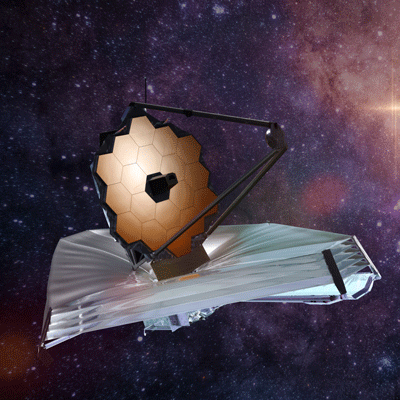
James Webb Space Telescope Finds Lemon-Shaped Exoplanet That Defies Planet Formation Models
Astronomers studying data from the James Webb Space Telescope have identified one of the strangest exoplanets ever observed, an object so extreme that it’s forcing scientists to rethink how planets can form at all.
Known as PSR J2322-2650b, the exoplanet has roughly the mass of Jupiter but lives an impossibly fast and hostile life. It completes a full orbit around its star in just 7.8 Earth hours, skimming past at a distance of only one million miles or about 1 percent of the distance between the Earth and the Sun.
At that range, the planet is locked in a brutal gravitational tug-of-war that physically deforms it, stretching it into a long, oblong shape resembling a lemon, with an equatorial diameter 38 percent wider than its polar diameter. Earth, by comparison, is around 0.3 percent wider than from pole to pole.
“It’s the stretchiest planet that we’ve confirmed the stretchiness of,” lead author Michael Zhang, an exoplanet scientist at the University of Chicago, told The New York Times.
“This was an absolute surprise,” said co-author Peter Gao of the Carnegie Earth and Planets Laboratory in Washington.
“I remember after we got the data down, our collective reaction was ‘What the heck is this?’ It’s extremely different from what we expected.”
The study, published in The Astrophysical Journal Letters, suggests the object may not even fit comfortably into existing categories of planets or stars. That’s because PSR J2322-2650b doesn’t orbit a normal sun, but a pulsar, one of the most extreme objects in the universe.
Pulsars are rapidly spinning neutron stars, the ultra-dense remnants left behind after massive stars explode as supernovae. They pack the mass of the Sun into a sphere roughly the size of a city, producing gravity so intense that a teaspoon of neutron-star material would weigh trillions of pounds. As these stars spin, they emit narrow beams of radiation that sweep across space.
Crucially, this pulsar emits most of its energy in gamma rays, making it effectively invisible to Webb’s infrared instruments. That turns a typical exoplanet problem on its head. Instead of being drowned out by starlight, the planet can be studied almost in isolation, said Maya Beleznay, a physicist at Stanford University, in a NASA statement.
“This system is unique because we are able to view the planet illuminated by its host star, but not see the host star at all. So we get a really pristine spectrum. And we can study this system in more detail than normal exoplanets.”
What that spectrum revealed only deepened the mystery. The planet’s surface temperature reaches 3,700 degrees Fahrenheit, about four times hotter than Venus, the hottest planet in our solar system. Under those conditions, its atmosphere is dominated almost entirely by helium and carbon, while lacking hydrogen, oxygen, and nitrogen, an unprecedented combination for a planet.
Carbon usually bonds readily with elements like oxygen and nitrogen, which are common in planetary atmospheres, especially in gas giants. Their absence suggests something profoundly unusual about how this object formed.
The planet’s bizarre chemistry may also drive alien weather patterns. Researchers speculate that clouds of carbon soot or graphite drift through the atmosphere, and deeper inside the planet, these clouds may compress into solid diamond fragments.
Virtually every aspect of PSR J2322-2650b defies expectations. Only a handful of pulsars are known to host planets at all, and none like this, one that’s visibly stretched, chemically anomalous, and orbiting so close it’s being pulled apart.
One explanation is that the system is a variation of a “black widow binary,” a configuration in which a pulsar slowly strips material from a smaller companion until it’s nearly destroyed. However, black widow systems have only been observed between pulsars and other stars, not planets.
That opens the possibility that PSR J2322-2650b isn’t truly a planet at all, but the remains of something much larger.
“It would have lost 99.9 percent of its mass, and we just happened to catch it right at the very end,” said Gao.
“I hope we have a sibling to compare this object to. If it’s continuously losing mass, we had to be really lucky to see it in its last breath before it disappears.”
Still, even that scenario raises problems. The planet’s extreme carbon abundance doesn’t align neatly with known stellar processes, leaving researchers with more questions than answers.
The most tantalizing option, Zhang suggests, is that astronomers are seeing something entirely unprecedented. “We’re witnessing an ‘entirely new type of object that we don’t have a name for,'” Zhang said.
“Did this thing form like a normal planet? No, because the composition is entirely different. Did it form by stripping the outside of a star, like ‘normal’ black widow systems are formed? Probably not, because nuclear physics does not make pure carbon. It’s very hard to imagine how you get this extremely carbon-enriched composition. It seems to rule out every known formation mechanism.”
Co-author Roger Romani, of Stanford University and the Kavli Institute for Particle Astrophysics and Cosmology, looks forward to further studying the phenomenon.
“As the companion cools down, the mixture of carbon and oxygen in the interior starts to crystallize. Pure carbon crystals float to the top and get mixed into the helium, and that’s what we see. But then something has to happen to keep the oxygen and nitrogen away. And that’s where the mystery comes in. But it’s nice to not know everything. I’m looking forward to learning more about the weirdness of this atmosphere. It’s great to have a puzzle to go after.”
For now, PSR J2322-2650b remains a cosmic riddle of a lemon-shaped, diamond-clouded anomaly orbiting one of the universe’s most violent stars.

Moumita Basuroychowdhury is a Contributing Reporter at The National Digest. After earning an economics degree at Cornell University, she moved to NYC to pursue her MFA in creative writing. She enjoys reporting on science, business and culture news. You can reach her at moumita.b@thenationaldigest.com.