Posts

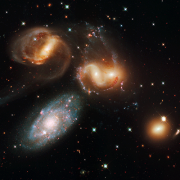
Stephans Quintet

Astronomers Identify Possible “Magma Ocean” Planet 35 Light Years Away

Astronomers studying a distant exoplanet say it may represent a previously unknown category of world—one dominated not by rock or water, but by molten lava.

The number of known exoplanets, or planets outside our solar system, has reached 6,000, according to NASA. The new research focuses on L98-59d, a planet orbiting a small red dwarf star roughly 35 light-years from Earth. The planet is about 1.6 times Earth’s size, placing it in a size range where scientists typically expect either rocky planets or ocean-covered “water worlds.” Yet new findings suggest it may instead be something entirely different.

Earlier observations using the James Webb Space Telescope revealed that L98-59d possesses an atmosphere unusually rich in sulfur. That chemical signature puzzled astronomers because neither rocky planets nor water worlds should be able to sustain such an atmosphere over the nearly 5 billion years the planet has existed.

To investigate, researchers at the University of Oxford ran advanced computer simulations tracing the planet’s evolution from shortly after its formation. The models suggest the world may contain a vast global magma ocean extending thousands of kilometers beneath its surface.

“Until now, astronomers would have placed a planet like this into one of two familiar categories, either a rocky ‘gas-dwarf’ with an atmosphere of hydrogen, or a water-rich world made of deep oceans and ice,” the University of Oxford said in a statement.

“These new findings reveal that L 98-59d fits neither description. Instead, it appears to belong to an entirely different class of planet containing heavy sulfur molecules.”

Embed from Getty Images

“You can only really explain this planet if it has this deep magma ocean inside of it,” said Dr. Harrison Nicholls, an astrophysicist at the university.

“The magma ocean efficiently stores the gases and keeps the gases protected from physical processes that would otherwise remove them.”

If the model is correct, L98-59d would be a world of extreme conditions. Scientists estimate that surface temperatures could reach 3,500°F (1,900°C). Tidal forces from neighboring planets may generate enormous waves across the molten surface, while the atmosphere, rich in hydrogen sulfide, would likely smell strongly of rotten eggs. “The whole thing really is in a mushy, molten state. It’s like molasses. It’s likely that this planet’s core would also be molten,” Nicholls said.

“We cannot yet quantify how rare this scenario is. However, given the results of our modeling, and also on the basis of well-justified physical processes which happen during planet formation, we believe that these magma ocean planets may represent a substantial fraction of the exoplanets in our galaxy.”

Although the discovery highlights the diversity of planetary systems beyond our own, researchers say the environment on L98-59d is unlikely to support life.

“If there are aliens out there that could live in lava, that would be amazing, but I don’t think it’s likely that it’s habitable. It’s nice to revel in the alienness of the planet itself.”

Studying exoplanets has long posed challenges for astronomers. Because these worlds are too distant to visit or directly photograph, scientists historically relied on indirect measurements, such as monitoring the slight dimming of a star when a planet passes in front of it, to estimate properties like size, density and temperature.

Embed from Getty Images

More recently, the James Webb Space Telescope has enabled analysis of planetary atmospheres by examining how starlight filters through them. These observations provided the initial clues that L98-59d might not fit neatly into existing categories of planets.

The possibility that molten planets could exist in significant numbers may also complicate how astronomers evaluate distant worlds for potential habitability.

“Some planets in the so-called habitable zone might not be very habitable at all, they might be these molten planets,” Nicholls said.

“While this molten planet is unlikely to support life, it reflects the wide diversity of the worlds which exist beyond the solar system. We may then ask, what other types of planets are waiting to be uncovered?”

Dr. Jo Barstow, a planetary scientist at the Open University who was involved in earlier Webb observations of L98-59d, said the new analysis offers a compelling explanation for the planet’s unusual characteristics.

“We talked about it possibly being an exoplanet that resembles Jupiter’s moon Io, with lots of volcanoes caused by tidal heating,” she said. “This work suggests it could be even more extreme.”

“What’s astonishing is that exoplanets are still delivering huge surprises decades after the field began,” said Dr. Sara Seager, an astrophysicist and planetary scientist at MIT, who wasn’t involved in the study. “We can look forward to more examples of this possible class of hydrogen-rich, sulfur-bearing atmosphere worlds.”

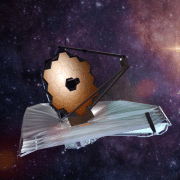
James Webb Space Telescope

James Webb Space Telescope Finds Lemon-Shaped Exoplanet That Defies Planet Formation Models

Astronomers studying data from the James Webb Space Telescope have identified one of the strangest exoplanets ever observed, an object so extreme that it’s forcing scientists to rethink how planets can form at all.

Known as PSR J2322-2650b, the exoplanet has roughly the mass of Jupiter but lives an impossibly fast and hostile life. It completes a full orbit around its star in just 7.8 Earth hours, skimming past at a distance of only one million miles or about 1 percent of the distance between the Earth and the Sun.

At that range, the planet is locked in a brutal gravitational tug-of-war that physically deforms it, stretching it into a long, oblong shape resembling a lemon, with an equatorial diameter 38 percent wider than its polar diameter. Earth, by comparison, is around 0.3 percent wider than from pole to pole.

“It’s the stretchiest planet that we’ve confirmed the stretchiness of,” lead author Michael Zhang, an exoplanet scientist at the University of Chicago, told The New York Times.

“This was an absolute surprise,” said co-author Peter Gao of the Carnegie Earth and Planets Laboratory in Washington.

“I remember after we got the data down, our collective reaction was ‘What the heck is this?’ It’s extremely different from what we expected.”

The study, published in The Astrophysical Journal Letters, suggests the object may not even fit comfortably into existing categories of planets or stars. That’s because PSR J2322-2650b doesn’t orbit a normal sun, but a pulsar, one of the most extreme objects in the universe.

Pulsars are rapidly spinning neutron stars, the ultra-dense remnants left behind after massive stars explode as supernovae. They pack the mass of the Sun into a sphere roughly the size of a city, producing gravity so intense that a teaspoon of neutron-star material would weigh trillions of pounds. As these stars spin, they emit narrow beams of radiation that sweep across space.

Embed from Getty Images

Crucially, this pulsar emits most of its energy in gamma rays, making it effectively invisible to Webb’s infrared instruments. That turns a typical exoplanet problem on its head. Instead of being drowned out by starlight, the planet can be studied almost in isolation, said Maya Beleznay, a physicist at Stanford University, in a NASA statement.

“This system is unique because we are able to view the planet illuminated by its host star, but not see the host star at all. So we get a really pristine spectrum. And we can study this system in more detail than normal exoplanets.”

What that spectrum revealed only deepened the mystery. The planet’s surface temperature reaches 3,700 degrees Fahrenheit, about four times hotter than Venus, the hottest planet in our solar system. Under those conditions, its atmosphere is dominated almost entirely by helium and carbon, while lacking hydrogen, oxygen, and nitrogen, an unprecedented combination for a planet.

Carbon usually bonds readily with elements like oxygen and nitrogen, which are common in planetary atmospheres, especially in gas giants. Their absence suggests something profoundly unusual about how this object formed.

The planet’s bizarre chemistry may also drive alien weather patterns. Researchers speculate that clouds of carbon soot or graphite drift through the atmosphere, and deeper inside the planet, these clouds may compress into solid diamond fragments.

Virtually every aspect of PSR J2322-2650b defies expectations. Only a handful of pulsars are known to host planets at all, and none like this, one that’s visibly stretched, chemically anomalous, and orbiting so close it’s being pulled apart.

One explanation is that the system is a variation of a “black widow binary,” a configuration in which a pulsar slowly strips material from a smaller companion until it’s nearly destroyed. However, black widow systems have only been observed between pulsars and other stars, not planets.

Embed from Getty Images

That opens the possibility that PSR J2322-2650b isn’t truly a planet at all, but the remains of something much larger.

“It would have lost 99.9 percent of its mass, and we just happened to catch it right at the very end,” said Gao.

“I hope we have a sibling to compare this object to. If it’s continuously losing mass, we had to be really lucky to see it in its last breath before it disappears.”

Still, even that scenario raises problems. The planet’s extreme carbon abundance doesn’t align neatly with known stellar processes, leaving researchers with more questions than answers.

The most tantalizing option, Zhang suggests, is that astronomers are seeing something entirely unprecedented. “We’re witnessing an ‘entirely new type of object that we don’t have a name for,'” Zhang said.

“Did this thing form like a normal planet? No, because the composition is entirely different. Did it form by stripping the outside of a star, like ‘normal’ black widow systems are formed? Probably not, because nuclear physics does not make pure carbon. It’s very hard to imagine how you get this extremely carbon-enriched composition. It seems to rule out every known formation mechanism.”

Co-author Roger Romani, of Stanford University and the Kavli Institute for Particle Astrophysics and Cosmology, looks forward to further studying the phenomenon.

“As the companion cools down, the mixture of carbon and oxygen in the interior starts to crystallize. Pure carbon crystals float to the top and get mixed into the helium, and that’s what we see. But then something has to happen to keep the oxygen and nitrogen away. And that’s where the mystery comes in. But it’s nice to not know everything. I’m looking forward to learning more about the weirdness of this atmosphere. It’s great to have a puzzle to go after.”

For now, PSR J2322-2650b remains a cosmic riddle of a lemon-shaped, diamond-clouded anomaly orbiting one of the universe’s most violent stars.


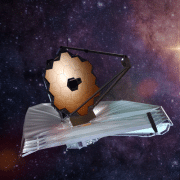
Webb Telescope

Webb Telescope Detects Potential Signs of Life on Distant Exoplanet

Scientists utilizing NASA’s James Webb Space Telescope (JWST) have captured what they describe as compelling indicators of potential life on an exoplanet beyond our solar system. The telescope detected gases in the atmosphere of exoplanet K2-18b that, on Earth, can only be produced by living organisms.

Specifically, the gases identified, dimethyl sulfide (DMS) and dimethyl disulfide (DMDS, are predominantly produced by marine phytoplankton, a form of algae. Although the findings are promising, scientists emphasize caution, highlighting that these gases represent potential biosignatures rather than direct evidence of extraterrestrial life.

“These are the first hints of a world that is possibly inhabited,” explained astrophysicist Nikku Madhusudhan from the University of Cambridge’s Institute of Astronomy at a press briefing on April 15. Madhusudhan was the lead author of the study, which was published in The Astrophysical Journal Letters.

“This is a transformational moment in the search for life beyond the solar system, where we have demonstrated that it is possible to detect biosignatures in potentially habitable planets with current facilities. We have entered the era of observational astrobiology.”

K2-18b is a sizable planet, approximately 8.6 times Earth’s mass and has a diameter about 2.6 times as large as our planet. It orbits its host star, a red dwarf smaller and cooler than our sun, in the “habitable zone,” where liquid water could potentially exist—a critical factor for life as we understand it.

Situated about 124 light-years away in the constellation Leo, K2-18b falls into a category scientists refer to as “Hycean” worlds, planets hypothesized to possess vast oceans conducive to microbial organisms beneath hydrogen-rich atmospheres.

Embed from Getty Images

Prior studies using Webb had already revealed the presence of methane and carbon dioxide in K2-18b’s atmosphere, marking the first identification of carbon-based molecules on an exoplanet within a habitable zone. “This is an independent line of evidence, using a different instrument than we did before and a different wavelength range of light, where there is no overlap with the previous observations,” Madhusudhan said. “The signal came through strong and clear.”

“The only scenario that currently explains all the data obtained so far from JWST, including the past and present observations, is one where K2-18b is a Hycean world teeming with life. However, we need to be open and continue exploring other scenarios.”

Madhusudhan clarified that while these environments suggest simple microorganisms, they do not yet indicate the existence of more complex or intelligent life forms.

Still, he described the findings as “potentially one of the biggest landmarks in the history of science,” stating, “I know this sounds grand, and it’s not my intention to make it sound grand, but there’s no other way to put it.”

DMS and DMDS were detected at atmospheric concentrations exceeding 10 parts per million by volume, much higher than those found naturally on Earth.

“For reference, this is thousands of times higher than their concentrations in the Earth’s atmosphere and cannot be explained without biological activity based on existing knowledge.”

However, the scientific community remains skeptical. Christopher Glein, principal scientist at the Southwest Research Institute’s Space Science Division in Texas, underscored the necessity of cautious optimism.

“The rich data from K2-18b make it a tantalizing world. These latest data are a valuable contribution to our understanding. Yet, we must be very careful to test the data as thoroughly as possible. I look forward to seeing additional, independent work on the data analysis starting as soon as next week.”

Embed from Getty Images

Astronomers determine the composition of exoplanet atmospheres using the transit method, analyzing starlight filtering through planetary atmospheres as the planet passes in front of its star. This technique allowed Webb to confirm the gases’ presence with a 99.7% confidence level, still leaving a slight possibility of 0.3% that the findings are a statistical anomaly.

Addressing the ultimate goal of exoplanet research, Madhusudhan deems discovering life on an Earth-like planet beyond our solar system as the “Holy Grail” of astronomy, noting humanity’s long-standing quest to answer whether we are alone in the universe.

“When you are seeing something like this, it’s like—this is a question humanity has been asking for thousands of years, and if you’re witnessing it for the first time, it is a shock to the system. And it takes a while to recover from that, from the enormity of it.”

Nevertheless, he emphasized the importance of rigorous validation, calling for repeated observations and further studies to rule out non-biological origins of these gases.

“First, we need to repeat the observations two to three times to make sure the signal we are seeing is robust and to increase the detection significance” to the level at which the odds of a statistical fluke are below roughly one in a million, Madhusudhan said.

“Additionally, further research is required to verify “whether or not there is another abiotic mechanism to make DMS or DMDS in a planetary atmosphere like that of K2-18b. Even though previous studies have suggested them [as] robust biosignatures even for K2-18b, we need to remain open and pursue other possibilities.”

For now, the discovery remains cautiously promising, marking an unprecedented step forward in our search for life among the stars.

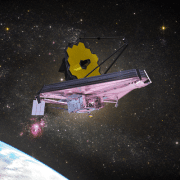
webb

Webb Telescope Confirms The Universe Is Expanding At An Unexpected Rapid Rate

Two years worth of data from NASA’s James Webb Space Telescope have confirmed a suspicion scientists have had for a while regarding the size and growth of the universe. The telescope’s data found that the rate of the universe’s expansion is faster than what would be expected based on the cosmos evolution throughout billions of years. 

The data showed the universe is expanding by about 8% faster than expected based on what astrophysicists know of the initial conditions of the universe. 

Webb is the most capable space telescope ever developed. 

“This is the largest sample of Webb Telescope data – its first two years in space – and it confirms the puzzling finding from the Hubble Space Telescope that we have been wrestling with for a decade – the universe is now expanding faster than our best theories can explain,” said astrophysicist Adam Riess of Johns Hopkins University in Maryland, lead author of the study published on Monday in the Astrophysical Journal.

Embed from Getty Images

“Yes, it appears there is something missing in our understanding of the universe,” Riess said.

“Our understanding of the universe contains a lot of ignorance about two elements – dark matter and dark energy – and these make up 96% of the universe, so this is no small matter.”

“The Webb results can be interpreted to suggest there may be a need to revise our model of the universe, although it is very difficult to pinpoint what this is at the moment,” said Siyang Li, a Johns Hopkins doctoral student in astronomy and astrophysics and a study co-author.

Dark matter is thought to make up around 27% of the universe. Dark matter is a hypothesized form of matter that is not visible but would exist instead based on its gravitational effects on ordinary matter such as stars, moons, and planets. 

“There are many hypotheses that involve dark matter, dark energy, dark radiation – for example, neutrinos (a type of ghostly subatomic particle) – or gravity itself having some exotic properties as possible explanations,” Riess said.