Certain Trees Found To Benefit From Being Struck By Lightning
In Panama’s tropical forests, trees in the species Dipteryx oleifera are surprisingly found to benefit from being struck by lightning, according to a new study published in New Phytologist.
Evan Gora, a forest ecologist from the Cary Institute of Ecosystem Studies who led the study, said that this research revealed that the trees could not only survive being struck by lightning, but were also shown to grow stronger.
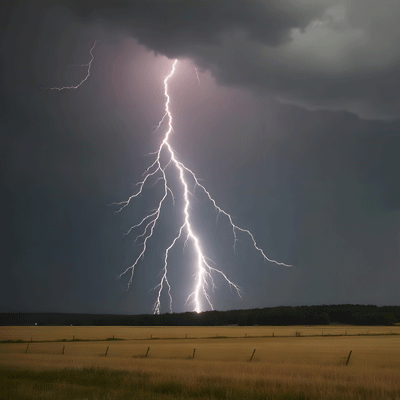
The beginning of this study was sparked in 2015 when Gora was in Panama and observed a Dipteryx oleifera get struck by lightning, and was surprised at how it was barely phased while other trees were completely destroyed.
“Seeing that there are trees that get struck by lightning and they’re fine was just mind-blowing.”
This motivated Gora and her team to pay closer attention to the trees, and kept finding that they could withstand powerful lightning.
Using lightning detection tools, the team of scientists tracked 93 trees that endured getting struck. Nine of those 93 were Dipteryx oleifera, and all of them survived with minimal damage. Other species that were stuck lost 5.7 times more foliage, and within two years, 64% of them died.
With the lightning killing the surrounding trees, the Dipteryx trees had more space to thrive, convincing Gora and her team that this survival was a strategic evolvement from the species.
Additionally, parasitic vines in the forest are a constant threat to many species of trees, as they drain the trees of light and nutrients. For Dipteryx, however, the lightning cleanses them of the vines with infections dropped by 78%.
Gora noted that this is the first evidence that a species of trees getting struck by lightning is actually crucial for their survival.
“It’s better off for a Dipteryx oleifera tree to be struck than not.”
Dipteryx trees also often grow taller and spread wider than species around them. The study stated that this species is 68% more likely to get hit with the tops of them acting like natural lightning rods.
One of the trees in the study was struck twice within five years. The study suggests that these trees have adapted over time. They have a long lifespan and can live for centuries, meaning one tree can be struck more than ten times throughout its entire lifetime.
Gora and her team will continue to observe the trees to get more specific answers as to why they can survive and thrive after a lightning strike.

Eric Mastrota is a Contributing Editor at The National Digest based in New York. A graduate of SUNY New Paltz, he reports on world news, culture, and lifestyle. You can reach him at eric.mastrota@thenationaldigest.com.