Posts

lightening

Certain Trees Found To Benefit From Being Struck By Lightning 

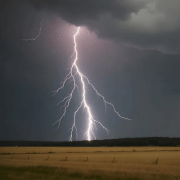
In Panama’s tropical forests, trees in the species Dipteryx oleifera are surprisingly found to benefit from being struck by lightning, according to a new study published in New Phytologist. 

Evan Gora, a forest ecologist from the Cary Institute of Ecosystem Studies who led the study, said that this research revealed that the trees could not only survive being struck by lightning, but were also shown to grow stronger.

Embed from Getty Images

The beginning of this study was sparked in 2015 when Gora was in Panama and observed a Dipteryx oleifera get struck by lightning, and was surprised at how it was barely phased while other trees were completely destroyed. 

“Seeing that there are trees that get struck by lightning and they’re fine was just mind-blowing.”

This motivated Gora and her team to pay closer attention to the trees, and kept finding that they could withstand powerful lightning. 

Using lightning detection tools, the team of scientists tracked 93 trees that endured getting struck. Nine of those 93 were Dipteryx oleifera, and all of them survived with minimal damage. Other species that were stuck lost 5.7 times more foliage, and within two years, 64% of them died. 

With the lightning killing the surrounding trees, the Dipteryx trees had more space to thrive, convincing Gora and her team that this survival was a strategic evolvement from the species. 

Embed from Getty Images

Additionally, parasitic vines in the forest are a constant threat to many species of trees, as they drain the trees of light and nutrients. For Dipteryx, however, the lightning cleanses them of the vines with infections dropped by 78%. 

Gora noted that this is the first evidence that a species of trees getting struck by lightning is actually crucial for their survival. 

“It’s better off for a Dipteryx oleifera tree to be struck than not.”

Dipteryx trees also often grow taller and spread wider than species around them. The study stated that this species is 68% more likely to get hit with the tops of them acting like natural lightning rods. 

One of the trees in the study was struck twice within five years. The study suggests that these trees have adapted over time. They have a long lifespan and can live for centuries, meaning one tree can be struck more than ten times throughout its entire lifetime. 

Gora and her team will continue to observe the trees to get more specific answers as to why they can survive and thrive after a lightning strike.

Forest of Trees

Genetically-Modified Trees May Be The Key to Reducing Climate Change

In what represents a potential breakthrough in scientific approaches to reducing the impact of climate change, scientists have created genetically-modified trees that do not emit a gas that contributes to poor air quality and global warming, without harming the health of the trees. Poplar trees give off isoprene, particularly when they are under stress like they would be during rapid changes in temperature or during a drought. Isoprene interacts with other substances to form ozone and types of aerosol, which have negative consequences on weather patterns. As poplar trees are widely used to create products like paper and plywood, and are also used as biofuel, the widespread adoption of genetically-modified poplar trees may enable a more environmentally-friendly method of producing these vital resources.

Embed from Getty Images

According to the study, which was published in the journal PNAS, researchers observed the genetically-modified trees, which were planted in Oregon and Arizona, for a period of three to four years and concluded that they were capable of producing just as much biofuel as normal poplar trees, but without releasing harmful isoprene. Instead, the trees generated “alternative signaling pathways that appear to compensate for the loss of stress tolerance due to isoprene,” according to the lead author Russell Monson, a professor of ecology and evolutionary biology at the University of Arizona. The researchers believe that neither the health of the trees nor the quantity of biomass produced were negatively affected by the genetic modification, giving hope that in the future, trees could be optimized to better suit the needs of a global climate that has been modified by human activity. As biofuel derived from poplar trees can replace traditional fossil fuels in a sustainable way, these new findings could pave the way for transitioning to a more carbon-neutral future.

The trees’ genetic code was modified by a process called “RNA interference.” In this process, specific genes are targeted and suppressed; in this case, the genes that are responsible for the production of isoprene are disabled. Multiple technologies exist in order to modify the genetic code of living organisms, including CRISPR, a newer technology that allows for even more drastic and precise genetic modification. In fact, traditional breeding of species, which humans have done for thousands of years, is itself a form of genetic modification, though it is a much slower and less precise way of altering the genetic makeup of an organism.

Embed from Getty Images

When it comes to technologies that help to reduce the impact of climate change, the widespread planting of trees is often proposed as a method of mitigating carbon emissions, as trees use natural processes to store carbon and produce oxygen. However, planting a tremendous number of trees poses its own problems to ecosystems and the global climate, as not all of the gases released by trees benefit the environment. This is of particular concern given the advancement of technologies designed to autonomously plant large quantities of trees at a rate much greater than is possible with human labor, which is currently being deployed as a strategy for geo-engineering. As such, the future of harm reduction in connection with climate change may depend upon a combination of natural resources and cutting-edge technologies, as scientists of the future may be able to genetically optimize trees to maximize their beneficial impact on the environment. That being said, other strategies in addition to planting genetically-modified trees will surely be necessary in the fight against climate change, as carbon emissions continue to rise to increasingly-dangerous levels with no signs of stopping any time soon.