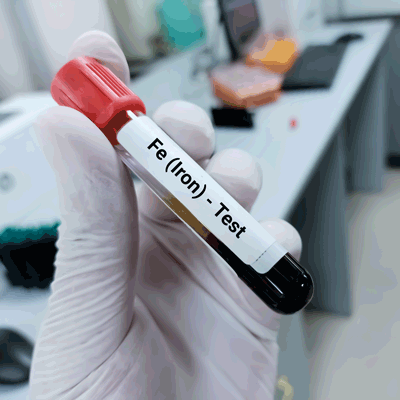
1 In 3 Americans Might Have Undiagnosed Iron Deficiency: “An Underappreciated Public Health Problem”
According to a new study that analyzed data from over 8,000 individuals, about 1 in 3 Americans might have an undiagnosed iron deficiency. Iron deficiency can cause levels of fatigue, brain fog, difficulty concentrating, heart palpitations, hair loss, and more.
The study itself was published last week in JAMA Network Open. It reported that 14% of the 8,000+ individuals studied had low iron blood levels, known as absolute iron deficiency, and 15% had the “right” iron levels, however, their bodies didn’t know how to use the mineral properly, which is known as functional iron deficiency.
In general, doctors don’t normally screen adults for iron deficiency, which is one of the reasons cited that many people may have it without knowing. Researchers weren’t surprised by the results of their study, as previous data has shown that iron deficiency may be more of a “widespread issue” that doctors know, NBC reported.
“This is a common yet underappreciated public health problem,” said study co-author Leo Buckley, a clinical pharmacology specialist.
“What’s unique about our study is we were looking at regular people who would not otherwise have been screened or tested.”
“[While iron deficiency] is almost never life-threatening, it’s a tremendous quality of life thing,” said Hematologist Dr. Andrew Eisenberger, an associate professor of medicine at the Columbia University Vagelos College of Physicians and Surgeons.
“Tens of millions of people in the U.S. are basically running on fumes either because there isn’t enough fuel in the tank or because the tank isn’t connecting to the engine well,” said Eisenberger.
“In our society we are hardwired to be at peak performance. With this tremendous prevalence of iron deficiency, so many people can’t do their best.”
One of the biggest hopes of the study is that it will bring greater attention to the issue and ideally raise awareness for both doctors and patients to realize the problem is much more common than we think.
Doctors typically screen patients for anemia during routine blood testing, however, that test simply measures the levels of red blood cells in an individual’s body, and someone can have a “normal” amount of cells while still having iron deficiency.
“This is an incredibly preventable disease,” Eisenberger said.
“So many people come to me who have had this problem for years and years and years, but their doctors have missed it, ignored it or just didn’t know what to do about it. People suffer tremendously. It’s one of the most satisfying things to take care of because people’s quality of life markedly improves.”
The Brigham and Women’s Hospital researchers were responsible for the new study and utilized information from the National Health and Nutrition Examination Survey which collected data from the years 2017 to 2021 from 8,021 adults. Participants in the study were on average around 48 years old.
Buckley stated that doctors should focus on individuals who exhibit symptoms of iron deficiency for testing in the future. Additionally, they should pay attention to individuals who are at high risk, such as pregnant women.
“The average pregnant woman needs 1,000 to 1,500 milligrams of additional iron,” Eisenberger said.
“Many women don’t have their iron levels checked till late in pregnancy. At that point, there’s not enough time to fix it before the woman delivers and the fetus has spent the entire pregnancy with not enough iron.”
“Low iron levels in a pregnant woman have been associated with long-term cognitive impairment in children, small size at birth and early delivery,” Eisenberger said.

Eric Mastrota is a Contributing Editor at The National Digest based in New York. A graduate of SUNY New Paltz, he reports on world news, culture, and lifestyle. You can reach him at eric.mastrota@thenationaldigest.com.