Halloween Candy Prices Spike In Prices Due To Trump’s Tariffs And Climate Change
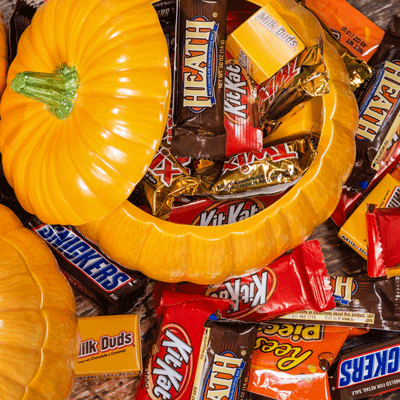
This year for Halloween, one of the most spooky elements of the season is the increasing price of the holiday’s most popular candies for trick or treating. These inflated prices are connected to both Donald Trump’s tariffs and climate change.
Candy prices are estimated to have increased by 10.8% this year, according to an analysis from the Century Foundation and the Groundwork Collaborative. Reports show that some of the most popular chocolate-based candy has seen at least a 20% rise in pricing.
Chocolate candies are increasing in price specifically due to years-long cocoa shortages which caused the price of cocoa in general to triple over the last few years.
In terms of climate change, increased rain and weather-related damage in west Africa, which is one of the biggest exporters of cocoa beans, has caused cocoa to peak at more than $12,000 per ton in 2024. Since then, prices have decreased to around $6,000 per ton, however, these prices are still much higher when compared to 2020; cocoa prices were about $2,300 per ton.
Alex Villacis, a food economist stated:
“Our food system is really global. Something that is happening in west Africa will ultimately have an impact on your front porch this Halloween season.”
Donald Trump has also implemented tariffs on the biggest exporters of chocolate to the US. Currently, imports from the largest producer of cocoa, the Ivory Coast, are currently taxed with a 21% tariff. Ecuador, the second-largest producer, is experiencing a 15% tariff.
The largest chocolate manufacturer in the US, Hershey’s, stated that in the spring, the tariffs could cost them over $100 million, forcing them to raise prices in addition to the fact that they need to pay more due to the cocoa shortage.
Other business groups have also pleaded with the Trump administration to make a tariff exemption for cocoa in addition to other agricultural products that are more difficult to source in the US.
The only two US locations that can produce cocoa are Hawaii and Puerto Rico, due to the fact that it needs a tropical climate to be properly grown. Even in those cases, however, the base cocoa ingredient still needs to be imported from outside nations.
Candy customers are not surprised by this rise in prices, in fact, a recent survey from the National Retail Federation (NRF) showed that 79% of consumers were expecting more expensive candy this Halloween. This keeps the demand high, especially for chocolate.
“Chocolate producers have two options: they can either just pass this additional cost to the final consumer or they can absorb this higher cost as a loss,” Villacis said.
“Something in between that we have been observing is a subtle form of what we call ‘shrinkflation’. In this case, what we have seen is not that they are making their products smaller, but they are reformulating the products in the sense that they are putting less cocoa and trying to replace cocoa with other things like almonds or more milk.”
“It’s not really clear how companies are approaching this right now, but we’ve all had this moment to get used to some of the tactics that they’re using to pass along price increases to consumers,” said Angela Hanks, chief of policy programs at the Century Foundation.
“Companies take advantage of a moment where people expect prices to increase and pre-emptively increase them.”
The NRF has estimated that with the existing demand for Halloween candy, costumes, and decorations will net sales of up to $13.1 billion.
The National Confectioners Association released data that showed Halloween candy sales making up 18% of all confectionery retail sales in 2024.
“Chocolate products are really embedded into American holiday culture,” Villacis said.
“As economists, we cannot help noticing how each candy bar tells a story of global trade. It’s a constant reminder that economics touches everything in our lives.”

Eric Mastrota is a Contributing Editor at The National Digest based in New York. A graduate of SUNY New Paltz, he reports on world news, culture, and lifestyle. You can reach him at eric.mastrota@thenationaldigest.com.