Lego Opens Factory In Vietnam That Runs Entirely On Clean Energy
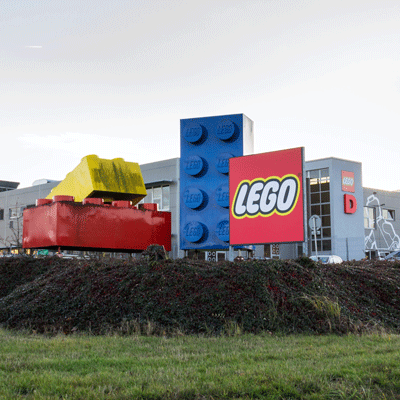
This week, Lego officially opened a new factory in Vietnam. The $1 billion project is making headlines after it was announced that the company will be producing their famous toys using completely clean energy.
The new factory is located in Binh Duong, an industrial area. This will be the first factory in Vietnam to run completely on clean energy, and Lego stated the factory will reach that goal by 2026.
This is Lego’s sixth factory worldwide and their second in Asia. The Lego market in Southeast Asia is growing rapidly, so the company has implemented high-tech equipment to match up with the market’s demand, according to reports.
“Today marks an exciting milestone for us as we proudly open our sixth factory in the world. We want to make sure that the planet that the children inherit when they grow up is a planet that is still there. That is functional,” Lego CEO Niels Christiansen told The Associated Press.
“This state-of-the-art site reflects our commitment to sustainable growth and innovation, bringing more LEGO play experiences to children and our fans in the Asia-Pacific region through increased manufacturing capacity.”
In general, Lego has stated that they have a goal of ending their greenhouse gas emissions by 2050, and are hoping to reduce their emissions by 37% by 2032. They’ve invested $1.2 billion in finding and implementing more sustainable production/manufacturing practices.
Vietnam as a nation is also working to achieve net-zero emissions by 2050, so the clean energy that the Lego factory will be running on is helping aid that goal. The factory is equipped with 12,400 solar panels and an energy storage system, which the nation is hoping will set a new standard for future sustainable manufacturing.
“The use of battery storage solutions and power purchase agreements to increase renewable energy is not just a first for the LEGO Group but among the first for any company in Vietnam. I am thankful for the collaboration we have had with our partners in establishing frameworks and policies that can serve other companies looking to increase their own use of renewable energy,” COO of the Lego Group, Carsten Rasmussen, said.
“I am extremely proud of our environmental sustainability progress in Vietnam, strengthening our positive impact locally while supporting our global ambitions.”
Mimi Vu, a founder of the consultancy Raise Partners in Ho Chi Minh City, said to AP:
“The Lego factory, which spans 62 soccer fields, sets the ‘blueprint’ for making large, power-guzzling factories sustainable while remaining profitable. Sometimes it takes a big company, like Lego, to take those risks. To show that we can do it … And we can be profitable.”
According to AP, this factory is an example of a facility that will benefit from the new 2024 rule called a direct power purchase agreement (DPPA). DPPA allows large foreign companies to buy clean energy directly from solar and wind power producers to meet clean energy requirements.
“Lego and Vietnam, we have the same aspirations. We both want to be green, to play our part in the climate. And I think this with the solar and battery and DPPA, it is showcasing that it can be done,” Senior Vice President Asia Operations at the LEGO GroupJesper Hassellund Mikkelsen, told AP.

Eric Mastrota is a Contributing Editor at The National Digest based in New York. A graduate of SUNY New Paltz, he reports on world news, culture, and lifestyle. You can reach him at eric.mastrota@thenationaldigest.com.