
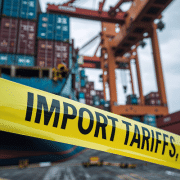
JPMorgan CEO Jamie Dimon: Tariffs Could Slow Growth, Spark Inflation, Weaken America
JPMorgan CEO Jamie Dimon delivered a stark warning regarding President Donald Trump’s recent tariff policies, cautioning that they could lead to rising prices, trigger an economic slowdown, and diminish America’s prominent global status.
In his annual letter to shareholders, Dimon stated plainly, “The recent tariffs will likely increase inflation and are causing many to consider a greater probability of a recession.”
While he did not definitively claim that tariffs alone would cause a recession, Dimon asserted confidently, “It will slow down growth.”
“As for the short-term, we are likely to see inflationary outcomes, not only on imported goods but on domestic prices, as input costs rise and demand increases on domestic products. How this plays out on different products will partially depend on their substitutability and price elasticity.”
Dimon, considered one of the world’s most influential business executives, emphasized that America’s unique global standing has historically been reinforced by the strength of its economy, military power, and moral leadership. Yet, he argued that Trump’s “America First” foreign policy approach and tariff strategy could inadvertently undermine this carefully cultivated global influence.
“America First is fine, as long as it doesn’t end up being America alone. If the Western world’s military and economic alliances were to fragment, America itself would inevitably weaken over time.”
Highlighting the interconnectedness of economic and geopolitical stability, Dimon noted that economic disruptions often precede broader security issues. “It is extremely important to recognize that security and economics are interconnected – ‘economic’ warfare has caused military warfare in the past,” he stated.
“Comprehensive strategies, diligently deployed, are required to address challenges on many fronts: the war in Ukraine; terrorism in the Middle East and the real possibility that Iran may develop a nuclear weapon; Europe’s potential fragmentation; and ongoing trade disputes and the rise of China. If Iran acquires a nuclear weapon, many other nations around the world will seek to acquire nuclear weapons, presenting us with a catastrophic situation.”
This pointed criticism marks a notable shift from Dimon’s earlier, more restrained comments. Previously, Dimon had minimized concerns about tariffs. In a January CNBC interview, he suggested that mild inflation resulting from tariffs would be manageable, advising critics to “get over it” if tariffs helped rejuvenate U.S. manufacturing sectors.
However, Trump’s recent tariff announcements have been unexpectedly aggressive, far surpassing the severity and breadth that many anticipated. Dimon’s current tone now urges caution and preparedness, contrasting his earlier optimism.
“Even with the recent decline in market values, prices remain relatively high,” Dimon stated, hinting that the recent plunge might just be the beginning.
Stocks, he indicated, could fall further, pushing the market firmly into bear territory. After reaching an all-time high on February 19, the U.S. stock market now stands near bear market levels, potentially marking the second-fastest transition from peak to bear market in history—second only to the rapid descent during the 2020 pandemic.
“Despite the unsettling landscape, the U.S. economy, at least until recently, continued to be resilient, with consumers still spending (though with some recent weakening) and businesses still healthy.”
Yet, Dimon’s broader outlook remains guarded. He highlighted persistent geopolitical and economic challenges facing both the United States and the global economy. His warning was explicit: “We face the most perilous and complicated geopolitical and economic environment since World War II.”
While Dimon recognized the legitimacy of addressing harmful trade practices, particularly China’s, which have impacted American workers negatively, his critique underscores a delicate balancing act. The potential benefits of rectifying unfair trade, he implied, must be carefully weighed against the severe economic consequences tariffs may impose.
Dimon’s explicit caution is rare for a business leader of his stature, signifying the grave uncertainty and concern permeating America’s financial institutions amid evolving trade tensions and shifting geopolitical dynamics.

Moumita Basuroychowdhury is a Contributing Reporter at The National Digest. After earning an economics degree at Cornell University, she moved to NYC to pursue her MFA in creative writing. She enjoys reporting on science, business and culture news. You can reach her at moumita.b@thenationaldigest.com.