
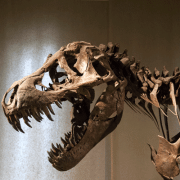
Scientists Discover Two Dinosaur ‘Mummies’ That Capture Every Scale and Spike
Long before Wyoming was cattle country, it was a land of monsters and mud. Sixty-six million years ago, rivers wound through a humid coastal valley where herds of the gentle, duck-billed plant eaters, Edmontosaurus, trudged along the floodplains. Some of them, through a bizarre twist of biology and luck, never fully disappeared.
In a study published Thursday in “Science,” paleontologist Paul Sereno and his colleagues describe two of these remarkably preserved creatures, their skin, spikes, and even hooves immortalized in stone. “For the first time, I think that we’ve got Edmontosaurus’s look completely down,” said Sereno, who teaches at the University of Chicago.
“Based on our drawings, you can put it in a Hollywood movie, and it’s going to be accurate head to toe.”
Sereno’s team stumbled across the fossils back in 2001 while exploring eastern Wyoming’s sandstone ridges, which date back to the late Cretaceous period, with a group of students. At first, they thought they had found ordinary skeletons. One belonged to a young dinosaur, the other to the back half of an older one. Only after months of painstaking cleanup in Sereno’s lab did the team realize what they had: two dinosaur mummies.
The smaller specimen, Ed Jr., bore a faint fleshy crest running along its back, coated in tiny, beadlike scales. The larger one, Ed Sr., had wrinkled skin, wedge-shaped hooves instead of claws, and a spiny tail.
Sereno later learned that these new mummies had been unearthed in the same patch of land where fossil hunter Charles H. Sternberg had made headlines more than a century earlier. In 1908, Sternberg discovered a skin-covered Edmontosaurus near the same site. When it was unveiled at the American Museum of Natural History, The New York Times raved that it was “not only a skeleton, but a genuine mummy.” Sternberg soon found another and shipped it to Germany. All four fossils, separated by time and ocean, came from what Sereno’s team now calls the “mummy zone.”
To understand how the dinosaurs avoided decay, Sereno’s team turned to CT scanning and electron microscopy. The results upended expectations. No remnants of skin or tissue survived. The animals had, in fact, decomposed before burial.
So how did the fine details of their bodies — every wrinkle and scale — remain? The researchers believe microbes were the secret undertakers. After the carcasses dried out on the floodplain, bacteria formed a biofilm that left behind a thin clay shell, sealing in the dinosaurs’ final forms.
“When you rub clay on your face, it goes into every pore. When you touch these fossils and then look at your fingers, you still see traces of clay.”
This microbial “spa treatment” preserved the animals in exquisite detail. Sereno noted that such preservation usually occurs in calm seas, not in the chaotic floods that swept ancient Wyoming.
For other scientists, the find offers a glimpse into one of paleontology’s strangest miracles—the making of a dinosaur mummy.
Stephanie Drumheller-Horton, a paleontologist at the University of Tennessee who was not involved in the study, told The New York Times that the findings present an intriguing new way to mummify a dinosaur.
Drumheller-Horton, who has studied a half-eaten Edmontosaurus mummy in North Dakota, said the latest discovery suggests there’s more than one recipe for this kind of fascinating preservation.
“Understanding what conditions you need to get a mummy in the first place can help paleontologists target where we’re looking. There’s so few mummies out there, and every single one is this amazing treasure trove of information.”
Back when Sternberg’s first find hit the news in 1909, it seemed almost mythical—a dinosaur that looked as if it might still twitch. Now, with modern tools and microbial insight, Sereno’s team has shown that the magic had a method.
In the quiet clay of Wyoming’s badlands, the ghosts of Edmontosaurus endure, not through miracles, but through the steady work of bacteria, floods, and time itself.

Moumita Basuroychowdhury is a Contributing Reporter at The National Digest. After earning an economics degree at Cornell University, she moved to NYC to pursue her MFA in creative writing. She enjoys reporting on science, business and culture news. You can reach her at moumita.b@thenationaldigest.com.