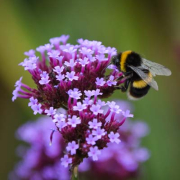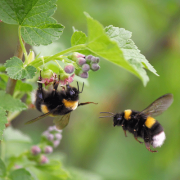
Study Finds Bumblebees Can Solve Puzzles Like Chimps and Elephants
For decades, complex problem-solving was often considered the domain of animals with large brains. Chimpanzees, elephants and certain bird species have all demonstrated the ability to overcome obstacles to obtain rewards. New research suggests that bumblebees, insects with brains no larger than sesame seeds, may belong on that list as well.
In a study published in Science, researchers found that untrained bumblebees could solve a challenge reminiscent of a classic intelligence experiment first conducted more than a century ago by German psychologist Wolfgang Köhler. The findings add to growing evidence that sophisticated cognition can emerge in creatures with remarkably small nervous systems.
“We had this underlying assumption that somehow bigger brains means more powerful computations,” Cat Hobaiter, a primatologist at the University of St. Andrews who was not involved in the study, told NPR. “And so demonstrating this in the bumblebees is really wonderful.”
Hobaiter noted that the work closely mirrors problem-solving experiments previously conducted across a wide range of animals. “Intelligent brains come in really diverse shapes and sizes,” she said.
The project was led by Olli Loukola, a behavioral ecologist at the University of Turku in Finland. After spending years studying bumblebees, Loukola said he has learned not to underestimate them. “Very tiny brains can solve super complex problems,” he said.
The inspiration for the experiment traces back to Köhler’s famous work with chimpanzees. In that study, a banana was suspended just out of reach while boxes were left nearby. Without training, a chimpanzee stacked the boxes, climbed up and retrieved the fruit, demonstrating what Köhler interpreted as spontaneous problem-solving.
Similar tests have since been adapted for birds and elephants, both of which successfully completed the challenge. Loukola wondered whether a comparable task could be designed for bumblebees.
His previous research had already revealed surprising capabilities in the insects.
“They learn socially from each other; they even understand the role of their partner in cooperative tasks. They learn to use tools.”
After studying bumblebees for about a decade, if you don’t have limitations on what’s possible for them, “you can go wild and crazy and find completely novel stuff,” he added.
Designing an insect version of Köhler’s challenge required some creativity. Because bees can fly, simply placing a reward out of reach would not work. To begin, researchers trained bees to associate a small blue circle with a sugary reward.
“Bees are super fast in associating things together,” Loukola said. “They will learn immediately that blue means reward. Then they start searching for blue stuff.”
The team then created a shallow, hollow arena roughly an inch high. A blue target was attached to the ceiling, but the setup prevented the bees from either flying to it or reaching it while standing on the floor.
“We designed the arena so that it’s just annoyingly [a] little bit too high for them to stand and reach the ceiling,” Loukola said, “but too tiny for them to fly.”
Inside the enclosure sat a small Styrofoam ball. Video recordings showed the insects repeatedly grabbing and moving the ball around the arena.
“Bumblebees, they love rolling balls,” Loukola said. “Some of them needed more time and made more errors. But then they continued.”
Eventually, nearly three-quarters of the bees maneuvered the ball directly beneath the blue target. They then climbed onto the ball and used it as a stepstool to reach the overhead reward.
“I planned the experiment so that it’s challenging for the bees,” Loukola said. “They really need to understand the task in order to solve it.”
Still, the results left another possibility open; perhaps the bees were simply moving the ball around at random and happened to succeed by luck.
“It’s possible that the bees don’t need to understand anything,” Loukola acknowledged. “Is this really goal-directed behavior or is this just playing with the balls and solving these tasks by chance?”
To test that question, researchers modified the arena by adding barriers that blocked the insects’ view of the blue target. Bees now had to navigate around obstacles before locating the goal, while the ball began in a separate location.
Even under those more demanding conditions, about 80% of the bees successfully rolled the ball beneath the target and climbed onto it. The result convinced Loukola that the insects were solving the problem spontaneously rather than stumbling upon a solution accidentally.
According to Loukola, it is the first demonstration of this type of spontaneous problem-solving in an insect.
The ability to adapt in this way could have important real-world benefits. Bumblebees forage in constantly changing environments where food sources appear and disappear rapidly.
“Today they might find flowers from here, but tomorrow those flowers are not blooming anymore. If the workers can flexibly find new ways to get food for the colony, that’s the skill that they need to have.”
The findings have also opened the door to new research questions. Loukola hopes to examine whether bumblebees display subtle body movements, grooming patterns or other behavioral signals before arriving at a solution.
Future technologies may even enable observation of brain activity as insects work through similar challenges. For now, Loukola believes scientists are only beginning to understand what bumblebees can do.
“When I started, the [cognitive] limit was somewhere here,” Loukola said, indicating a low point with his hand. “And now it’s much higher.”
“We have to be smarter to develop or design experimental setups where we can test their real limits.”

Moumita Basuroychowdhury is a Contributing Reporter at The National Digest. After earning an economics degree at Cornell University, she moved to NYC to pursue her MFA in creative writing. She enjoys reporting on science, business and culture news. You can reach her at moumita.b@thenationaldigest.com.