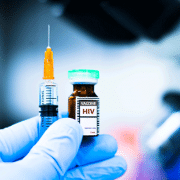
Twice-a-Year HIV Prevention Drug Gets FDA Green Light
The Food and Drug Administration has approved a new long-acting HIV prevention medication that has shown near-total effectiveness in clinical trials, offering a potential breakthrough in the decades-long effort to curb the spread of the virus. Gilead Sciences, the maker of the drug, announced the approval on Wednesday.
The injectable medication, branded as Yeztugo (generic name: lenacapavir), is administered just twice a year and is being hailed by public health experts as a significant advance in HIV prevention, particularly for individuals who struggle to adhere to daily oral PrEP regimens.
“This is the single best opportunity in 44 years of HIV prevention,” said Mitchell Warren, executive director of AVAC, an HIV advocacy nonprofit group.
Clinical trials of lenacapavir showed striking results. In a study involving gay and bisexual men and transgender individuals, participants who received the twice-yearly shot experienced an 89% lower rate of HIV infection than those who took Truvada, a daily oral PrEP pill, and a 96% lower rate than what would have been expected without any preventive medication. In a separate trial conducted among cisgender women in sub-Saharan Africa, no participants who received lenacapavir contracted HIV.
Yeztugo is the first drug in a new class of antiretrovirals designed to prevent HIV from infecting and replicating within the immune system’s target cells. It was previously approved in 2022 under the name Sunlenca for use alongside other medications to treat certain drug-resistant strains of HIV.
All PrEP medications operate on a similar principle. If a sufficient level of the drug is present in the body at the time of exposure, it can prevent the virus from establishing a permanent infection. What sets lenacapavir apart is its extended duration of protection, requiring just two injections per year, administered in a clinical setting.
Gilead’s CEO, Daniel O’Day, called the drug “a major milestone,” suggesting in a statement that it has the potential to “end the HIV epidemic once and for all.”
“Providers are excited about the approval of long-acting lenacapavir for HIV prevention since this once-every-six-month injection has been shown to have high efficacy in preventing HIV in both women and men in two large trials,” Dr. Monica Gandhi, a professor of medicine at the University of California, told Healthline.
“Data from our clinic in San Francisco, which serves low income people with or at risk of HIV, and others have shown that long-acting PrEP works well for people living with HIV who have high rates of concomitant challenges such as housing insecurity and substance use where it can be difficult to take a daily oral pill for PrEP.”
However, despite the excitement surrounding the approval, public health experts warn that political and financial obstacles could limit the drug’s reach.
The cost of Yeztugo is expected to be a significant hurdle. At $14,109 per injection—or approximately $2,352 per month—the drug is significantly more expensive than generic oral PrEP options like Truvada, which can cost as little as $30 per month. Experts worry that insurers may either decline to cover the injectable or place it on a higher copay tier, making it financially inaccessible to many of the people who would benefit most from it.
A looming Supreme Court case that could strike down provisions of the Affordable Care Act requiring insurers to cover preventive services, including PrEP, adds another layer of uncertainty. Elizabeth Kaplan, director of health care access at Harvard Law School’s Health Law and Policy Clinic, said the potential policy shift “could further complicate access for the populations most at risk.”
Although a Gilead spokesperson stated that individuals could begin requesting the drug from healthcare providers within two days of FDA approval, it may take up to two months for patients to receive their first injection.
PrEP has been available in pill form for more than a decade. Truvada received FDA approval in 2012, followed by Descovy in 2019, both of which are manufactured by Gilead. While these drugs are highly effective when taken daily, reducing the risk of HIV transmission by more than 99%, their success has been uneven across demographic lines.
PrEP uptake has been highest among white gay and bisexual men, who make up the majority of PrEP users. But the HIV burden remains disproportionately high among Black and Latino gay and bisexual men, whose rates of PrEP usage remain comparatively low. Even when PrEP is prescribed, adherence rates are lower among these groups, limiting its effectiveness.
In 2021, ViiV Healthcare introduced an injectable PrEP option called Apretude, administered every two months. While Apretude demonstrated superior efficacy compared to Truvada in clinical trials, it has seen limited uptake. According to the manufacturer, only about 21,000 individuals are currently taking Apretude. Experts cite the frequency of required clinic visits, every two months, as a likely deterrent for many patients.
Yeztugo could overcome some of these barriers. Requiring only two clinic visits per year, the drug has the potential to simplify prevention for people who cannot or will not take a daily pill. However, maintaining adherence to a biannual injection schedule will still be a challenge. Two recent studies found that fewer than half of oral PrEP users continued the regimen for more than six months.
Dr. Susanne Doblecki-Lewis, chief of the Division of Infectious Diseases at the University of Miami Miller School of Medicine, who led several lenacapavir trials, said the new drug could help reduce racial disparities in HIV transmission, provided access is equitable.
“If there are barriers, like complicated prior authorizations or high copays that will prevent people from easily starting it, we could see disparities just get worse.”
Another concern is the erosion of public health infrastructure needed to support the wide-scale deployment of new prevention methods. The Trump administration recently proposed a 35% cut to domestic HIV funding, including a plan to eliminate the CDC’s $794 million HIV prevention division. Although the administration says elements of the program will be absorbed into a restructured federal agency, many experts fear the impact of such cuts will be severe.
Much of the CDC’s HIV prevention budget is distributed through grants to local health departments and nonprofits that provide education, outreach, and services, such as PrEP navigation. If funding dries up, experts say, it will be significantly harder to raise awareness about lenacapavir or to get it into clinics and community health centers that serve uninsured or underinsured populations.
Despite these challenges, Gilead says it is working to make the drug accessible. The company has pledged to cover up to $7,200 in annual out-of-pocket costs for insured patients and will provide the drug at no cost to low-income individuals through its patient assistance program. Additional funding and logistical support may be available through a patchwork of federal and state programs that help cover the costs of clinic visits and lab work.
Some telehealth and clinic networks are already preparing to distribute the drug. Tristan Schukraft, CEO of the PrEP-focused telehealth service Mistr, said his company plans to begin offering lenacapavir immediately at its storefronts in seven major U.S. cities. The company is also partnering with a nationwide network of community-based clinics to provide the drug to uninsured patients. “We’re ready,” Schukraft said.
According to the Centers for Disease Control and Prevention, the national HIV transmission rate declined just 17% from 2012 to 2022, dropping from 38,300 to 31,800 cases annually. Most of the progress occurred in recent years, including a 12% drop between 2018 and 2022. That same period saw increased investment in HIV prevention under the federal Ending the HIV Epidemic initiative, launched by the Trump administration in 2019, which targeted nearly $3 billion in new spending to reduce infections in 48 high-burden counties.
Still, the reach of PrEP remains limited. In 2023, about 200,000 people were using some form of PrEP each month, a small fraction of the estimated 1.5 million gay and bisexual men who meet eligibility criteria. Whether lenacapavir can reach those who have been left behind by previous prevention methods remains to be seen.
Johanna Mercier, Gilead’s chief commercial officer, said in a recent interview that the company is “optimistic” about securing broad insurance coverage for lenacapavir and believes the new drug could play a transformative role in ending HIV transmission—if the systems to deliver it are adequately funded and supported.
For now, the focus will shift to implementation. With a medication that could radically change the trajectory of HIV prevention, the question becomes not whether it works, but whether the U.S. health system can deliver it to the people who need it most.

Moumita Basuroychowdhury is a Contributing Reporter at The National Digest. After earning an economics degree at Cornell University, she moved to NYC to pursue her MFA in creative writing. She enjoys reporting on science, business and culture news. You can reach her at moumita.b@thenationaldigest.com.