
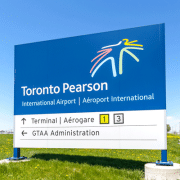
Delta Flight Crashes, Turns Upside Down at Toronto Airport—21 Injured, No Fatalities
A Delta Airlines flight from Minneapolis crashed, turned upside down and caught fire as it tried to land at Toronto Pearson International Airport on Monday. The crash is the latest in a series of incidents involving passenger planes in North America since last December.
Delta Airlines confirmed that all 80 individuals aboard the CRJ900 twin-jet aircraft survived. However, 21 passengers were transported to hospitals for treatment of injuries. As of Tuesday morning, all but two individuals have been discharged from the hospital.
Footage acquired by CNN captured the moment the aircraft’s rear landing gear buckled while the right wing disintegrated into a fireball following a hard landing on the runway. The aircraft momentarily skidded on its underside before overturning, creating a plume of smoke and fine snow.
The person taking the video, observing from the interior of another aircraft near the runway, can be heard saying, “Oh no, no, no, no, no!” One passenger, John Nelson, told CNN what the crash felt like from inside the plane.
“When we hit, it was just super hard. It hit the ground, and the plane went sideways. It’s amazing that we’re still here. Even now, I smell like jet fuel.”
The wrecked Bombardier CRJ900 was designed to withstand a hard landing, according to Peter Goelz, a CNN aviation analyst and former managing director of the National Transportation Safety Board. This allowed for the rapid evacuation of passengers and crew.
Another passenger, Pete Koukov, said he “didn’t know anything was the matter” until the plane was on the ground. “We hit the ground, and we were sideways, and then we were upside down, hanging like bats.”
While several passengers required assistance removing themselves from their seats, Koukov was able to undo his seatbelt, lower himself to the floor, and exit the aircraft on his own.
“Just feeling lucky and happy I got to give the person I didn’t know sitting next to me a big hug, that we were OK, and see my friends who are here to pick me up from the airport and give them a big hug.”
Pete Carlson, an executive at a healthcare company, shared a similar experience.
“I took my seat belt off, which I’d obviously left fastened for the landing, and as I took it off, I crashed down onto the ceiling, which had become the floor.”
Delta Flight 4819, which is operated by Endeavor Air, a subsidiary of Delta, took off from Minneapolis/St. Paul International Airport before crashing at the airport located in a suburb west of Toronto at approximately 2:15 p.m. ET on Monday, according to a statement from Delta CEO Ed Bastian.
“The hearts of the entire global Delta family are with those affected by today’s incident at Toronto-Pearson International Airport. I want to express my thanks to the many Delta and Endeavor team members and the first responders on site. We are working to confirm the details and will share the most current information on news.delta.com as soon as it becomes available. In the meantime, please take care and stay safe.”
Bastian also sent a memo to Delta employees stating, “I’m incredibly proud of the professionalism of the Endeavour crew members who evacuated the aircraft, as well as the first responders at Toronto Pearson International Airport and the airport leadership team.”
According to aviation analyst and former inspector general of the Department of Transportation Mary Schiavo, the typical “flare” of the jet—when the pilot lifts the nose shortly before landing to expose the wings to increased air resistance—does not seem to appear in the footage of the disaster. “There was no attempt to flare at all, which slows the plane down,” she said.
Former director of the FAA’s Office of Crash Investigation, Steven Wallace, suggested that videos of the crash may provide insights into why the aircraft flipped over after landing.
“You see, the right wing fails, but the airplane is still going quite fast, and that left wing is generating a tremendous amount of lift. So, that immediately causes the airplane to roll inverted. That’s quite clear.”
The crash occurred on a blustery day after significant snowfall in Toronto. Notably, the airport fire chief said, “The runway was dry, and there were no crosswind conditions.”
However, recordings from air traffic control towers conflict with this account. An air traffic controller informed the Endeavour pilot of winds measuring 26 mph, with gusts reaching up to 38 mph, crossing the plane’s trajectory at a 40-degree angle. Reports indicate that the wind at Pearson was stirring up snow into the air, resulting in a visibility of five miles. Retired jet pilot Les Abend told CNN this may have caused a situation that was hard to control.
“The weather conditions may have become treacherous before the pilots were able to adapt. With blowing snow, it may have changed rapidly, so the airplane that landed ahead of this aircraft may have had a different condition than this particular Delta regional jet.”
The crash on Monday marks yet another tragic event in what has been a perilous year for air travel across North America. In an incident earlier this month, a regional airline plane crashed in Alaska, resulting in the deaths of 10 individuals.
Less than three weeks ago, a midair collision between an American Airlines plane and a US Army Black Hawk helicopter resulted in the deaths of 67 individuals near Washington, DC. Just two days later, a medevac jet crashed in Philadelphia, resulting in the deaths of all six individuals on board, as well as one person on the ground.
The Transportation Safety Board of Canada is leading the investigation with assistance from the National Transportation Safety Board in the US. The runway involved in the plane crash is anticipated to stay closed until at least Thursday evening.

Moumita Basuroychowdhury is a Contributing Reporter at The National Digest. After earning an economics degree at Cornell University, she moved to NYC to pursue her MFA in creative writing. She enjoys reporting on science, business and culture news. You can reach her at moumita.b@thenationaldigest.com.