Posts

splenda

Artificial Sweetener Shown To Trick Your Brain Into Being More Hungry 

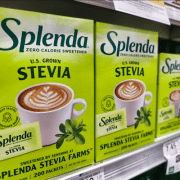
In a new study published in Nature Metabolism, scientists have found a link between artificial sweetener sucralose (sold as Splenda) and the way our brains make us feel hungry. In a crossover trial, a group of 75 adults showed heightened blood flow to the hypothalamus, the part of the brain that helps control appetite and cravings, after drinking a beverage that contains sucralose, according to Science Alert

The study also showed that when the participants drank a beverage with regular sugar (sucrose) they didn’t feel the same level of hunger. Scientists determined that as the participants’ glucose levels increased, there was a reduced flow of blood to the hypothalamus.

Embed from Getty Images

The findings were supported by initial studies done on rodents. The study suggests that non-caloric sweeteners could not be as beneficial to individuals trying to lose weight or who are trying to reduce their sugar intake. 

Non-caloric sweeteners have been shown to change how the hypothalamus communicates with other parts of our brains. 

Sucralose is known to be 600 times sweeter than sucrose without the calories. “[This creates] a mismatch between the expectation of caloric intake and the absence of actual energy,” the authors wrote

“If your body is expecting a calorie because of the sweetness, but doesn’t get the calorie it’s expecting, that could change the way the brain is primed to crave those substances over time,” said a supervisor of the study, endocrinologist Kathleen Alanna Page from the University of Southern California.

The trial included 75 participants between the ages of 18 and 35 and each endured three interventions and received blood tests and brain scans both before and after ingestion. 

Embed from Getty Images

On one day of the study they drank a beverage with sucralose, and another day they drank a beverage with sucrose. On the third day they drank a glass of water. 

The order of these drinks was randomized for each person, and the gaps between each session varied from two days to two months. 

“The body uses these hormones (like insulin and glucagon-like peptide 1) to tell the brain you’ve consumed calories, in order to decrease hunger,” said Page. 

“Sucralose did not have that effect – and the differences in hormone responses to sucralose compared to sugar were even more pronounced in participants with obesity.”

Page and the other scientists who worked on the study said their next move is to conduct a follow-up study that will look at the impact of sucralose in children and adolescents. 

“Are these substances leading to changes in the developing brains of children who are at risk for obesity? The brain is vulnerable during this time, so it could be a critical opportunity to intervene.”

nestle

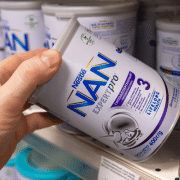
Nestlé Adds Sugar To Infant Milk Sold In Poorer Nations, According To New Report

A new report has found that Nestlé, the largest consumer goods company in the world, adds sugar and honey to infant milk and cereal products that are sold in poorer nations. This directly contradicts international guidelines that are implemented to prevent childhood obesity and chronic diseases, according to The Guardian

The report itself came from Public Eye, a Swiss investigative organization. The organization sent samples of Nestlé’s baby-food products sold in Asia, Latin America, and Africa to a Belgian laboratory for testing. 

After testing the products and examining the packaging, the report revealed the presence of sugar in the form of sucrose, or honey in samples of Nido, one of Nestlé’s milk formula brands intended for infants aged one and up. They also found it in Cerelac, a cereal that is aimed for kids aged six months and two years. 

In the main European markets for Nestlé, there are no added sugars in formulas for young children. Some cereals that are advertised for older toddlers have added sugar, but none in any product targeted at babies between six-months-old to a year. 

Embed from Getty Images

“Nestlé must put an end to these dangerous double standards and stop adding sugar in all products for children under three years old, in every part of the world,” said Laurent Gaberell, the agriculture and nutrition expert for Public Eye

Obesity in general is an ongoing and growing problem in lower and middle income countries. According to the World Health Organization, in Africa specifically the number of overweight children under five has increased by nearly 23% since 2000. 

The Guardian reported that worldwide, more than 1 billion people are living with obesity. 

In many countries it can be difficult for consumers to tell whether or not a certain product contains added sugar or how much is present due to how the nutritional information is printed. The labels also often have natural sugars found in milk and fruit under the same heading as any added sugars.

For European regions, the World Health Organization has guidelines that says no added sugars or sweetening agents should be permitted in any food for children under three. 

The UK recommends that children under four should also avoid food with added sugars, because of their risk of gaining weight and developing tooth decay. The US government has guidelines that simply recommend children under two avoid food and drinks with added sugars. 

The Public Eye report was written alongside the International Baby Food Action Network. Public Eye stated that data from Euromonitor International, a market-research company, showed that global retail sales for Cerelac exceeded $1 billion. The highest of those figures came from low and middle income nations; 40% of sales were within just Brazil and India. 

Embed from Getty Images

Dr. Nigel Rollins, a medical officer at the World Health Organization, said this new report shows “a double standard that can’t be justified.”

Researchers found that biscuit-flavored cereals for babies six months and older contained 6 grams of added sugar for every serving sold in Senegal and South Africa. The same exact product sold in Switzerland has no added sugars. 

In India, tests performed on Cerelac products had, on average, more than 2.7 grams of added sugar for every serving. In Brazil, two out of eight products were found to have no added sugar, but the remaining six products had about 4 grams in each serving, according to The Guardian. In Nigeria, one product had up to 6.8 grams.  

Additionally, tests on Nido brand products showed a significant variation in sugar levels, much like with Cerelac. Worldwide retail sales for Nido products have grossed more than $1 billion. 

In the Philippines, no added sugars are in products aimed for toddler consumption, however, in Indonesia, Nido baby-food products all contain around 2 grams of added sugar per 100 gram of product in the form of honey. 

“We believe in the nutritional quality of our products for early childhood and prioritize using high-quality ingredients adapted to the growth and development of children,” a Nestlé spokesperson stated. 

“[Within the] highly regulated category of baby food, Nestlé always complied with local regulations or international standards, including labeling requirements and thresholds on carbohydrate content that encompasses sugars and declared total sugars in its products, including those coming from honey,” The Guardian reported

“Variations in recipes depended on factors including regulation and availability of local ingredients,” the spokesperson said.