Posts

dinosaur

Scientists Discover Two Dinosaur ‘Mummies’ That Capture Every Scale and Spike

Long before Wyoming was cattle country, it was a land of monsters and mud. Sixty-six million years ago, rivers wound through a humid coastal valley where herds of the gentle, duck-billed plant eaters, Edmontosaurus, trudged along the floodplains. Some of them, through a bizarre twist of biology and luck, never fully disappeared.

In a study published Thursday in “Science,” paleontologist Paul Sereno and his colleagues describe two of these remarkably preserved creatures, their skin, spikes, and even hooves immortalized in stone. “For the first time, I think that we’ve got Edmontosaurus’s look completely down,” said Sereno, who teaches at the University of Chicago.

“Based on our drawings, you can put it in a Hollywood movie, and it’s going to be accurate head to toe.”

Sereno’s team stumbled across the fossils back in 2001 while exploring eastern Wyoming’s sandstone ridges, which date back to the late Cretaceous period, with a group of students. At first, they thought they had found ordinary skeletons. One belonged to a young dinosaur, the other to the back half of an older one. Only after months of painstaking cleanup in Sereno’s lab did the team realize what they had: two dinosaur mummies.

The smaller specimen, Ed Jr., bore a faint fleshy crest running along its back, coated in tiny, beadlike scales. The larger one, Ed Sr., had wrinkled skin, wedge-shaped hooves instead of claws, and a spiny tail.

Embed from Getty Images

Sereno later learned that these new mummies had been unearthed in the same patch of land where fossil hunter Charles H. Sternberg had made headlines more than a century earlier. In 1908, Sternberg discovered a skin-covered Edmontosaurus near the same site. When it was unveiled at the American Museum of Natural History, The New York Times raved that it was “not only a skeleton, but a genuine mummy.” Sternberg soon found another and shipped it to Germany. All four fossils, separated by time and ocean, came from what Sereno’s team now calls the “mummy zone.”

To understand how the dinosaurs avoided decay, Sereno’s team turned to CT scanning and electron microscopy. The results upended expectations. No remnants of skin or tissue survived. The animals had, in fact, decomposed before burial.

So how did the fine details of their bodies — every wrinkle and scale — remain? The researchers believe microbes were the secret undertakers. After the carcasses dried out on the floodplain, bacteria formed a biofilm that left behind a thin clay shell, sealing in the dinosaurs’ final forms.

“When you rub clay on your face, it goes into every pore. When you touch these fossils and then look at your fingers, you still see traces of clay.”

This microbial “spa treatment” preserved the animals in exquisite detail. Sereno noted that such preservation usually occurs in calm seas, not in the chaotic floods that swept ancient Wyoming.

Embed from Getty Images

For other scientists, the find offers a glimpse into one of paleontology’s strangest miracles—the making of a dinosaur mummy.

Stephanie Drumheller-Horton, a paleontologist at the University of Tennessee who was not involved in the study, told The New York Times that the findings present an intriguing new way to mummify a dinosaur.

Drumheller-Horton, who has studied a half-eaten Edmontosaurus mummy in North Dakota, said the latest discovery suggests there’s more than one recipe for this kind of fascinating preservation.

“Understanding what conditions you need to get a mummy in the first place can help paleontologists target where we’re looking. There’s so few mummies out there, and every single one is this amazing treasure trove of information.”

Back when Sternberg’s first find hit the news in 1909, it seemed almost mythical—a dinosaur that looked as if it might still twitch. Now, with modern tools and microbial insight, Sereno’s team has shown that the magic had a method.

In the quiet clay of Wyoming’s badlands, the ghosts of Edmontosaurus endure, not through miracles, but through the steady work of bacteria, floods, and time itself.

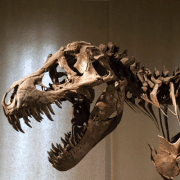
T-Rex

The Reapers Of Death: New T-Rex Species Discovered in Canada

The fossil remains of a Tyrannosaurus Rex (T. Rex) “cousin species” have been uncovered in Alberta, Canada. Scientists are classifying the meat-eating dinosaur as Thanatotheristes degrootorum, and since they concluded that the remains are over 80 million years old, the T. Rex cousin is being deemed as the oldest known Tyrannosaur on record in North America; “Tyrannosaur” is the general term that covers all subspecies of the T. Rex. 

Scientists are also nicknaming the species the “reapers of death” based on the fact that their fossils show evidence of a “monstrous face”, vicious looking serrated teeth that were likely as sharp as steak knives and 3 inches long, and legs that were 8 feet in length from foot to hip. The fossil evidence also allowed scientists to estimate that the reapers measured in at 26 feet long from snout to tail. 

Embed from Getty Images

“Like other tyrannosaurs, the ‘reaper of death’ had strange bumps on its skull that gave it a monstrous appearance. But it also had a one-of-a-kind feature, a distinct set of vertical ridges that ran from its eyes along its upper snout. These ridges are not like anything we’ve ever seen before in other tyrannosaur species. Exactly what the ridges do, we’re not quite sure,” said study lead researcher Jared Voris, a doctoral student of paleontology at the University of Calgary in Alberta.

Voris and his team also concluded that the reapers of death walked the Earth during the Cretaceous period, which was the final period of the dinosaur age on Earth before they all were wiped out. This also means that these creatures were likely alive 145 million years ago (when the Cretaceous period began). 

Embed from Getty Images

The initial remains that were discovered were found by a Canadian couple on the shore of the Bow River in southern Alberta. That was back in 2010, and at the time it was believed that the only dinosaurs who lived in the Alberta area, hundreds of millions of years ago, were plant eaters. So 10 years ago it was believed that the mysterious skull remains that the couple found were just another Triceratops relative of sorts; even though the skull remains were abnormally three feet in length.

Once Voris began his own personal research regarding new dinosaur species he was able to determine that those decade old remains were actually the reapers of death, and not just another herbivore. In fact, based on their new conclusions they’ve determined that the reapers likely ate a majority of the herbivores that did live in Alberta. 

“The new discovery shows that Daspletosaurus-like tyrannosaurs were diversifying in the northern part of western North America about 80 million years ago. But these long- and deep-snouted tyrannosaurs appeared to stay in their neck of the woods. This seems to be a bigger theme: There were different subgroups of tyrannosaurs characteristic of certain times and places, and they did not all mix together,” said Steve Brusatte, a paleontologist at the University of Edinburgh in Scotland. 

While the reapers of death weren’t as large as their more well known younger T. Rex cousins, their remains give scientists a great insight into the vastly diverse world of dinosaurs. Paleontologists and scientists alike can never be fully satisfied with their “conclusive” data regarding dinosaurs because they lived millions of years ago, making it close to impossible to know about every detail and subspecies that pertained to their time on Earth. However, discoveries such as this open dozens of doors in terms of possibilities for what other kinds of dinosaurs were roaming the Earth and where.

Girl Using Binoculars

The Best Science Gifts For Kids

Gift giving can be one of the most daunting tasks of the holiday season, but it doesn’t have to be. Luckily there are tons of online resources and articles to help you find the best gifts for your loved ones, this being one of them! With Black Friday coming up, there’s never been a better time to shop for your specific loved ones wants. Many kids these days are so engulfed in technology, they forgot about the lost art of toys as a source of entertainment. As a child, I always loved gifts that involved making anything. The tactile process of creation is one that keeps kids engaged, their brains stimulated, and is also extremely fun. Live Science Magazine recently compiled a list of amazing Black Friday gift ideas for all of your little creators! What child doesn’t want to conduct experiments and create some scientific magic all by themselves? These gifts not only are a great source of non-digital entertainment for your kids, but provides an educational component that is disguised as fun experimentation. 

Amazon has a bunch of online Black Friday deals that have already been discounted on the site, and these science themed toys are some of the best deals out there! Even if you’re child isn’t too keen on scientific experiments yet, these toys will surely grab their interest, without breaking your bank.

Embed from Getty Images

First up is a Tyrannosaurus Rex skeleton model that assembles to be two feet long (26 inches to be exact)! This toy is for kids ages six and up, and is perfect for any child who has a keen interest in the species that ruled the planet before we got here. The kit also comes with a colorful instruction manual that will catch the eye of any child. The kit itself is made up of twenty different pieces, so depending on how old your child is, they may require some assistance, however, that just means you get some extra time both playing with and teaching your kid about something really cool! Once complete, the T. Rex model comes with it’s own stand, so your little paleontologist can display their beautiful work, and educate all their friends about the cool dinosaur skeleton in their room! The best part? It’s currently discounted at $10 off the original price (now $19.99)!

Next up is the Kidzlane Microscope. This microscope is for kids ages three and up and is the best way to introduce your children to the magical powers of magnifying something to see all its inner workings. The kit itself comes with two rubber “specimens” that your  child can view up close with a magnifying glass that zooms in eight times the size of the object! In addition, the built in light, fun design, and science tools will have any kid feeling like a real scientist ready to learn! Currently on sale from $20 to $16!

Embed from Getty Images

Speaking of magnification, for more portable fun you can get your child a cool pair of compact binoculars made for kids! Currently priced at $10 with free shipping, these vibrantly colored binoculars can bring the microscope powers outdoors! Your child will be able to see the world magnified eight times, perfect for discovering new birds and critters lurking in the backyard, as well as getting a closer look at any planes flying up above. This gift is perfect to fulfill all the curiosity cravings that kids are constantly engulfed with.

Going back to our dinosaur theme, this set of four dinosaur figurines with movable jaws is perfect for any child who wants to see what their favorite prehistoric friends looked like beyond just a skeleton. At just $13, this set will give your child a variety of dinosaurs to learn about and play with. The figures range in size from five to ten inches and are perfect for any child ages three and up!

Last, but certainly not least, what child do you know that wouldn’t be completely entertained by the classic exploding volcano experiment? Amazon is now offering a Volcanic Eruption and Lava experimentation Kit at 60% off, making it just $20! This 22 piece set is made for children eight and older, and provides enough entertainment for a full day of building, mixing, and exploding! The best deal on the list and by far the most entertaining and educational. This gift will allow your child to not only have a great time making a cool volcano craft, but they’ll be able to learn about the inner workings of one of the Earth’s coolest natural features.