Puerto Rico Plunged Into Darkness by Island-Wide Power Outage
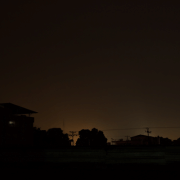
A significant failure in Puerto Rico’s power grid has resulted in a widespread blackout throughout the island. The incident has left 1.4 million users without power on New Year’s Eve.
The blackout began on Tuesday morning at 5:30 a.m. Luma Energy, the Canadian-American power company primarily tasked with energy distribution on the island, is collaborating with Genera and other suppliers to repair the system. The company shared on X that it anticipates the complete restoration process will require one to two days.
“While the cause of the outage is under investigation, preliminary findings point to a fault on an underground line. The cause of the fault remains under investigation. LUMA crews responded immediately and have begun their process to restore power to customers as quickly and safely as possible. LUMA will restore power to customers in phases. We have already begun the process of restoring some customers, and the entire process will take between 24 and 48 hours, conditions permitting. LUMA will provide regular updates on the restoration via its social media channels every two hours.”
Governor Pedro Pierluisi also shared on his X account that repairs were being carried out. “We can report that work is already underway to restore service with the San Juan and Palo Seco plants,” Gov. Pierluisi said.
“We are demanding answers and solutions from both Luma and Genera, who must expedite the restart of the generating units outside the fault area and keep the people duly informed about the measures they are taking to restore service throughout the Island.”
The recent outage marks yet another instance of Puerto Rico’s unreliable power infrastructure failing on a large scale. On Tuesday morning, just 13% of Puerto Rico’s utility customers had power.
Island residents have become accustomed to frequent power outages, a consequence of their dependence on a fragile and inadequately maintained power grid. One resident shared her frustrations with The New York Times, stating, “People are so used to this already that we’ve gotten used to mediocrity.”
The aftermath of Hurricane Maria in 2017 saw the grid’s subsequent failure lead to prolonged power outages for hundreds of thousands of individuals, with many enduring these disruptions for months on end. The outage in the wake of the hurricane has been characterized as the most significant blackout in US history, based on the total hours of electricity that were lost.
In June this year, a significant blackout affected 350,000 residents, while August brought further disruption as Hurricane Ernesto caused power outages for 70,000 individuals.
The US Federal Emergency Management Agency has allocated $9.9 billion for permanent projects aimed at repairing the damage inflicted by Hurricane María. LUMA Energy assumed control of the grid in 2021, succeeding the government-owned Puerto Rico Electric Power Authority, referred to as PREPA. Genra PR has taken the helm of energy production, commencing its operations in 2023.
Luis Muñoz Marín International Airport, recognized as the busiest airport in Puerto Rico, said in a statement that it is “operating normally thanks to electric generators.” An official at the administrator’s office of the Caribbean Medical Center in Fajardo, P.R., confirmed to The New York Times that the facility is functioning as usual, supported by four generators.

Moumita Basuroychowdhury is a Contributing Reporter at The National Digest. After earning an economics degree at Cornell University, she moved to NYC to pursue her MFA in creative writing. She enjoys reporting on science, business and culture news. You can reach her at moumita.b@thenationaldigest.com.