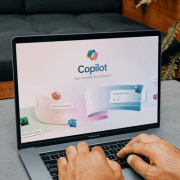
Microsoft’s New “Mico” Assistant Revives the Spirit of Clippy for the AI Era
Nearly three decades after the beloved, and at times despised, paperclip named Clippy first blinked to life in Microsoft Office, the tech giant is trying once again to give your computer a face or, at least, a personality. This time, meet Mico, a new animated character for Copilot’s voice mode, designed to be as expressive as it is helpful.
“We all live in Clippy’s shadow in some sense,” Jacob Andreou, corporate VP of product and growth at Microsoft AI, told The Verge. “Clippy walked so that we could run.”
After Clippy’s tenure ended in 2001 with Office XP, Microsoft spent years experimenting with new forms of digital assistants. Cortana, introduced on Windows Phone in 2014, was the company’s next big bet, but despite its potential, the AI technology of the time couldn’t live up to the vision. Cortana quietly faded out, with its app discontinued on Windows 11 just a couple of years ago.
Now, Mico represents Microsoft’s modern attempt to rekindle that human-machine connection, one built for a world already familiar with Alexa, Siri, and ChatGPT.
Mico has been quietly in testing for months. Unlike the static paperclip of yesteryear, it’s responsive, real-time, like a glowing orb that shifts as you talk.
“You can see it. It reacts as you speak to it, and if you talk about something sad, you’ll see its facial expressions react almost immediately. All the technology fades into the background, and you just start talking to this cute orb and build this connection with it.”
By default, Mico will appear in Copilot’s voice mode, though for the shy or skeptical, you can toggle it off. It’s launching first in the US, UK, and Canada, and it will take advantage of Copilot’s new memory system, which allows it to recall information it’s learned about you and your projects.
Beyond conversation, Microsoft wants Mico to become a guide. A new “Learn Live” feature transforms it into what the company calls a “Socratic tutor.” Instead of just providing answers, Mico leads users through concepts, using interactive whiteboards and visual prompts to encourage deeper understanding, something Microsoft hopes will appeal to students cramming for finals or adults tackling new skills, such as a language.
Microsoft AI CEO Mustafa Suleyman hinted earlier this year that giving Copilot a recognizable personality was a key part of the company’s vision.
“Copilot will certainly have a kind of permanent identity, a presence, and it will have a room that it lives in, and it will age. I’m really interested in this idea of digital patina. The things I love in my world are the things that are a little bit worn or rubbed down, and have scuff marks. Unfortunately, in the digital world, we don’t have a sense of age.”
Mico is also the star of Microsoft’s newest marketing push, with TV spots promoting Windows 11 PCs as “the computer you can talk to.” The company hopes this will help normalize the idea of speaking to your PC, something previous efforts like Cortana couldn’t quite achieve.
Of course, Microsoft knows nostalgia is a powerful tool. For all its new capabilities, Mico doesn’t entirely escape the long, animated shadow of Clippy. “It’s funny you mention Clippy; there is an Easter egg when you get to try Mico. If you poke Mico very, very quickly, something special may happen,” Andreou revealed.
Mico may look nothing like that bug-eyed paperclip, but the mission remains to make technology feel more like a companion.

Moumita Basuroychowdhury is a Contributing Reporter at The National Digest. After earning an economics degree at Cornell University, she moved to NYC to pursue her MFA in creative writing. She enjoys reporting on science, business and culture news. You can reach her at moumita.b@thenationaldigest.com.